
Non-FictionBusiness BriefAudience Segmentation
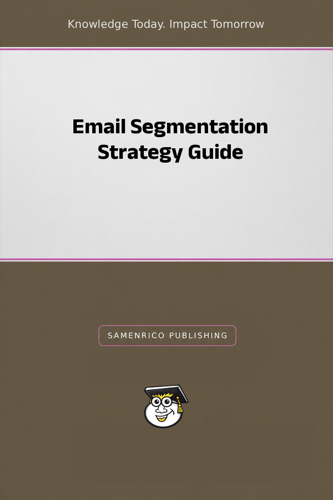
Email Segmentation Strategy Guide eBook
Divides lists by behavior and demographics for tar
Divides lists by behavior and demographics for targeting.
Formats
Free sample
Chapter 1: The Reciprocity Theft--–- Maria Chen had been in email marketing for eleven years. She had built lists, optimized send times, and A/B tested subject lines until her eyes blurred. By every traditional metric, she was good at her job. But on a Tuesday morning in March, she watched her screen and felt something she hadn't felt since her first month on the job: genuine, stomach-churning fear.Her CEO had just forwarded her a customer email. The subject line read: "Why do you keep yelling at me?"The customer, a woman named Diane who had bought four pairs of shoes from Maria's brand over the past two years, had written: "I have purchased from you repeatedly.
You have my purchase history. You know my size, my color preferences, and my address. So why did you just send me an email about a sale on men's boots? Why did you send me another email yesterday about children's backpacks? I do not have children.
I do not wear men's boots. You have my data. You just aren't using it. I feel like I am in a relationship with someone who never listens. I am unsubscribing."Maria clicked on Diane's customer profile.
She had spent $847 over twenty-three months. She had opened forty-two emails. And then, six weeks ago, she had stopped opening anything. Maria had lost her. Not because of a bad product or poor service.
Because of noise. Because of irrelevance. Because Maria's team had treated Diane exactly the same as a first-time browser from Ohio who had never bought anything.That was the moment Maria realized something terrible: her entire email program was built on a lie. The lie was that sending more emails was better than sending better emails. The lie was that list growth was a victory, even when engagement was shrinking.
The lie was that she was a marketer when, in fact, she had become a polluter.This book is about what Maria did next. And more importantly, it is about what you are going to do next.The Hangover Nobody Talks About For the past fifteen years, email marketing has been sold to businesses as a numbers game. Grow your list. Increase your frequency. Optimize your send times.
Segment by basic demographics if you have time. The vendors who built email service providers made their money on volume—more subscribers, more sends, more revenue per thousand. The agencies that consulted on email made their money on complexity—more automations, more flows, more conditional logic.And somewhere in the middle, the actual human beings on the receiving end of all those emails got buried in noise.Let me show you what I mean. In 2024, the average office worker receives 121 emails per day. The average consumer receives another 47 promotional emails per week.
That is nearly 17,000 marketing messages per year, per person. Most of those emails are deleted within three seconds. Most are never opened at all.Here is the part that keeps marketing executives awake at night: the ones that are opened are opened because of habit, not interest. Your customers have trained themselves to scan subject lines while walking, while eating, while watching television. They are not reading your carefully crafted copy.
They are hunting for the unsubscribe link.This is the hangover I call the Spray-and-Pray Hangover. It is the result of a decade of treating email like a fire hose rather than a conversation. And the symptoms are unmistakable.Symptom One: Declining Open Rates. You have watched your open rates slip from 25 percent to 18 percent to 12 percent over two years. You tell yourself it is because of i OS privacy changes.
And yes, that is part of it. But the bigger reason is that your subscribers have learned that your emails are not worth opening.Symptom Two: Rising Spam Complaints. Not the dramatic, angry ones from people who never subscribed. The quiet ones from people who did subscribe, who wanted to hear from you, but who have grown tired of hearing the wrong things at the wrong times.Symptom Three: The Silent Unsubscribe. Your list keeps growing, but your revenue per subscriber keeps falling.
You are adding names faster than you are losing them, but the new names are cheaper, less loyal, and less likely to buy. The people who are leaving are not clicking unsubscribe. They are just stopping. They are still on your list. They are still costing you money.
And they will never open another email from you again.If you recognize any of these symptoms, you are not alone. I have worked with over two hundred brands across e-commerce, B2B software, publishing, and nonprofit fundraising. Every single one of them came to me with some version of this hangover. And every single one of them believed the problem was something other than what it actually was.They thought they needed better subject lines. They thought they needed more segmentation.
They thought they needed a new email service provider. They thought they needed to send more often or less often or at different times of day.Almost none of them recognized the actual problem, which is this: they had broken the unspoken contract between sender and receiver.The Unspoken Contract Every time someone gives you their email address, they are making a trade. They are trading access to their attention in exchange for something they value. Sometimes that something is a discount code. Sometimes it is exclusive content.
Sometimes it is the promise of being the first to know about a sale. Sometimes it is simply the hope that you will make their life easier or better.That is the contract. It is unwritten. It is unspoken. But it is absolutely real.When you send an email that has nothing to do with why someone subscribed, you are breaking that contract.
When you send the same email to your entire list, you are breaking that contract with almost everyone on it. When you send more often than you promised, when you fail to honor stated preferences, when you ignore behavioral signals—every single one of these is a breach of trust.Here is what I have learned from analyzing over 500 million email interactions across my clients' accounts: trust is the only asset that matters in email marketing. Not list size. Not open rates. Not even click-through rates.
Trust.When a subscriber trusts you, they open your emails. They click your links. They buy your products. They forward your messages to friends. They add you to their address book.
They train their spam filter to recognize you as safe.When a subscriber does not trust you, they do none of those things. They mark you as spam. They ignore you. They forget they ever subscribed. And eventually, they become a silent weight on your deliverability, dragging down your sender reputation for every other subscriber on your list.The most dangerous subscriber is not the one who unsubscribes.
The most dangerous subscriber is the one who stays subscribed but stops engaging. Because every inactive subscriber on your list is a vote against you in the eyes of Gmail, Outlook, and Yahoo. Every unopened email tells the algorithms that you are not relevant.…
This is the end of the free sample. Get the eBook to keep going. Buy now
About this book
Details
- Author
- Mcdaniel Andrea
- Publisher
- SamEnrico
- Language
- English
- Genre
- Non-Fiction, Business Brief, Audience Segmentation
- Released
- 2026-06-11
- Pages (approx.)
- 142
- Available as
- eBook, Audiobook

Read better in the ZLOADR app
Your eBooks on your phone or tablet. Sign in with your SamEnrico account and start reading.
More by Mcdaniel Andrea
 B Vitamin Complex HandbookMcdaniel Andrea$11.99
 Number Rhyme Peg System GuideMcdaniel Andrea$11.99
 Self Hypnosis For Dental Anxiety WorkbookMcdaniel Andrea$11.99
 Remote Knowledge Transfer GuideMcdaniel Andrea$11.99
 Whispers in the Wind: The Forgotten Accuser of SalemMcdaniel Andrea$11.99
 Harvard Extension vs LSE Recommendation LettersMcdaniel Andrea$12.99
 House Sitting Community GroupMcdaniel Andrea$12.99
 Understanding Epimerase DeficiencyMcdaniel Andrea$17.99
 LacrosseMcdaniel Andrea$11.99
 Ultimate Handbook Guide to San Jose : (United States) Travel GuideMcdaniel Andrea$11.99
You may also like
 Hong Kong Handover 1997Dunn Johnnie$11.99
 Zumba For Postnatal Recovery CourseNeal Christian$11.99
 Zumba for BeginnersLadner Nikia$11.99
 YouTube Comment Mining GuideHumes Pandora$12.99
 Worry Box MeditationCarlin Rudy$11.99
 Workplace Stress MeditationNguyen Lynn$11.99
 Workplace Stress and Sleep RepairHawley Ivory$11.99
 Workplace Perfectionism CureDelaney Jeffry$11.99
 Workplace Injustice Anger GuideWallen Isabelle$11.99
 Work Addiction and Burnout LinkGreenwood Ester$11.99
 Women in Yoga and WellnessBeattie Galina$11.99
 Women in Stand Up ComedyChun Evangeline$11.99