
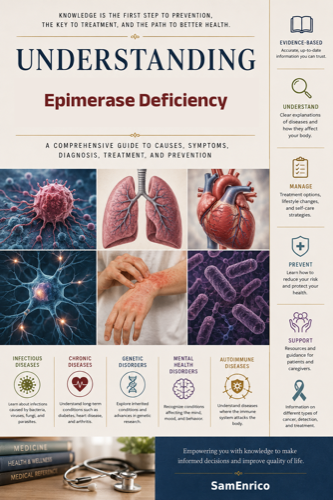
Understanding Epimerase Deficiency
This disease publication, published by SamEnrico,
This disease publication, published by SamEnrico, covers Understanding Epimerase Deficiency
Formats
About this book
Free sample
Chapter 1: The Sugar Trap...--The most dangerous foods are often the ones we trust the most. A new parent does not fear the bottle of warm milk they offer their newborn. They fear car seats, choking hazards, and fevers in the night. They do not fear the very substance that has sustained mammalian life for two hundred million years. Yet for approximately one in every fifty thousand to one hundred thousand infants worldwide, that milk is a slow poison.
And for a smaller subset—those born with epimerase deficiency—the situation is even more insidious. Their bodies cannot process the simple sugar galactose, one of the two building blocks of lactose. But unlike patients with the more common classic galactosemia, they also cannot survive on a diet completely free of that same sugar. They are trapped. Give them milk, and they become desperately ill.
Give them no galactose at all, and a different kind of crisis emerges—one that clinicians often fail to recognize because it looks nothing like the classic disease.This is the sugar trap. Understanding its mechanism requires a journey into the microscopic machinery of human metabolism, a world of enzymes and substrates where one broken gear can bring an entire factory to a halt. But unlike a mechanical factory, the human body is adaptable. It has redundancies, workarounds, and surprising sources of resilience. In epimerase deficiency, those workarounds are both the key to survival and the source of the disorder’s most confusing feature: its astonishing variability from one patient to the next.The Leloir Pathway: Nature’s Galactose Recycling Plant To understand epimerase deficiency, you must first understand how healthy cells handle galactose.
Unlike glucose—the body’s primary fuel, which can enter the energy-production pathway directly—galactose requires a conversion process. This process is called the Leloir pathway, named after the Argentine biochemist Luis Leloir, who pieced it together in the 1950s and 1960s. Leloir’s work was so fundamental that he received the Nobel Prize in Chemistry in 1970. Yet despite its elegance, the pathway he discovered is surprisingly fragile. It depends on three enzymes working in…
This is the end of the free sample. Get the eBook to keep going. Buy now
Contents
- Chapter 1
- Chapter 2
- Chapter 3
- Chapter 4
- Chapter 5
- Chapter 6
- Chapter 7
- Chapter 8
- Chapter 9
- Chapter 10
- Chapter 11
- Chapter 12
Details
- Author
- Mcdaniel Andrea
- Publisher
- SamEnrico
- Language
- English
- Genre
- Non-Fiction, Informative, Educational
- Released
- 2026-05-11
- Pages (approx.)
- 158
- Available as
- eBook, Audiobook

Read better in the ZLOADR app
Your eBooks on your phone or tablet. Sign in with your SamEnrico account and start reading.
More by Mcdaniel Andrea
 Email Segmentation Strategy GuideMcdaniel Andrea$11.99
 B Vitamin Complex HandbookMcdaniel Andrea$11.99
 Number Rhyme Peg System GuideMcdaniel Andrea$11.99
 Self Hypnosis For Dental Anxiety WorkbookMcdaniel Andrea$11.99
 Remote Knowledge Transfer GuideMcdaniel Andrea$11.99
 Whispers in the Wind: The Forgotten Accuser of SalemMcdaniel Andrea$11.99
 Harvard Extension vs LSE Recommendation LettersMcdaniel Andrea$12.99
 House Sitting Community GroupMcdaniel Andrea$12.99
 LacrosseMcdaniel Andrea$11.99
 Ultimate Handbook Guide to San Jose : (United States) Travel GuideMcdaniel Andrea$11.99