
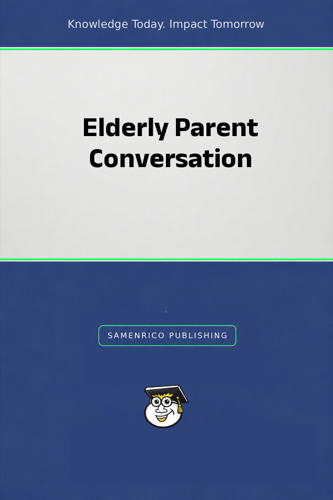
Non-FictionSelf-HelpElderly Communication
Elderly Parent Conversation
Connect meaningfully with aging parents using this
Connect meaningfully with aging parents using this practical communication guide.
Formats
About this book
Free sample
Here is an in-depth, chapter-by-chapter summary for the book The Elderly Parent Conversation: A Practical Guide to Connecting with Dignity, Purpose, and Peace, based on the synthesized bestseller outline.Part I: The Foundation (The "Why" Behind the Resistance)Chapter 1: The Silent Shift: Why "Talking" Suddenly Stopped Working This chapter opens with the universal adult child's lament: "Why won't they just listen to reason?" It identifies the precise moment when the parent-child dynamic fractures—usually when the adult child notices a safety risk (e.g., missed medication, a fall) and the parent responds with anger, deflection, or silence. The core problem, the chapter argues, is not stubbornness but a clash of developmental stages. Drawing on David Solie's work, it introduces the two hidden psychological tasks of late life: Maintaining Control (the fierce protection of autonomy) and Curating a Legacy (the need to feel one's life mattered). Logical arguments about "safety" or "efficiency" feel like threats to these tasks. The chapter reframes success: the goal is not to win the argument or force compliance, but to preserve the relationship.
A short self-assessment quiz helps readers identify whether they are currently operating in "fixer mode" or "connector mode."Chapter 2: The Dignity Code: How to Talk With, Not At This chapter provides the foundational communication toolkit for every subsequent conversation. It begins by diagnosing the most common failure mode: the adult child as "Fixer" (problem-solver, list-maker, triager) versus the aging parent as "Feeler" (identity-protector, emotion-driven, legacy-sensitive). The heart of the chapter is Scripting 101: a set of gentle openers that replace accusation with vulnerability. Examples: instead of "You need to stop driving," say "I feel scared when I think about you on the highway." Instead of "You can't live alone anymore," say "Help me understand what safety looks like to you." The chapter also teaches active listening for the life review—why repetition is not a memory failure but a search for meaning, and how to validate without agreeing. A "Dignity Code" checklist is provided (e.g., no eye-rolling, no finishing sentences, no "remember when you told me this already").Part II: The Physical Environment (Home, Health…
This is the end of the free sample. Get the eBook to keep going. Buy now
Contents
- Chapter 1
- Chapter 2
- Chapter 3
- Chapter 4
- Chapter 5
- Chapter 6
- Chapter 7
- Chapter 8
- Chapter 9
- Chapter 10
- Chapter 11
- Chapter 12
Details
- Author
- Hughey Tristan
- Publisher
- SamEnrico
- Language
- English
- Genre
- Non-Fiction, Self-Help, Elderly Communication
- Released
- 2026-06-11
- Pages (approx.)
- 145
- Available as
- eBook, Audiobook

Read better in the ZLOADR app
Your eBooks on your phone or tablet. Sign in with your SamEnrico account and start reading.
More by Hughey Tristan
 Flow FAQ GuideHughey Tristan$11.99
 Political Nonprofit Fraud GuideHughey Tristan$11.99
 Food Addiction Recovery MilestonesHughey Tristan$11.99
 The Leftover Reinvention GuideHughey Tristan$11.99
 The Phantom of Park Lane: The $1.5M Bugatti Heist That Shocked the WorldHughey Tristan$11.99
 Virtual BaristaHughey Tristan$11.99
 How to Start a Photoflash Bulb Business (Beginners Guide)Hughey Tristan$11.99
 Ghana Government GrantsHughey Tristan$12.99
 Founder Nutrition for DepressionHughey Tristan$12.99
 Understanding Wildervanck SyndromeHughey Tristan$17.99
You may also like
 Hong Kong Handover 1997Dunn Johnnie$11.99
 Zumba For Postnatal Recovery CourseNeal Christian$11.99
 Zumba for BeginnersLadner Nikia$11.99
 YouTube Comment Mining GuideHumes Pandora$12.99
 Worry Box MeditationCarlin Rudy$11.99
 Workplace Stress MeditationNguyen Lynn$11.99
 Workplace Stress and Sleep RepairHawley Ivory$11.99
 Workplace Perfectionism CureDelaney Jeffry$11.99
 Workplace Injustice Anger GuideWallen Isabelle$11.99
 Work Addiction and Burnout LinkGreenwood Ester$11.99
 Women in Yoga and WellnessBeattie Galina$11.99
 Women in Stand Up ComedyChun Evangeline$11.99