
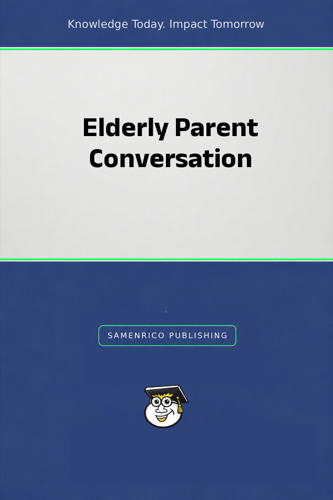
Non-FictionSelf-HelpElderly Communication
Elderly Parent Conversation eBook
Connect meaningfully with aging parents using this
Connect meaningfully with aging parents using this practical communication guide.
Formats
Free sample
Here is an in-depth, chapter-by-chapter summary for the book The Elderly Parent Conversation: A Practical Guide to Connecting with Dignity, Purpose, and Peace, based on the synthesized bestseller outline.Part I: The Foundation (The "Why" Behind the Resistance)Chapter 1: The Silent Shift: Why "Talking" Suddenly Stopped Working This chapter opens with the universal adult child's lament: "Why won't they just listen to reason?" It identifies the precise moment when the parent-child dynamic fractures—usually when the adult child notices a safety risk (e.g., missed medication, a fall) and the parent responds with anger, deflection, or silence. The core problem, the chapter argues, is not stubbornness but a clash of developmental stages. Drawing on David Solie's work, it introduces the two hidden psychological tasks of late life: Maintaining Control (the fierce protection of autonomy) and Curating a Legacy (the need to feel one's life mattered). Logical arguments about "safety" or "efficiency" feel like threats to these tasks. The chapter reframes success: the goal is not to win the argument or force compliance, but to preserve the relationship.
A short self-assessment quiz helps readers identify whether they are currently operating in "fixer mode" or "connector mode."Chapter 2: The Dignity Code: How to Talk With, Not At This chapter provides the foundational communication toolkit for every subsequent conversation. It begins by diagnosing the most common failure mode: the adult child as "Fixer" (problem-solver, list-maker, triager) versus the aging parent as "Feeler" (identity-protector, emotion-driven, legacy-sensitive). The heart of the chapter is Scripting 101: a set of gentle openers that replace accusation with vulnerability. Examples: instead of "You need to stop driving," say "I feel scared when I think about you on the highway." Instead of "You can't live alone anymore," say "Help me understand what safety looks like to you." The chapter also teaches active listening for the life review—why repetition is not a memory failure but a search for meaning, and how to validate without agreeing. A "Dignity Code" checklist is provided (e.g., no eye-rolling, no finishing sentences, no "remember when you told me this already").Part II: The Physical Environment (Home, Health, & Safety)Chapter 3: The House Check: "Aging in Place" vs.
"Living in a Museum"This chapter tackles the emotionally charged question of whether a parent's home is still safe. It acknowledges that "aging in place" is a noble goal, but a cluttered home with loose rugs and poor lighting is a "living in a museum" hazard. The key insight: safety assessments feel like personal insults. The chapter offers practical scripts for initiating the conversation without triggering defensiveness, such as "I'd love to walk through the house with fresh eyes—just to see if my clumsy self would trip on anything." It then provides a room-by-room safety checklist presented as a collaborative project, not an inspection. For clutter, the chapter introduces the "one-item-a-day" method and the "grandchild test" (if a toddler couldn't safely navigate this space, neither can a senior).
Finally, it offers compromise scripts for modifications: "I found these grab bars that look like towel holders" and "Let's remove this rug and put down this nonslip mat in a color you love."Chapter 4: The Great Downsize: Letting Go of the Stuff (Without Losing the Memories)This chapter reframes downsizing as a legacy project, not a purge. It explains the psychology of possessions for seniors: a broken clock is not clutter but a symbol of a marriage, a career, or a lost child. The common adult child mistake is asking "Why are you keeping this trash?" The chapter replaces that with the powerful question: "Who would love this next?" This shifts the focus from loss to gifting. Practical strategies include: hosting a "storytelling party" where each item is discussed before it leaves the house; digitizing photos and creating labeled USB drives for grandchildren; and the "maybe box" method for items too painful to decide on immediately. The chapter also provides scripts for sensitive situations like selling the family home ("Help me understand what would make the next owners feel as happy as we did here") and for handling a parent who wants to keep everything ("Let's pick the ten most important things to display, and store the rest for six months—then we'll check in").Chapter 5: Keys to the Kingdom: The Impossible Driving Conversation This is often the single most explosive conversation in elder care, and the chapter treats it with the gravity it deserves.
It begins by naming the emotional landmine: the car is not transportation; it is freedom, identity, and competence rolled into one. Taking the keys feels like a death sentence. The chapter advises a slow, data-driven, team-based approach. First, separate ego from facts: use medical data (reaction time, vision tests, medication side effects) rather than subjective judgments ("you seem confused"). Second, involve a third party—a geriatrician, a driving rehabilitation specialist, or even a police friend—to deliver the hard news.
Third, offer a face-saving transition: "You're not quitting driving; you're graduating to a personal driver service." The chapter provides full scripts for framing the conversation as a mutual safety agreement ("I need your help to keep everyone on the road safe, including the neighborhood kids") and for handling the parent who passes a driving test but clearly shouldn't be on the road (the "voluntary surrender with dignity" pathway).Part III: Legal & Medical (Managing Risk with Respect)Chapter 6: The "If You Get Hit by a Bus" Talk (Powers of Attorney)This chapter makes the case that the legal conversation is actually an act of love, not an invasion of privacy. It acknowledges that many adult children fear being seen as "after the money." The solution is to initiate the conversation using a hypothetical that removes greed from the equation: "If you got hit by a bus tomorrow, who would you want paying your bills and talking to your doctors?" The chapter then clearly explains the difference between Medical Power of Attorney (healthcare decisions when unable to speak) and Financial Power of Attorney (banking, taxes, property) without legal jargon. It provides scripts for each. The most valuable section addresses sibling rivalry: how to appoint one decision-maker without causing a family war. Strategies include naming a primary POA but requiring them to consult a sibling advisory board, or rotating financial oversight annually.
The chapter also includes a "red flag" checklist for when a parent's request (e.g., naming a new romantic partner as sole POA) requires professional legal advice.Chapter 7: The Fog of Cognition: Navigating Dementia Together This chapter moves beyond generic "memory loss" advice to specific, actionable strategies for different stages of cognitive decline. It begins with a field guide to spotting the signs that distinguish normal aging (forgetting a name) from mild cognitive impairment (getting lost in a familiar neighborhood) from early dementia (inability to learn a new phone number). The chapter introduces the concept of anosognosia—the neurological inability to perceive one's own cognitive decline, which explains why saying "You have dementia" is not only cruel but useless. The core technique is the "Yes, And" Method borrowed from improvisational theater: instead of correcting a parent's reality (e.g., "Mom, Dad died ten years ago"), you enter their reality ("Tell me about Dad—I miss him too. What did you…
This is the end of the free sample. Get the eBook to keep going. Buy now
About this book
Details
- Author
- Hughey Tristan
- Publisher
- SamEnrico
- Language
- English
- Genre
- Non-Fiction, Self-Help, Elderly Communication
- Released
- 2026-06-11
- Pages (approx.)
- 145
- Available as
- eBook, Audiobook

Read better in the ZLOADR app
Your eBooks on your phone or tablet. Sign in with your SamEnrico account and start reading.
More by Hughey Tristan
 Flow FAQ GuideHughey Tristan$11.99
 Political Nonprofit Fraud GuideHughey Tristan$11.99
 Food Addiction Recovery MilestonesHughey Tristan$11.99
 The Leftover Reinvention GuideHughey Tristan$11.99
 The Phantom of Park Lane: The $1.5M Bugatti Heist That Shocked the WorldHughey Tristan$11.99
 Virtual BaristaHughey Tristan$11.99
 How to Start a Photoflash Bulb Business (Beginners Guide)Hughey Tristan$11.99
 Ghana Government GrantsHughey Tristan$12.99
 Founder Nutrition for DepressionHughey Tristan$12.99
 Understanding Wildervanck SyndromeHughey Tristan$17.99
You may also like
 Hong Kong Handover 1997Dunn Johnnie$11.99
 Zumba For Postnatal Recovery CourseNeal Christian$11.99
 Zumba for BeginnersLadner Nikia$11.99
 YouTube Comment Mining GuideHumes Pandora$12.99
 Worry Box MeditationCarlin Rudy$11.99
 Workplace Stress MeditationNguyen Lynn$11.99
 Workplace Stress and Sleep RepairHawley Ivory$11.99
 Workplace Perfectionism CureDelaney Jeffry$11.99
 Workplace Injustice Anger GuideWallen Isabelle$11.99
 Work Addiction and Burnout LinkGreenwood Ester$11.99
 Women in Yoga and WellnessBeattie Galina$11.99
 Women in Stand Up ComedyChun Evangeline$11.99