
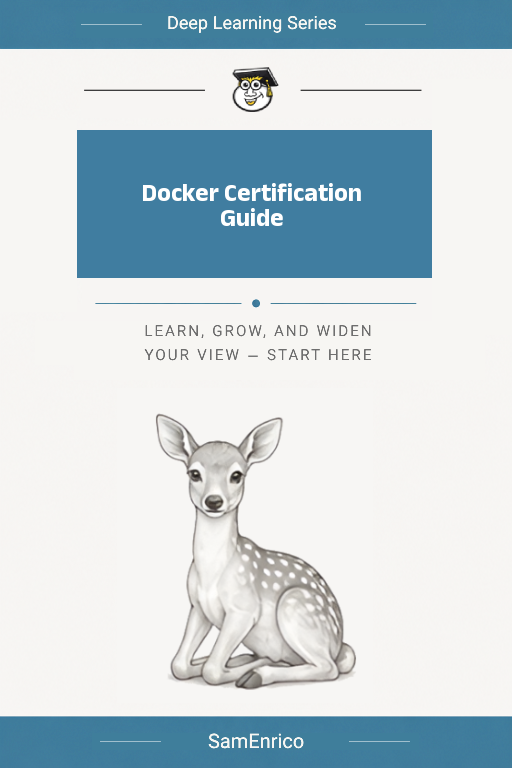
Non-FictionStudent's ShortcutDocker
Docker Certification Guide eBook
Earn Docker Certified Associate for containerizati
Earn Docker Certified Associate for containerization roles.
Formats
Free sample
Chapter 1: The 90-Second Challenge--You have ninety seconds. That is how long it takes to go from a clean laptop to a running web server using containers. Try that with a virtual machine, and you will still be waiting for the operating system to boot. This single fact — the brutal, visceral speed difference between containers and every technology that came before — explains why the Docker Certified Associate (DCA) certification has become the gold standard for containerization roles. This book will get you that certification. But more importantly, it will teach you why the ninety-second challenge matters in production, where every second of downtime costs money, and every inefficient image wastes cloud budget.Before you write a single Dockerfile or memorize a single exam objective, you need to understand what you are actually working with. Containers are not lightweight virtual machines. That is the most common misconception among new learners, and it leads to flawed mental models that break down under pressure. A virtual machine virtualizes the hardware. It runs a full operating system kernel, a full init system, and a full userspace. A container, by contrast, virtualizes the operating system. It shares the host kernel and runs only the application and its immediate dependencies. The difference is not academic. It is the difference between booting in forty-five seconds versus booting in forty-five milliseconds.The Efficiency Gap That Changed Infrastructure Let us make this concrete. Imagine you need to run ten instances of a web application for load testing. On a traditional hypervisor, each virtual machine consumes one to two gigabytes of RAM for the operating system alone. Multiply by ten, and you need at least twenty gigabytes of RAM before you run a single line of application code. Each virtual machine requires its own kernel, its own memory management, its own network stack. The overhead is staggering.Now do the same with containers. Each container shares the host kernel. The first container needs to load libraries and binaries. Every subsequent container uses the same kernel and often shares the same page cache. Ten containers running the same application might consume only a few hundred megabytes beyond the base application memory. The difference is not incremental. It is transformative.This efficiency is why companies like Google, Netflix, and Amazon run everything in containers. Google reports launching over two billion containers per week. Netflix deploys thousands of times per day using container-based pipelines. The economics are unstoppable. When your infrastructure bill drops by seventy percent and your deployment time drops by ninety percent, you do not go back.But efficiency comes with a cost: complexity. Containers introduce new concepts about networking, storage, security, and orchestration that do not exist in the virtual machine world. The DCA exam is designed to validate that you understand this complexity well enough to operate safely in production. It is not a beginner exam. It assumes six to twelve months of hands-on experience. But this book will accelerate that timeline by giving you the mental models and the hands-on practice you need to pass the exam on your first attempt.The Three-Phase Lab Environment This book uses a phased lab approach because the DCA exam covers three distinct environments that cannot coexist on the same hardware. Phase One, which covers Chapters One through Six, uses a standard open-source Docker Swarm cluster. Phase Two, covering Chapters Seven and Eight, uses Mirantis Kubernetes Engine (MKE) and Docker Trusted Registry (DTR) — enterprise components that require a fresh environment. Phase Three, covering Chapter Nine, uses a separate Kubernetes cluster (minikube or kind). You cannot install MKE on a Swarm cluster. You cannot run DTR alongside a standard registry without port conflicts. The exam expects you to know these boundaries, and the lab roadmap at the beginning of this book makes them explicit.For Phase One — which begins right now — you will build a three-node virtual cluster using Vagrant and Virtual Box. This cluster will persist throughout the first six chapters. You will take a snapshot called phase1-swarm-clean before proceeding. That snapshot is your insurance policy. If you break something, and you will break things, you restore the snapshot and continue. Breaking things is how you learn. Fixing them is how you get certified.Installing Docker CE: The Right Way Docker CE (Community Edition) is the free, open-source version of Docker. It contains everything you need for the DCA exam except the enterprise components covered in Chapters Seven and Eight. You will install it on three Ubuntu 22.04 virtual machines that you will create using Vagrant. But before you type a single command, understand the installation methods.There are three ways to install Docker. The convenience script (curl -fs SL https://get.docker.com | sh) is fast and easy. It is also the worst choice for production or for this book. The convenience script adds third-party repositories without verification, installs the latest version (which may have breaking changes), and does not pin versions. It is fine for a throwaway laptop. It is not fine for anything that matters.The second method uses the operating system package manager (apt, yum, or homebrew). This is better because packages are signed and dependencies are managed. But operating system repositories often lag months behind the latest Docker releases. You need a balance between stability and currency.The third method — and the one you will use in this book — adds Docker's official repositories to your system and then installs from them. This gives you signed packages, controlled updates, and recent versions. It is the recommended method for production and for certification preparation because it matches real-world practices.Here is the complete procedure for Ubuntu 22.04. First, update your package index and install prerequisites:text Copy Downloadsudo apt-get update
sudo apt-get install -y ca-certificates curl gnupg lsb-release Second, add Docker's official GPG key:text Copy Downloadsudo mkdir -p /etc/apt/keyrings curl -fs SL https://download.docker.com/linux/ubuntu/gpg | sudo gpg --dearmor -o /etc/apt/keyrings/docker.gpg Third, set up the stable repository:text Copy Downloadecho "deb [arch=$(dpkg --print-architecture) signed-by=/etc/apt/keyrings/docker.gpg] https://download.docker.com/linux/ubuntu $(lsb_release -cs) stable" | sudo tee /etc/apt/sources.list.d/docker.list > /dev/null Fourth, install Docker Engine, containerd, and the Docker Compose plugin:text Copy Downloadsudo apt-get update sudo apt-get install -y docker-ce docker-ce-cli containerd.io docker-compose-plugin Fifth, add your user to the docker group to run commands without sudo:text Copy Downloadsudo usermod -a G docker $USERYou will need to log out and back in for this change to take effect. On a virtual machine, the easiest way is to close the SSH session and reconnect.Verification is simple and should be part of your muscle memory. Run docker version to see client and server versions. Run docker info to see system-wide details, including the storage driver, logging driver, and number of containers. Run docker run hello-world to pull and run a test container. If all three commands succeed, Docker is installed correctly.For Windows Server 2022, the process uses Power Shell and the Install-Windows Feature cmdlet. For mac OS, you will use Docker Desktop, which is a different installation path. The DCA exam allows you to choose Linux, Windows, or mac OS as your development platform, but the production targets are almost always Linux. This book focuses on Linux because that is what the exam tests.Configuring daemon.json: The Hidden Configuration File The Docker daemon — the…
This is the end of the free sample. Get the eBook to keep going. Buy now
About this book
Details
- Author
- Waggoner Dortha
- Publisher
- SamEnrico
- Language
- English
- Genre
- Non-Fiction, Student's Shortcut, Docker
- Released
- 2026-06-01
- Pages (approx.)
- 118
- Available as
- eBook, Audiobook

Read better in the ZLOADR app
Your eBooks on your phone or tablet. Sign in with your SamEnrico account and start reading.
More by Waggoner Dortha
 CrossFit Competition Prep HandbookWaggoner Dortha$11.99
 Crop Insurance Agency DirectoryWaggoner Dortha$11.99
 The Shame of Loneliness WorkbookWaggoner Dortha$11.99
 Meditation for Sickle Cell PainWaggoner Dortha$11.99
 Beginner Fitness Warm Up GuideWaggoner Dortha$11.99
 The Last Tycoon’s Island: How Howard Hughes Bought His Own ParadiseWaggoner Dortha$11.99
 The Ballot Rebellion: How a Single Town Overturned a GovernorWaggoner Dortha$11.99
 Understanding D-glyceric AcidemiaWaggoner Dortha$17.99
 Dissolved Entities CTA GuideWaggoner Dortha$12.99
 VivariumsWaggoner Dortha$11.99
 How to Become a Charger OperatorWaggoner Dortha$11.99
You may also like
 Hong Kong Handover 1997Dunn Johnnie$11.99
 Zumba For Postnatal Recovery CourseNeal Christian$11.99
 Zumba for BeginnersLadner Nikia$11.99
 YouTube Comment Mining GuideHumes Pandora$12.99
 Worry Box MeditationCarlin Rudy$11.99
 Workplace Stress MeditationNguyen Lynn$11.99
 Workplace Stress and Sleep RepairHawley Ivory$11.99
 Workplace Perfectionism CureDelaney Jeffry$11.99
 Workplace Injustice Anger GuideWallen Isabelle$11.99
 Work Addiction and Burnout LinkGreenwood Ester$11.99
 Women in Yoga and WellnessBeattie Galina$11.99
 Women in Stand Up ComedyChun Evangeline$11.99