
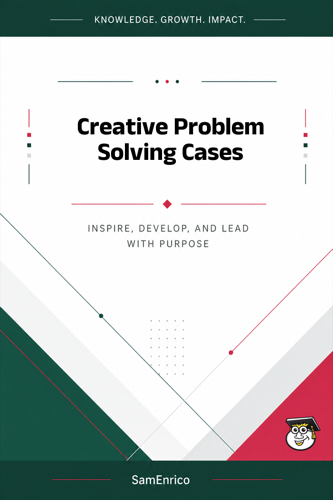
Creative Problem Solving Cases eBook
undefined
by Carrillo Wai
undefined
Formats
Free sample
Chapter 1: The Efficiency Trap--–- The year is 1975. Inside a Kodak research laboratory in Rochester, New York, a young engineer named Steven Sasson assembles a contraption that looks nothing like a camera. It has a tangled mess of wires, a bulky lens scavenged from a used movie camera, a digital cassette recorder, and a circuit board with precisely one hundred twelve analog-to-digital converter chips. The device weighs eight pounds. It takes twenty-three seconds to capture a single black-and-white image.
And the resolution is a grainy 0.01 megapixels.Sasson’s boss asks him to demonstrate the invention. Sasson points the device at a lab technician, presses a button, waits, then connects the cassette recorder to a television screen. An image appears. It is blocky, jagged, and utterly unremarkable by today’s standards. But it is the first photograph ever captured without film.The executives who view the demonstration do not applaud.
They do not ask for more funding. They do not schedule a follow-up meeting. According to company lore, one executive looks at Sasson and says, “That’s cute, but don’t tell anyone about it.”Kodak had just invented the digital camera. And they buried it for the next twenty years.This is not a story about technological failure. Kodak’s engineers were brilliant.
They solved every technical problem placed before them. The digital camera worked. The failure was not in the solution. The failure was in the question they were asking.For decades, Kodak had framed their problem as “how do we sell more film?” Every innovation, every marketing campaign, every strategic decision flowed from that frame. When the digital camera appeared, the engineers saw an opportunity.
The executives saw a threat to the film business. Both were right, according to their respective frames. But only one frame led to survival.The executives chose the wrong question. And by the time they realized it, the company that invented digital photography was filing for bankruptcy while Japanese competitors who had never sold a roll of film owned the future of imaging.This book is about that gap—the space between the problem you think you are solving and the problem that actually exists. Most professionals are excellent at solving problems.
They have MBAs. They have decades of experience. They have spreadsheets, data dashboards, and project management software. They can optimize a supply chain, reduce costs, and increase efficiency with surgical precision.But they are often solving the wrong problems.The Paradox That Kills Organizations Let us begin with a counterintuitive claim: the better you are at solving problems, the more vulnerable you become to solving the wrong ones.This is the Efficiency Paradox. It works like this.
When you are highly skilled at optimization—doing things right—you naturally double down on your existing processes. You invest in making them faster, cheaper, and more reliable. You create metrics to track your progress. You celebrate improvements in efficiency. All of this is rational, responsible, and entirely self-defeating when the underlying problem changes.Imagine a carriage driver in 1895.
He is the best in London. He knows every street, every shortcut, every stable. He has optimized his routes, trained his horses, and built a loyal clientele. He is solving the problem “how do I transport people across London faster than anyone else?” perfectly.Then the automobile arrives.The driver’s expertise in horse-drawn transportation becomes irrelevant not because he stopped being good at his job, but because the problem itself transformed. The automobile did not require a better carriage driver.
It required a completely different frame: “how do we build roads, fueling stations, and a new kind of vehicle?”The Efficiency Paradox explains why dominant companies almost never invent the technologies that disrupt them. It is not because they lack intelligence or resources. It is because their very success makes them incapable of seeing that the question has changed.Kodak is the classic case, but it is not the only one. Blockbuster had the opportunity to buy Netflix for $50 million in 2000. Blockbuster’s executives looked at Netflix’s DVD-by-mail model and saw a niche service for a small segment of movie enthusiasts.
From Blockbuster’s frame—“how do we get people to rent more movies from our stores?”—the analysis was correct. Netflix’s model could never match Blockbuster’s store-based revenue per customer. But Blockbuster was asking the wrong question. The right question was “how will people access movies in ten years?” The answer was streaming, not stores, and not DVDs by mail.Nokia faced the same paradox. In 2007, Nokia had forty percent of the global mobile phone market.
Their engineers had created phones with longer battery life, better cameras, and more durable cases than anything Apple had ever made. They were optimizing a world that was about to disappear. Nokia’s frame—“how do we make phones better?”—missed that the i Phone was not a better phone. It was a pocket computer that happened to make calls. By the time Nokia recognized the new frame, they had lost a decade.The Two Modes of Problem-Solving To escape the Efficiency Paradox, you must understand a foundational distinction that runs through every chapter of this book.
There are two fundamentally different ways to approach a problem.The first is algorithmic problem-solving. This applies when the variables are known, the relationships between them are understood, and the path to a solution is repeatable. Algorithmic problems are like recipes. Follow the steps, measure the ingredients, control the temperature, and you will produce the same cake every time. Most of what we learn in business school, engineering programs, and professional training is algorithmic problem-solving.
It is valuable. It is necessary. And it is entirely insufficient for novel challenges.The second is heuristic problem-solving. This applies when the variables are unknown, the relationships are uncertain, and there is no guaranteed path to a solution. Heuristic problems require creative leaps, experimentation, and the willingness to be wrong.
They cannot be solved by following a checklist. They require reframing.Most professionals are trained extensively in algorithmic thinking. They are rarely trained in heuristic thinking. When a heuristic problem appears, they instinctively reach for algorithmic tools—more data, more analysis, more optimization. This is like using a magnifying glass to put out a fire.
The tool is precise, but it is the wrong tool for the situation.Consider the difference between these two questions:Algorithmic question: “Our factory is producing defective units at a rate of three percent. How do we reduce defects to one percent?” This has known variables (production process, defect types, quality control checkpoints). It can be solved through root cause analysis, statistical process control, and Six Sigma methods.Heuristic question: “Our industry is being disrupted by a technology we don’t fully understand. What should our business become in ten years?” This has unknown variables (future technology, competitor moves, changing customer preferences). It cannot be solved through analysis alone.
It requires reframing.The tragedy is that most organizations treat heuristic problems as if they were algorithmic. They call meetings. They demand more data. They ask for five-year plans with financial projections. They create the illusion of control while avoiding the uncomfortable work of questioning their fundamental assumptions.The…
This is the end of the free sample. Get the eBook to keep going. Buy now
About this book
Details
- Author
- Carrillo Wai
- Publisher
- SamEnrico
- Language
- English
- Genre
- Non-Fiction, Self-Help
- Released
- 2026-06-09
- Pages (approx.)
- 132
- Available as
- eBook, Audiobook

Read better in the ZLOADR app
Your eBooks on your phone or tablet. Sign in with your SamEnrico account and start reading.
More by Carrillo Wai
 Journaling Morning Routine GuideCarrillo Wai$11.99
 Daily Review for HR ProsCarrillo Wai$11.99
 The Winona LaDuke AccountCarrillo Wai$11.99
 Cross Addiction and Alcohol RecoveryCarrillo Wai$11.99
 Self Esteem Therapy GuideCarrillo Wai$11.99
 Meditation for Testicular PainCarrillo Wai$11.99
 Caregiver Anger ManagementCarrillo Wai$11.99
 The Melodic Conquerors: Black Maestros of the Roman Imperial CourtCarrillo Wai$11.99
 Socrates: The Dawn of Western ThoughtCarrillo Wai$11.99
 How to Produce Reel-to-reel Tape Players and RecordersCarrillo Wai$11.99
 How to Produce Extension CordsCarrillo Wai$11.99
 Manama B2B Financial SalesCarrillo Wai$12.99
You may also like
 Workplace Stress MeditationNguyen Lynn$11.99
 Volcano Monitoring ScientistCox Alexis$11.99
 The Tech Professional NetAguiar Nevada$11.99
 The Morning Metta RitualCanales Anya$11.99
 The Chunking Memory TechniqueClanton Hyacinth$11.99
 The Beginner Mistake FixAmmons Cassondra$11.99
 Surrendering to What IsGrimm Reatha$11.99
 Self Hypnosis for Fear of FireBillups Eli$11.99
 Road Rage for Professional DriversBrackett Janise$11.99
 Psychiatric Ward Nurse StressDunning Wyatt$11.99
 Observation vs Evaluation NVCTimmons Alda$11.99
 Networking for Nonprofit ProfessionalsPoole Jesse$11.99