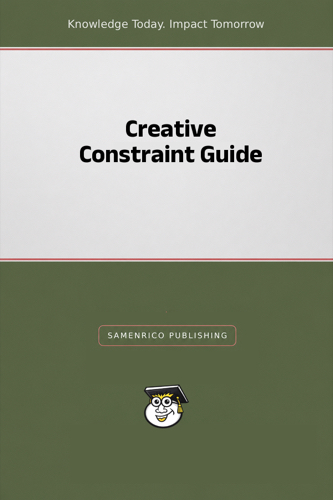
Creative Constraint Guide eBook
Use limitations as creative catalysts rather than
Use limitations as creative catalysts rather than obstacles.
Formats
Free sample
Chapter 1: The Empty Throne--–- In 1962, the artist Yves Klein stood before a bare white canvas in a Parisian gallery. The canvas was entirely empty—no brushstrokes, no color, no form. A crowd had gathered to witness the premiere of his latest work, The Void. Klein had spent weeks preparing the room: painting every surface white, removing all furniture, and installing nothing but a single empty cabinet. When the doors opened, the audience stood in confusion.
Some walked out. Others whispered that he had lost his mind. One critic called it “the most expensive nothing ever sold.”But Klein was not being lazy. He was not blocked. He was not suffering from a lack of ideas.
In fact, he had spent years mastering traditional painting, figurative drawing, and even judo. His early works were technically proficient, even brilliant. So why would a skilled artist choose to present nothing?The answer changed the way I think about creativity forever.Klein later explained that The Void was not about emptiness. It was about the condition that makes anything possible. He had imposed upon himself the most radical constraint imaginable: absolute minimalism.
By removing every possible element—color, form, texture, subject—he forced his audience (and himself) to confront the raw architecture of perception itself. The emptiness was not a lack. It was a fence. And inside that fence, something paradoxical happened: the audience began to see more, not less. They noticed the quality of the light.
The texture of the white paint. The weight of their own breathing. The constraint of “nothing” had amplified everything.This is the central paradox of creative constraint, and it is the subject of this book.The Lie We All Believe Most of us grow up believing that creativity requires freedom. More space. More time.
More money. More options. We look at the blank page, the empty studio, the unfilled calendar, and we think: If only I had more resources, I could finally create something great.This belief is not just wrong. It is actively destructive.For the past fifteen years, I have studied how creative people actually work—not how they say they work in interviews, but the hidden structures, rituals, and limitations they impose upon themselves. I have analyzed the habits of Nobel Prize winners, Mac Arthur “Genius Grant” recipients, Oscar-winning screenwriters, and Fortune 500 innovation teams.
And I have found a consistent, counterintuitive pattern running through almost every success story.The pattern is this: The most creative people do not seek freedom. They build cages.They impose arbitrary rules. They set impossible deadlines. They work with broken tools. They choose difficult materials.
They create constraints where none exist. And then—only then—do they produce their best work.Consider the following examples, which we will explore in depth throughout this book:The composer who wrote his most famous symphony after losing his hearing (Chapter 6)The novelist who wrote his breakthrough book in broken English because his Japanese felt “too fluent” (this chapter)The tech startup that forced itself to launch with half the features they planned—and won the market (Chapter 9)The architect who designed award-winning buildings using only materials found within 100 miles of the site (Chapter 7)The poet who wrote an entire collection using only five vowels (Chapter 8)Each of these creators faced a real limitation. Each could have complained, delayed, or given up. Instead, each used the limitation as a lever—a tool to pry open possibilities they would never have found in total freedom.This book will teach you how to do the same.The Paranoia Formula: When Fear Helps and When It Hurts Before we go further, I need to address a critical distinction that most books on creativity get wrong. You have probably heard the saying: “Fear kills creativity.” This is true in some contexts and dangerously false in others.Let me introduce what I call the Paranoia Formula.Imagine two types of creative tasks.Type A: Simple, routine, or deadline-driven tasks.
These include filing taxes, formatting a report, cleaning a workspace, or completing a familiar template. For these tasks, a small amount of fear-based motivation (the “stick”) works extremely well. The fear of a deadline, a penalty, or public embarrassment can push you through boredom and procrastination. This is why deadlines exist. This is why accountability partners work.Type B: Complex, novel, or breakthrough-oriented tasks.
These include writing a novel, designing a logo, composing music, inventing a product, or solving an ambiguous problem. For these tasks, fear backfires. The fear of failure constricts your thinking, narrows your options, and pushes you toward the safest, most boring solution. For complex creative work, you need the “carrot”—the promise of discovery, mastery, or meaning.Here is the resolution that many constraint theorists miss: Fear-based constraints are effective for simple tasks. Reward-based constraints are effective for complex tasks.
The Egyptian pharaohs understood this thousands of years ago. They used the flail (punishment) to enforce labor discipline—simple, repetitive work. But they used the crook (guidance, reward, meaning) to inspire architectural and artistic innovation. Two different tools for two different jobs.Throughout this book, when I discuss creative constraints, I am talking about reward-based constraints—limits you choose to impose because they make the work more interesting, not because you are afraid of punishment. The goal is to transform “I have to” into “I get to.”The Haruki Murakami Breakthrough No example illustrates this transformation better than the story of Haruki Murakami, one of the most inventive novelists alive.Before he became a writer, Murakami ran a jazz club in Tokyo.
He wrote his first novel, Hear the Wind Sing, late at night after closing the bar. He had no training in fiction. He had no mentor. He had nothing but exhaustion and a strange idea.But he faced a specific problem: when he tried to write in Japanese, his native language, the prose came out stiff and overworked. He had read too many Japanese classics.
He knew the rules too well. Every sentence felt like it was being judged by the ghosts of every writer who came before him. His domain knowledge (Chapter 3) had become a prison rather than a scaffold.So Murakami did something radical. He switched languages.He sat down and wrote the first draft of his novel in broken English. His English vocabulary was limited.
His grammar was shaky. He had no access to elegant phrases or literary flourishes. He could only say simple things in simple ways.And that was the breakthrough.The constraint of broken English forced Murakami to abandon every literary affectation. He could not show off. He could not imitate his heroes.
He could only find the most direct, clearest way to say what he meant. When he finished the English draft, he translated it back into Japanese—and discovered a voice that was entirely his own. Sparse. Rhythmic. Almost musical.
The constraint had carved away everything unnecessary.Hear the Wind Sing won a literary prize for new writers. Murakami went on to become an international phenomenon. And he has continued to use constraints throughout his career: writing exactly ten pages per day, running ten kilometers daily, never outlining his plots in advance. His cage is…
This is the end of the free sample. Get the eBook to keep going. Buy now
About this book
Details
- Author
- Mccall Saundra
- Publisher
- SamEnrico
- Language
- English
- Genre
- Non-Fiction, Self-Help, Constraints
- Released
- 2026-06-09
- Pages (approx.)
- 136
- Available as
- eBook, Audiobook

Read better in the ZLOADR app
Your eBooks on your phone or tablet. Sign in with your SamEnrico account and start reading.
More by Mccall Saundra
 Immigrant Education Tutoring Business GuideMccall Saundra$11.99
 Teaching Active Listening GuideMccall Saundra$11.99
 The Broken GuitarMccall Saundra$11.99
 Sensitive Information PenaltiesMccall Saundra$11.99
 Huston Dynasty - Anjelica HustonMccall Saundra$11.99
 Soccer Injury Prevention GuideMccall Saundra$11.99
 Peer Mentorship CirclesMccall Saundra$11.99
 Assertiveness For Family ConversationsMccall Saundra$11.99
 Ticking Toward Tomorrow: The Timekeepers Who Built the Modern WorldMccall Saundra$11.99
 Midnight in the Mediterranean: The Vanishing of the Emerald EmpressMccall Saundra$11.99
 Blood Moon Conspiracy: The Jaguar Priest’s GambitMccall Saundra$11.99
 Short-Form UGC Monetization ModelsMccall Saundra$11.99