
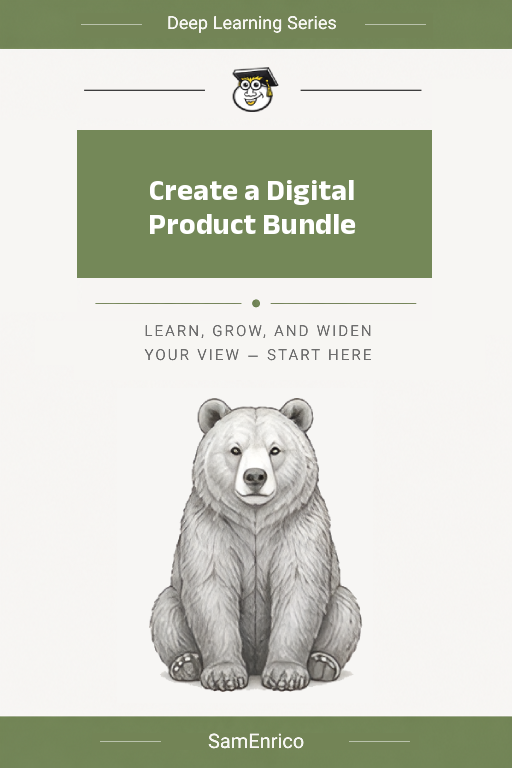
Non-FictionFirst 30 DaysPartnership
Create a Digital Product Bundle eBook
Partner with other creators to bundle products and
Partner with other creators to bundle products and cross-promote to each other's audiences.
Formats
Free sample
Chapter 1: The Solo Trap--–- Sarah had done everything right. She had built an email list of 42,000 engaged subscribers. She had launched three digital products that generated a respectable $8,000 per month. She posted consistently on Instagram, showed up for every weekly live stream, and answered every customer email within 24 hours. By any reasonable measure, Sarah was a successful creator.But Sarah was also exhausted.She hadn't taken a vacation in two years.
Her last "day off" was a Tuesday when she spent six hours responding to comments and fulfilling orders. She looked at other creators in her niche—people with smaller lists, less polished products, and objectively worse content—and watched them surpass her income month after month. They were doing something she was not. They were collaborating. They were bundling.
They were growing their audiences not by grinding harder, but by joining forces.Sarah's story is not unique. It is the story of thousands of digital creators who have been sold a dangerous myth: the myth of the solo entrepreneur.The Lie You Have Been Sold The solo entrepreneur myth is one of the most persistent and damaging narratives in online business. It goes something like this: if you work hard enough, if you create good enough products, if you market yourself consistently, you will succeed. Your success is entirely within your control. Your failure is entirely your fault.This myth sells courses.
It sells productivity apps. It sells the dream of being your own boss, beholden to no one, building an empire from your laptop while sipping coffee at a beachside café.It is also, for the vast majority of creators, complete fiction.Consider this: the average solo creator spends 70% of their time on activities that do not directly generate revenue—marketing, administrative tasks, customer support, and content creation that may or may not convert. Only 30% of their time is spent on actual product creation and high-value work. And of that 30%, much of it is duplicated across hundreds of other creators serving the same audience.Think about the absurdity of this. Ten different fitness creators each spend twenty hours creating a "7-Day Meal Plan" PDF.
Each PDF is slightly different, but each solves essentially the same problem for essentially the same customer. Each creator then spends another forty hours trying to get that PDF in front of customers. Meanwhile, the customer is overwhelmed by choice, paralyzed by decision fatigue, and ends up buying nothing from anyone.There is a better way.The Bellroy Wake-Up Call In 2019, a wallet company called Bellroy did something unusual. Instead of spending its marketing budget on Facebook ads or Google search terms, it partnered with a group of creators. Not paid influencers in the traditional sense, but genuine partners who believed in the product and had audiences that would genuinely benefit from it.The results were staggering.
Bellroy achieved a 3,823% return on investment from its creator partnership program. For every dollar spent on partnership infrastructure, the company generated thirty-eight dollars in revenue.But the more interesting number is the one that does not appear in the press release. Bellroy found that customers acquired through creator partnerships had a 40% higher lifetime value than customers acquired through traditional advertising. They stayed longer. They bought more.
They referred friends.Why? Because trust had been transferred.When a customer sees an ad, they know it is an ad. Their brain activates the "persuasion knowledge" defense mechanism—a psychological shield that automatically discounts claims made by advertisers. But when a customer hears a recommendation from a creator they already follow and trust, that shield is down. The trust the customer has in the creator is transferred, at least partially, to the product being recommended.This is the power of cross-promotion.
And it is the single most underutilized growth lever in the digital creator economy.The Multi-Touchpoint Trust Effect Let me explain why this works so powerfully, and why solo selling is mathematically inferior.A single creator promoting a product to their audience has one trust touchpoint. The customer trusts the creator (or does not), and that single relationship determines whether they buy. The conversion rate on a solo launch, even from a warm email list, typically ranges from 2% to 5%.Now imagine that same product is promoted by three different creators, each with their own audience, each with their own relationship of trust. A customer who follows all three creators—and many customers do follow multiple creators in the same niche—sees the product recommended not once, but three times.This is the multi-touchpoint trust effect. Each recommendation reinforces the previous one.
The first recommendation creates awareness. The second creates interest. The third creates action. The customer thinks: "If all three of these people I trust are recommending this, it must be legitimate."The conversion rate on a multi-creator bundle launch, when done correctly, typically ranges from 10% to 25% of the combined email lists. That is not additive.
It is multiplicative.And here is the counterintuitive part: your audience does not shrink when you share it. It grows.The Rising Tide Theory Most solo creators hoard their audience like a dragon hoards gold. They fear that if they introduce their subscribers to another creator, those subscribers will leave. They fear that the attention economy is zero-sum—that every minute a customer spends with another creator is a minute stolen from them.This fear is understandable but factually wrong.The Rising Tide Theory, named for the saying "a rising tide lifts all boats," proposes that when multiple creators in a niche collaborate, the entire market expands. New customers enter the ecosystem who would not have entered otherwise.
Existing customers deepen their engagement because they now have access to a richer set of solutions.Here is the data: in a study of twelve digital product bundles across fitness, business, and creative niches, the average creator saw a 15% increase in their own email list growth rate after participating in a bundle. Not a decrease. An increase. Customers who discovered a creator through a bundle were 2.3 times more likely to buy that creator's standalone products later.Why? Because the bundle served as a low-risk introduction.
A customer who had never heard of you before sees you as part of a trusted bundle. They pay 97forfiveproducts.Theyuseyours.Theylikeit.Nowtheytrustyouenoughtobuyyour97 for five products. They use yours. They like it. Now they trust you enough to buy your 97forfiveproducts.Theyuseyours.Theylikeit.Nowtheytrustyouenoughtobuyyour497 course.
Without the bundle, that customer never would have found you at all.The solo creator sees other creators as competitors. The smart creator sees them as distribution channels.The Three Costs of Going Solo Before we go further, I want to be brutally honest about what going solo is actually costing you. Most creators do not realize these costs exist because they have never experienced the alternative.Cost One: The Attention Tax When you promote only your own products to your own audience, you are taxing your own attention. Every email you send, every social post you make, every live stream you host is consumed by the same people. Over time, engagement drops.
The audience becomes fatigued. Your open rates decline from 40% to 20% to 10%. You respond by sending more emails, posting…
This is the end of the free sample. Get the eBook to keep going. Buy now
About this book
Details
- Author
- Monson Taneka
- Publisher
- SamEnrico
- Language
- English
- Genre
- Non-Fiction, First 30 Days, Partnership
- Released
- 2026-05-30
- Pages (approx.)
- 146
- Available as
- eBook, Audiobook

Read better in the ZLOADR app
Your eBooks on your phone or tablet. Sign in with your SamEnrico account and start reading.
More by Monson Taneka
 Sam Sheppard Infidelity MotiveMonson Taneka$11.99
 Poor Peoples CampaignMonson Taneka$11.99
 The Graduate Student Study GuideMonson Taneka$11.99
 Overlearning for AutomaticityMonson Taneka$11.99
 Terminal Illness TalkMonson Taneka$11.99
 Pet Loss After DivorceMonson Taneka$11.99
 Goal Setting For KidsMonson Taneka$11.99
 Morning Visualization TechniquesMonson Taneka$11.99
 Silent Suffering: The Deadly Deception of Dr. Michael SwangoMonson Taneka$11.99
 Service Providers Guide to Antique & Collectibles DealersMonson Taneka$11.99
 How to Produce Kitesurfing EquipmentMonson Taneka$11.99
 How to Start a Air Rifle Business (Beginners Guide)Monson Taneka$11.99
You may also like
 Hong Kong Handover 1997Dunn Johnnie$11.99
 Zumba For Postnatal Recovery CourseNeal Christian$11.99
 Zumba for BeginnersLadner Nikia$11.99
 YouTube Comment Mining GuideHumes Pandora$12.99
 Worry Box MeditationCarlin Rudy$11.99
 Workplace Stress MeditationNguyen Lynn$11.99
 Workplace Stress and Sleep RepairHawley Ivory$11.99
 Workplace Perfectionism CureDelaney Jeffry$11.99
 Workplace Injustice Anger GuideWallen Isabelle$11.99
 Work Addiction and Burnout LinkGreenwood Ester$11.99
 Women in Yoga and WellnessBeattie Galina$11.99
 Women in Stand Up ComedyChun Evangeline$11.99