
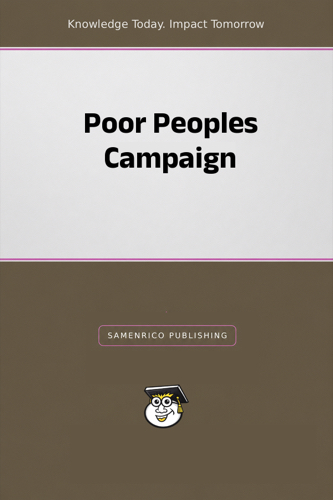
Non-FictionBiographyEconomic Justice
Poor Peoples Campaign
Expand civil rights into economic justice for all.
Expand civil rights into economic justice for all.
Formats
About this book
Free sample
Chapter 1: The Other America...--–- In the winter of 1967, Dr. Martin Luther King Jr. sat in a cramped apartment in Chicago’s Lawndale neighborhood, watching a young mother boil water on a stove that hadn’t worked properly in three years. Her children shared a single blanket. The landlord, a man who owned seventeen buildings across the city, had not answered her calls in eleven months.
King had come to Chicago to fight for open housing. He would leave having learned that a door to a better neighborhood meant nothing if the family walking through it had no money to pay the rent, no job to keep the lights on, and no power to demand that a stove be fixed.That moment in Lawndale—one of dozens like it—became the seed of what history would call the Poor People’s Campaign. But to understand that campaign, we must first understand a more fundamental truth that King had been chasing for nearly a decade: America was not one nation but two. And the second America, the one where stoves broke and landlords answered to no one, was not an accident. It was engineered.The Speech That Named the Wound On April 4, 1967—exactly one year before his assassination—King stood in the pulpit of Riverside Church in New York City and delivered a speech that most Americans remember for its condemnation of the Vietnam War.
But buried inside that address, between the sentences about napalm and conscription, was a diagnosis of domestic inequality so precise and so devastating that it would become the blueprint for his final crusade.“There is at hand a significant and profound change in American public opinion,” King told the congregation. He was not speaking about the war. He was speaking about poverty. “The dispossessed of this nation—the poor, both white and Negro—live in a cruelly unjust society. They must organize a revolution against that injustice, not against the lives of their fellow citizens, but against the structures through which the society is refusing to take means which have been called for.”The phrase “the dispossessed” was deliberate.…
This is the end of the free sample. Get the eBook to keep going. Buy now
Contents
- Chapter 1
- Chapter 2
- Chapter 3
- Chapter 4
- Chapter 5
- Chapter 6
- Chapter 7
- Chapter 8
- Chapter 9
- Chapter 10
- Chapter 11
- Chapter 12
Details
- Author
- Monson Taneka
- Publisher
- SamEnrico
- Language
- English
- Genre
- Non-Fiction, Biography, Economic Justice
- Released
- 2026-06-09
- Pages (approx.)
- 146
- Available as
- eBook, Audiobook

Read better in the ZLOADR app
Your eBooks on your phone or tablet. Sign in with your SamEnrico account and start reading.
More by Monson Taneka
 Sam Sheppard Infidelity MotiveMonson Taneka$11.99
 The Graduate Student Study GuideMonson Taneka$11.99
 Overlearning for AutomaticityMonson Taneka$11.99
 Terminal Illness TalkMonson Taneka$11.99
 Pet Loss After DivorceMonson Taneka$11.99
 Goal Setting For KidsMonson Taneka$11.99
 Morning Visualization TechniquesMonson Taneka$11.99
 Silent Suffering: The Deadly Deception of Dr. Michael SwangoMonson Taneka$11.99
 Service Providers Guide to Antique & Collectibles DealersMonson Taneka$11.99
 How to Produce Kitesurfing EquipmentMonson Taneka$11.99
 How to Start a Air Rifle Business (Beginners Guide)Monson Taneka$11.99
 Diplomatic Engagement GuideMonson Taneka$12.99
You may also like
 Hong Kong Handover 1997Dunn Johnnie$11.99
 Zumba For Postnatal Recovery CourseNeal Christian$11.99
 Zumba for BeginnersLadner Nikia$11.99
 YouTube Comment Mining GuideHumes Pandora$12.99
 Worry Box MeditationCarlin Rudy$11.99
 Workplace Stress MeditationNguyen Lynn$11.99
 Workplace Stress and Sleep RepairHawley Ivory$11.99
 Workplace Perfectionism CureDelaney Jeffry$11.99
 Workplace Injustice Anger GuideWallen Isabelle$11.99
 Work Addiction and Burnout LinkGreenwood Ester$11.99
 Women in Yoga and WellnessBeattie Galina$11.99
 Women in Stand Up ComedyChun Evangeline$11.99