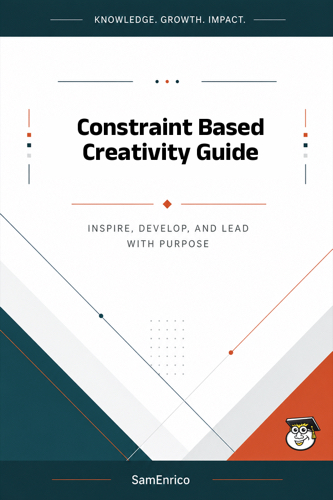
Constraint Based Creativity Guide eBook
Use limitations in budget, time, and resources to
Use limitations in budget, time, and resources to fuel rather than block innovation.
Formats
Free sample
Chapter 1: The Box You Need--–- The year is 1960. Theodor Geisel, better known to the world as Dr. Seuss, sits across from his publisher, Bennett Cerf, in a New York restaurant. The conversation turns to children's literature, to the challenge of teaching reading, and to a bet. Cerf, a man who made his career betting on writers, looks at Geisel and says: "I bet you fifty dollars you cannot write an entertaining children's book using only fifty different words."Geisel, never one to back down from a challenge, takes the bet.
He is already famous for The Cat in the Hat, which used 225 distinct words. Cutting that vocabulary by nearly eighty percent seems impossible. How do you tell a complete story—with characters, conflict, suspense, and resolution—with the linguistic equivalent of a teaspoon? How do you create rhythm, humor, and emotional resonance when every single word must carry the weight of ten?Nine months later, Geisel delivers the manuscript for Green Eggs and Ham. It uses exactly fifty words.
Forty-nine of them are monosyllabic. The fiftieth is "anywhere." The book becomes the best-selling Dr. Seuss title of all time, outselling his less constrained works by a wide margin. Children learn to read from it. Adults quote it from memory.
A story about persistence, picky eating, and the virtue of trying new things—written under a constraint so severe that most writers would have refused the bet outright.The box did not confine Geisel. The box set him free.The Great Misunderstanding For generations, business leaders, educators, and creativity gurus have repeated the same hollow mantra: "Think outside the box." The phrase has become so ubiquitous that it has lost all meaning. It adorns motivational posters in office breakrooms. It punctuates corporate strategy meetings. It is invoked whenever a team is stuck, whenever a problem seems intractable, whenever someone wants to sound innovative without actually changing anything.The problem is not the box.
The problem is the assumption that the box is the enemy.This book makes a counterintuitive argument, one supported by decades of cognitive psychology research, engineering case studies, and artistic practice: Total freedom is the enemy of creativity. Boundaries breed brilliance. The box is not a prison—it is a scaffold.The most innovative products, the most memorable works of art, the most successful companies in history did not achieve their breakthroughs by removing constraints. They achieved them by embracing the right constraints, by working passionately within limits, and by discovering that the box—properly understood—is the most powerful creative tool available.The Jam Study That Changed Everything Let us begin with evidence. In 2000, psychologists Sheena Iyengar and Mark Lepper published a study that would upend decades of assumptions about choice and motivation.
They set up a tasting booth in a gourmet grocery store. On some days, they displayed twenty-four varieties of jam. On other days, they displayed only six. Passersby could sample as many jams as they wished and receive a discount coupon for any purchase.The results: the large display attracted more attention. Shoppers stopped more often, looked longer, and sampled more flavors.
But the small display produced dramatically more sales. Shoppers who saw twenty-four jams were ten times less likely to buy any than those who saw six. More options led to less action.This finding, replicated across dozens of domains—from 401(k) investment choices to college course selections to dating app swipes—reveals a fundamental truth about human cognition. Choice overload does not liberate; it paralyzes. When faced with unlimited possibilities, the brain enters a state of what psychologists call "analysis paralysis." The decision-making machinery overheats.
Opportunity costs become salient: choosing one option means rejecting all others. Anticipated regret rises: what if I make the wrong choice? Satisfaction after choice falls: the unchosen alternatives linger in imagination, breeding doubt.Now translate this to the workplace. A team given unlimited budget, unlimited time, and unlimited scope does not produce unlimited innovation. It produces endless meetings, feature creep, scope bloat, and perfectionist delay.
The blank page is terrifying not because it offers nothing but because it offers everything. Every possibility is open, which means no possibility is privileged. The team cannot move forward because moving forward requires closing doors, and closing doors feels like loss.The box solves this problem. The box closes doors. The box tells you what you cannot do, which clarifies what you must do.
The box eliminates the noise of infinite possibility and reveals the signal of genuine priority.Defining the Box: Creative vs. Administrative Constraints Not all boxes are created equal. Before we proceed further, we must make a crucial distinction that will guide the entire book.Creative constraints are limits that force trade-offs leading to better outcomes. They are the walls of the box that concentrate attention, eliminate distractions, and demand resourcefulness. Examples include:A budget cap that forces prioritization of features A deadline that compresses decision-making time A material limit that requires elegant simplicity A word count that demands precision in language A technical regulation that prevents obvious but lazy solutions Creative constraints are the tools we will explore in depth throughout this book.
They are the mechanisms by which limitations become fuel.Administrative constraints are limits that add friction without improving output. They are the red tape, the arbitrary approvals, the legacy rules, the political boundaries that serve no creative purpose. Examples include:Five signature approvals for a fifty-dollar purchase A mandatory thirty-slide Power Point deck for every project update"We've always done it this way" as a justification for process Reporting requirements that outlive their original purpose Territorial boundaries between departments that prevent collaboration Administrative constraints are not fuel. They are drag. Part of learning to work with constraints is learning to distinguish between the two—to embrace the creative ones and eliminate or route around the administrative ones.The Constraint Inventory tool at the end of this chapter will help you make that distinction for your own projects.The Science of Option Elimination The psychological mechanisms behind constraint-based creativity go beyond choice overload.
Let us examine three additional phenomena that explain why boundaries breed brilliance.The Focusing Illusion. Psychologist Daniel Kahneman observed that "nothing in life is as important as you think it is while you are thinking about it." When faced with unlimited options, the human mind tends to fixate on features that are salient but not necessarily important. A team with unlimited budget will spend weeks debating the color scheme of a landing page because the color scheme is visible, not because it matters. Constraints force attention away from the merely visible and toward the genuinely consequential. A budget cap makes you ask: what is the one thing that must work?
Everything else becomes secondary.Parkinson's Law of Triviality. Also known as "bike-shedding," this phenomenon describes the human tendency to devote disproportionate attention to trivial issues. A committee asked to approve a nuclear power plant will spend most of its time debating the bike shed because everyone understands bike sheds. The complex decisions about reactor cooling systems are deferred to experts. Constraints prevent bike-shedding by eliminating the trivial as an option.
When you cannot afford to debate the bike shed, you debate what matters.The Scarcity Heuristic. When resources are abundant, the…
This is the end of the free sample. Get the eBook to keep going. Buy now
About this book
Details
- Author
- Lombardi Marissa
- Publisher
- SamEnrico
- Language
- English
- Genre
- Non-Fiction, Self-Help, Creative Constraints
- Released
- 2026-06-07
- Pages (approx.)
- 134
- Available as
- eBook, Audiobook

Read better in the ZLOADR app
Your eBooks on your phone or tablet. Sign in with your SamEnrico account and start reading.
More by Lombardi Marissa
 Growth Mindset For RecoveryLombardi Marissa$11.99
 Rebuilding Trust After BetrayalLombardi Marissa$11.99
 The Support Group Complicated GriefLombardi Marissa$11.99
 Contrast Effect PersuasionLombardi Marissa$11.99
 The Deep Blue Pioneers: Africa's Unseen Mariners of the Indian OceanLombardi Marissa$11.99
 YC Video Submission AfricaLombardi Marissa$12.99
 Franchise Succession AbroadLombardi Marissa$12.99
 Understanding Triphalangeal Thumb Polysyndactyly SyndromeLombardi Marissa$17.99
 Chemical Production OperatorLombardi Marissa$11.99
 10 Ways to Use Date Paste (Recipe Book)Lombardi Marissa$11.99