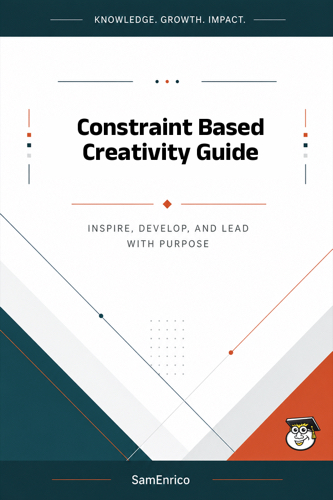
Constraint Based Creativity Guide
Use limitations in budget, time, and resources to
Use limitations in budget, time, and resources to fuel rather than block innovation.
Formats
About this book
Free sample
Chapter 1: The Box You Need--–- The year is 1960. Theodor Geisel, better known to the world as Dr. Seuss, sits across from his publisher, Bennett Cerf, in a New York restaurant. The conversation turns to children's literature, to the challenge of teaching reading, and to a bet. Cerf, a man who made his career betting on writers, looks at Geisel and says: "I bet you fifty dollars you cannot write an entertaining children's book using only fifty different words."Geisel, never one to back down from a challenge, takes the bet.
He is already famous for The Cat in the Hat, which used 225 distinct words. Cutting that vocabulary by nearly eighty percent seems impossible. How do you tell a complete story—with characters, conflict, suspense, and resolution—with the linguistic equivalent of a teaspoon? How do you create rhythm, humor, and emotional resonance when every single word must carry the weight of ten?Nine months later, Geisel delivers the manuscript for Green Eggs and Ham. It uses exactly fifty words.
Forty-nine of them are monosyllabic. The fiftieth is "anywhere." The book becomes the best-selling Dr. Seuss title of all time, outselling his less constrained works by a wide margin. Children learn to read from it. Adults quote it from memory.
A story about persistence, picky eating, and the virtue of trying new things—written under a constraint so severe that most writers would have refused the bet outright.The box did not confine Geisel. The box set him free.The Great Misunderstanding For generations, business leaders, educators, and creativity gurus have repeated the same hollow mantra: "Think outside the box." The phrase has become so ubiquitous that it has lost all meaning. It adorns motivational posters in office breakrooms. It punctuates corporate strategy meetings. It is invoked whenever a team is stuck, whenever a problem seems intractable, whenever someone wants to sound innovative without actually changing anything.The problem is not the box.
The problem is the assumption that the box is the enemy.This book makes a counterintuitive argument, one supported by decades of cognitive psychology research, engineering case studies…
This is the end of the free sample. Get the eBook to keep going. Buy now
Contents
- Chapter 1
- Chapter 2
- Chapter 3
- Chapter 4
- Chapter 5
- Chapter 6
- Chapter 7
- Chapter 8
- Chapter 9
- Chapter 10
- Chapter 11
- Chapter 12
Details
- Author
- Lombardi Marissa
- Publisher
- SamEnrico
- Language
- English
- Genre
- Non-Fiction, Self-Help, Creative Constraints
- Released
- 2026-06-07
- Pages (approx.)
- 134
- Available as
- eBook, Audiobook

Read better in the ZLOADR app
Your eBooks on your phone or tablet. Sign in with your SamEnrico account and start reading.
More by Lombardi Marissa
 Growth Mindset For RecoveryLombardi Marissa$11.99
 Rebuilding Trust After BetrayalLombardi Marissa$11.99
 The Support Group Complicated GriefLombardi Marissa$11.99
 Contrast Effect PersuasionLombardi Marissa$11.99
 The Deep Blue Pioneers: Africa's Unseen Mariners of the Indian OceanLombardi Marissa$11.99
 YC Video Submission AfricaLombardi Marissa$12.99
 Franchise Succession AbroadLombardi Marissa$12.99
 Understanding Triphalangeal Thumb Polysyndactyly SyndromeLombardi Marissa$17.99
 Chemical Production OperatorLombardi Marissa$11.99
 10 Ways to Use Date Paste (Recipe Book)Lombardi Marissa$11.99