
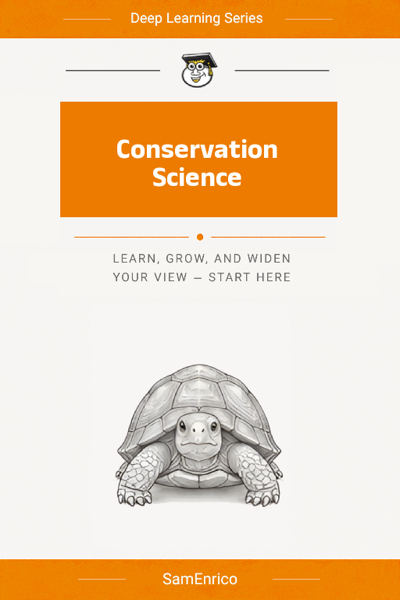
Non-FictionInformativeEducational
Conservation Science Audiobook
A Coursebook on Conservation Science
A Coursebook on Conservation Science
Formats
Free sample
Chapter 1: The Broken Compass--– In the summer of 1971, a young biologist named Daniel Janzen stood at the edge of a Costa Rican forest that was about to be burned for cattle pasture. He had calculated, with meticulous precision, that this particular patch of trees contained at least sixty-seven species of orchids found nowhere else on Earth. He had maps, data, and the full authority of his university credentials. He pleaded with the landowner. He offered alternatives.
He explained the science of extinction. The landowner listened patiently, then lit the match.That forest burned for three days. Janzen later wrote that he learned something in the smoke that no textbook could have taught him: conservation is not a battle between knowledge and ignorance. It is a battle between values. The landowner knew exactly what he was destroying.
He simply valued his cattle more than Janzen’s orchids. And on a human-dominated planet, that kind of value conflict is not an exception. It is the rule.This book begins with that fire because it illuminates the central dilemma of twenty-first-century conservation science. For most of its history, conservation operated under a quiet assumption: if we could just get the science right—if we could map biodiversity, calculate extinction risks, and demonstrate ecological value—then rational people would inevitably choose to protect nature. That assumption has failed.
We now have more data, more models, and more monitoring than Janzen could have dreamed of in 1971, and yet species are disappearing faster than ever. The problem is not a lack of information. The problem is that the old philosophical compasses of conservation—preserve pristine wilderness, maximize sustainable yield, save every species—no longer point in usable directions on a planet where every ecosystem bears human fingerprints.This chapter is called The Broken Compass because we need to be honest about that disorientation before we can learn to navigate without one. We will trace how conservation arrived at its current crisis of purpose, why the traditional goals of “nature for nature’s sake” and “nature for people” have both become insufficient, and what it means to practice conservation science in the Anthropocene—a world of shifting baselines, novel ecosystems, and unavoidable trade-offs. By the end, you will understand why this book rejects both apocalyptic despair and naive techno-optimism in favor of something harder but more honest: hopeful realism, the conviction that we cannot return to 1491, but we can intentionally…
This is the end of the free sample. Get the Audiobook to keep going. Buy now
About this book
Details
- Author
- Hirsch Caitlin
- Publisher
- SamEnrico
- Language
- English
- Genre
- Non-Fiction, Informative, Educational
- Released
- 2026-05-06
- Pages (approx.)
- 160
- Available as
- eBook, Audiobook

Listen in the VoxFlicks app
Audiobooks and audio dramas wherever you go. Sign in with your SamEnrico account and press play.
More by Hirsch Caitlin
 The Upwork Profit MaximizerHirsch Caitlin$11.99
 Zoom Meeting Etiquette GuideHirsch Caitlin$11.99
 Twelve Step for Marijuana AddictionHirsch Caitlin$11.99
 Silent Meeting CuesHirsch Caitlin$11.99
 Kachin Camp To TexasHirsch Caitlin$11.99
 The Professor Meeting AnxietyHirsch Caitlin$11.99
 Teen Anticipatory GriefHirsch Caitlin$11.99
 Salt and Fat AddictionHirsch Caitlin$11.99
 Neck and Shoulder Tension Release CourseHirsch Caitlin$11.99
 The Great Train Heist: How a 19th-Century Con Artist Fooled an EmpireHirsch Caitlin$11.99
 Love Letters in the Attic: The Secret Correspondence of JFK and JackieHirsch Caitlin$11.99
 The Bone Hunters of the Gobi: When the Desert Yielded DinosaursHirsch Caitlin$11.99
You may also like
 Hong Kong Handover 1997Dunn Johnnie$11.99
 Zumba For Postnatal Recovery CourseNeal Christian$11.99
 Zumba for BeginnersLadner Nikia$11.99
 YouTube Comment Mining GuideHumes Pandora$12.99
 Worry Box MeditationCarlin Rudy$11.99
 Workplace Stress MeditationNguyen Lynn$11.99
 Workplace Stress and Sleep RepairHawley Ivory$11.99
 Workplace Perfectionism CureDelaney Jeffry$11.99
 Workplace Injustice Anger GuideWallen Isabelle$11.99
 Work Addiction and Burnout LinkGreenwood Ester$11.99
 Women in Yoga and WellnessBeattie Galina$11.99
 Women in Stand Up ComedyChun Evangeline$11.99