
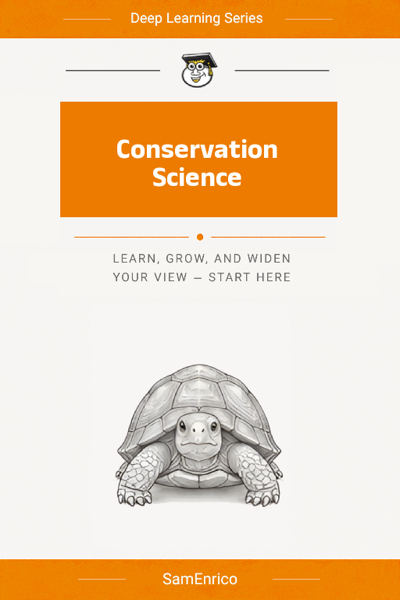
Non-FictionInformativeEducational
Conservation Science eBook
A Coursebook on Conservation Science
A Coursebook on Conservation Science
Formats
Free sample
Chapter 1: The Broken Compass--– In the summer of 1971, a young biologist named Daniel Janzen stood at the edge of a Costa Rican forest that was about to be burned for cattle pasture. He had calculated, with meticulous precision, that this particular patch of trees contained at least sixty-seven species of orchids found nowhere else on Earth. He had maps, data, and the full authority of his university credentials. He pleaded with the landowner. He offered alternatives.
He explained the science of extinction. The landowner listened patiently, then lit the match.That forest burned for three days. Janzen later wrote that he learned something in the smoke that no textbook could have taught him: conservation is not a battle between knowledge and ignorance. It is a battle between values. The landowner knew exactly what he was destroying.
He simply valued his cattle more than Janzen’s orchids. And on a human-dominated planet, that kind of value conflict is not an exception. It is the rule.This book begins with that fire because it illuminates the central dilemma of twenty-first-century conservation science. For most of its history, conservation operated under a quiet assumption: if we could just get the science right—if we could map biodiversity, calculate extinction risks, and demonstrate ecological value—then rational people would inevitably choose to protect nature. That assumption has failed.
We now have more data, more models, and more monitoring than Janzen could have dreamed of in 1971, and yet species are disappearing faster than ever. The problem is not a lack of information. The problem is that the old philosophical compasses of conservation—preserve pristine wilderness, maximize sustainable yield, save every species—no longer point in usable directions on a planet where every ecosystem bears human fingerprints.This chapter is called The Broken Compass because we need to be honest about that disorientation before we can learn to navigate without one. We will trace how conservation arrived at its current crisis of purpose, why the traditional goals of “nature for nature’s sake” and “nature for people” have both become insufficient, and what it means to practice conservation science in the Anthropocene—a world of shifting baselines, novel ecosystems, and unavoidable trade-offs. By the end, you will understand why this book rejects both apocalyptic despair and naive techno-optimism in favor of something harder but more honest: hopeful realism, the conviction that we cannot return to 1491, but we can intentionally design a biodiverse, functional, and just future.
And crucially, you will learn that hopeful realism does not mean saving everything. As we will see in Chapter 9, conservation triage—the painful but necessary act of choosing which species to prioritize—is not a betrayal of hope but its practical expression when resources are finite.The Two Fathers of Conservation and Their Unfinished War To understand where we are, we must understand where we came from. Modern conservation has two origin stories, and they have never fully reconciled.The first origin story belongs to John Muir, the Scottish-born naturalist who wandered the Sierra Nevada in the 1870s and fell into what he called “a sublime wilderness.” Muir believed that nature had intrinsic value—worth that existed independently of human use or benefit. He wrote that “going to the woods is going home,” that mountains were “God’s cathedrals,” and that the preservation of wild places was a moral imperative regardless of whether they produced timber, water, or tourist dollars. When he founded the Sierra Club in 1892, his slogan was simple: “Nothing dollarable is safe.” Muir’s conservation was preservationist, spiritual, and absolutist.
A dam in Hetch Hetchy Valley was not a trade-off; it was a sacrilege.The second origin story belongs to Gifford Pinchot, the first chief of the United States Forest Service. Pinchot was trained in forestry in France and Germany, where the dominant philosophy was scientific management: forests existed to produce timber, and the forester’s job was to maximize that output without destroying the underlying resource. Pinchot famously defined conservation as “the greatest good for the greatest number for the longest time.” His conservation was utilitarian, democratic, and deeply pragmatic. A dam on a wild river might be acceptable if it generated electricity for a growing city, provided that the river’s long-term productivity was maintained. Pinchot’s famous battle cry was not “preserve” but “use wisely.”For most of the twentieth century, American conservation oscillated between these two poles.
The National Park system was Muir’s legacy—places set aside for their grandeur, where logging and grazing were forbidden. The National Forest system was Pinchot’s—multiple-use lands where timber harvest, livestock grazing, and recreation were balanced. For a time, this dual system worked reasonably well, at least in wealthy nations with abundant land and relatively small populations.But both frameworks share a fatal assumption. They both presume the existence of a baseline—a “natural” state of ecosystems that existed before human disturbance, against which degradation could be measured. Muir’s wilderness needed to be kept “pure.” Pinchot’s sustainable yield needed to be calculated against an undamaged starting point.
And in the late twentieth century, that baseline began to dissolve.The Anthropocene: When the Map Changes In 2000, the atmospheric chemist Paul Crutzen stood at a scientific conference in Mexico and, in a moment of frustration, blurted out that the world was no longer in the Holocene—the warm interglacial period that had supported human civilization for twelve thousand years. He proposed a new name: the Anthropocene, the age of humans. The term spread like fire through a dry forest, not because Crutzen had discovered something new, but because he had named something that scientists had been noticing for decades.The evidence for the Anthropocene is now overwhelming. Humans have altered between one-third and one-half of the planet’s ice-free land surface. We have doubled the amount of nitrogen cycling through ecosystems through fertilizer production.
We have moved more sediment than all the world’s rivers combined. We have raised atmospheric carbon dioxide from 280 parts per million to over 420 parts per million. We have created entirely new geological materials, from plastics to concrete to altered soils. Microplastics now fall like rain in national parks. Lead and mercury from industrial activity are embedded in Arctic ice cores.
Even the deep ocean shows the signature of anthropogenic climate change.What does this mean for conservation science? It means that there is no “pristine” baseline to return to. Every ecosystem on Earth—from the Amazon rainforest to the Antarctic ice sheet—has been altered by human activity. The Amazon, often called the world’s greatest wilderness, was actively managed by Indigenous peoples for thousands of years before European contact. The Great Barrier Reef has been warming for decades.
The Serengeti’s animal populations are shaped by international tourism and climate patterns that trace back to European coal plants. To speak of “restoring” ecosystems to some prehuman ideal is to chase a ghost.This realization has produced something like a philosophical panic among conservationists. If there is no pristine nature to preserve, what exactly are we trying to save? And how do we know when we have succeeded?Shifting Baselines: The Generational Blindness One answer comes from the fisheries biologist Daniel Pauly…
This is the end of the free sample. Get the eBook to keep going. Buy now
About this book
Details
- Author
- Hirsch Caitlin
- Publisher
- SamEnrico
- Language
- English
- Genre
- Non-Fiction, Informative, Educational
- Released
- 2026-05-06
- Pages (approx.)
- 160
- Available as
- eBook, Audiobook

Read better in the ZLOADR app
Your eBooks on your phone or tablet. Sign in with your SamEnrico account and start reading.
More by Hirsch Caitlin
 The Upwork Profit MaximizerHirsch Caitlin$11.99
 Zoom Meeting Etiquette GuideHirsch Caitlin$11.99
 Twelve Step for Marijuana AddictionHirsch Caitlin$11.99
 Silent Meeting CuesHirsch Caitlin$11.99
 Kachin Camp To TexasHirsch Caitlin$11.99
 The Professor Meeting AnxietyHirsch Caitlin$11.99
 Teen Anticipatory GriefHirsch Caitlin$11.99
 Salt and Fat AddictionHirsch Caitlin$11.99
 Neck and Shoulder Tension Release CourseHirsch Caitlin$11.99
 The Great Train Heist: How a 19th-Century Con Artist Fooled an EmpireHirsch Caitlin$11.99
 Love Letters in the Attic: The Secret Correspondence of JFK and JackieHirsch Caitlin$11.99
 The Bone Hunters of the Gobi: When the Desert Yielded DinosaursHirsch Caitlin$11.99
You may also like
 Hong Kong Handover 1997Dunn Johnnie$11.99
 Zumba For Postnatal Recovery CourseNeal Christian$11.99
 Zumba for BeginnersLadner Nikia$11.99
 YouTube Comment Mining GuideHumes Pandora$12.99
 Worry Box MeditationCarlin Rudy$11.99
 Workplace Stress MeditationNguyen Lynn$11.99
 Workplace Stress and Sleep RepairHawley Ivory$11.99
 Workplace Perfectionism CureDelaney Jeffry$11.99
 Workplace Injustice Anger GuideWallen Isabelle$11.99
 Work Addiction and Burnout LinkGreenwood Ester$11.99
 Women in Yoga and WellnessBeattie Galina$11.99
 Women in Stand Up ComedyChun Evangeline$11.99