
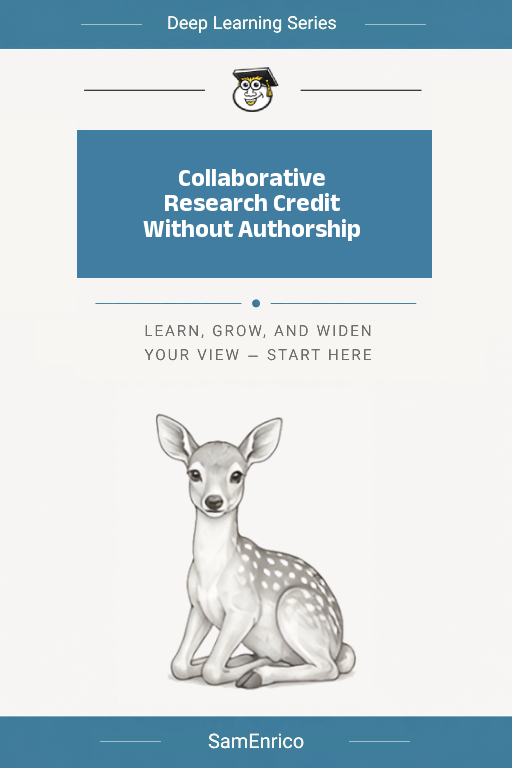
researchStudent's ShortcutCollaboration
Collaborative Research Credit Without Authorship
Document your contributions to group research even
by Bynum Isaura
Document your contributions to group research even when you're not a named author on papers.
Formats
About this book
Free sample
Chapter 1: The Gratitude Graveyard--Every researcher has stood in that graveyard. You know the one. It is the final paragraph of a published paper, tucked between the funding statement and the competing interests declaration. The heading is always the same: Acknowledgements. Inside, if you are lucky, your name appears in a string of others, often with a vague descriptor like “for technical assistance” or “for helpful discussions.” You scan the sentence, feel a brief flicker of recognition, and then close the PDF.
The paper goes into your CV under “Publications” – but your name is not there. It is under “Other Contributions,” if you list it at all. And no hiring committee has ever read an acknowledgement section looking for evidence of research excellence.This chapter is called The Gratitude Graveyard because that is precisely what the traditional acknowledgement section has become: a burial ground for the labor, skill, and creativity of the invisible workforce of science. It is a place where vital contributions go to die, unseen by promotion panels, funding agencies, and the citation metrics that govern academic careers. But before we can build a better system – and the rest of this book is dedicated to doing exactly that – we must first understand why the current system fails so systematically.Let me start with a story.
It is not a hypothetical case study or a anonymized example from a textbook. It is a real story, documented in the research literature and discussed in ethics committees around the world.The 470 Contributors Who Disappeared In 2010, a business strategy book called Business Model Generation became an international bestseller. It was visually stunning, practically useful, and collaborative in a way that few books had been before. The author, Alexander Osterwalder, invited readers to contribute ideas, case studies, and feedback through an open online platform. Nearly 470 people responded.
Their contributions ranged from small typo corrections to entire chapter drafts. When the book was published, Osterwalder did something unusual: he listed all 470 contributors on a single page, right after the table of contents.On the surface, this looked like generosity. He had not buried them in…
This is the end of the free sample. Get the eBook to keep going. Buy now
Contents
- Chapter 1
- Chapter 2
- Chapter 3
- Chapter 4
- Chapter 5
- Chapter 6
- Chapter 7
- Chapter 8
- Chapter 9
- Chapter 10
- Chapter 11
- Chapter 12
Details
- Author
- Bynum Isaura
- Publisher
- SamEnrico
- Language
- English
- Genre
- research, Student's Shortcut, Collaboration
- Released
- 2026-06-01
- Pages (approx.)
- 157
- Available as
- eBook, Audiobook

Read better in the ZLOADR app
Your eBooks on your phone or tablet. Sign in with your SamEnrico account and start reading.
More by Bynum Isaura
 Metta for Work StressBynum Isaura$11.99
 Rewire Your Inner VoiceBynum Isaura$11.99
 Anapanasati for Zoom FatigueBynum Isaura$11.99
 The Five Item Limit RuleBynum Isaura$11.99
 Reading Microexpressions Flash GuideBynum Isaura$11.99
 Carl Icahn ActivistBynum Isaura$11.99
 The Sanger Sequencing StoryBynum Isaura$11.99
 Whoopi Goldberg ViewBynum Isaura$11.99
 The Golden Voices: Black Opera’s Royal LegacyBynum Isaura$11.99
 The Yellow Jersey Heist: The Stolen Glory of the 1990s Tour de FranceBynum Isaura$11.99
 Introduction to Data Analytics and Business IntelligenceBynum Isaura$11.99
 Growing ColquhouniaBynum Isaura$11.99
You may also like
 Scientific Research On TM GuideMartens Nathanial$11.99
 Research Proposal Methodology Section MasteryPauley Debroah$11.99
 Research Proposal Appendix CompilationRaines Tyisha$11.99
 Academic Researcher Distraction GuideFord Virgil$11.99
 TM Research and ScienceCovert Nicki$11.99
 Social Anxiety Research ReviewRoberge Cole$11.99
 Research Proposal Significance Section GuideBock Tory$12.99
 Research Proposal Reviewer PsychologyLugo Tawanda$11.99
 Research Proposal Research Questions DesignLara Robbi$11.99
 Research Proposal References and CitationsPatten Shanice$11.99
 Research Proposal Mixed Methods DesignCameron Omega$11.99
 Research Proposal Data Management PlanAnderson Roberto$12.99