
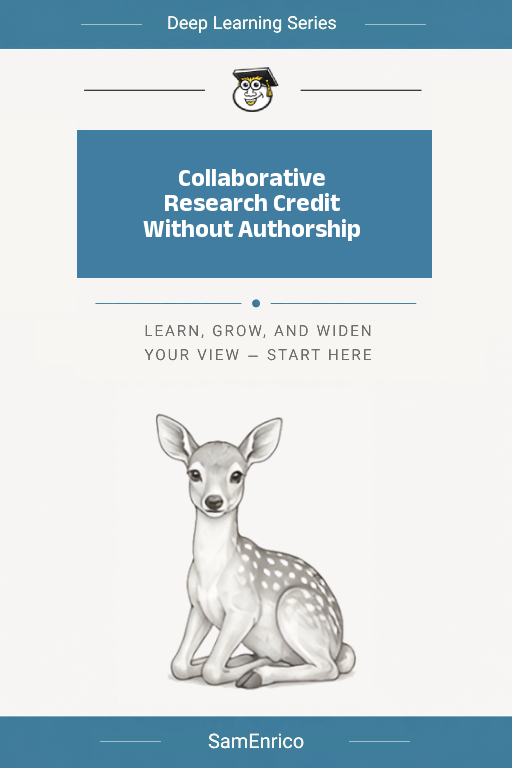
researchStudent's ShortcutCollaboration
Collaborative Research Credit Without Authorship eBook
Document your contributions to group research even
by Bynum Isaura
Document your contributions to group research even when you're not a named author on papers.
Formats
Free sample
Chapter 1: The Gratitude Graveyard--Every researcher has stood in that graveyard. You know the one. It is the final paragraph of a published paper, tucked between the funding statement and the competing interests declaration. The heading is always the same: Acknowledgements. Inside, if you are lucky, your name appears in a string of others, often with a vague descriptor like “for technical assistance” or “for helpful discussions.” You scan the sentence, feel a brief flicker of recognition, and then close the PDF.
The paper goes into your CV under “Publications” – but your name is not there. It is under “Other Contributions,” if you list it at all. And no hiring committee has ever read an acknowledgement section looking for evidence of research excellence.This chapter is called The Gratitude Graveyard because that is precisely what the traditional acknowledgement section has become: a burial ground for the labor, skill, and creativity of the invisible workforce of science. It is a place where vital contributions go to die, unseen by promotion panels, funding agencies, and the citation metrics that govern academic careers. But before we can build a better system – and the rest of this book is dedicated to doing exactly that – we must first understand why the current system fails so systematically.Let me start with a story.
It is not a hypothetical case study or a anonymized example from a textbook. It is a real story, documented in the research literature and discussed in ethics committees around the world.The 470 Contributors Who Disappeared In 2010, a business strategy book called Business Model Generation became an international bestseller. It was visually stunning, practically useful, and collaborative in a way that few books had been before. The author, Alexander Osterwalder, invited readers to contribute ideas, case studies, and feedback through an open online platform. Nearly 470 people responded.
Their contributions ranged from small typo corrections to entire chapter drafts. When the book was published, Osterwalder did something unusual: he listed all 470 contributors on a single page, right after the table of contents.On the surface, this looked like generosity. He had not buried them in an acknowledgements section; he had given them a full page. But here is what actually happened. When researchers later interviewed those 470 contributors, almost none of them felt recognized.
Why? Because a list of 470 names, presented alphabetically or by contribution type with no differentiation, becomes visual noise. The human brain cannot process that many names as individual credits. More importantly, none of those contributors could point to the book and say, “My work is on page 47, figure 3.” Their labor had been absorbed into a collective mass labeled “contributors.” In academic terms, they were ghost contributors – people who performed author-level work but received footnote-level credit.One contributor, who had written an entire case study that appeared as a two-page spread, told the researchers: “I didn’t expect authorship. But I also didn’t expect my name to be one of 470 in a font size so small I needed a magnifying glass to find myself.” Another contributor said: “I showed the book to my dean.
He said, ‘That’s nice. Now where are your peer-reviewed papers?’” The acknowledgement page, no matter how prominently placed, had no career currency.The Fandom That Built a Bestseller The second story is even more troubling because it involves exploitation disguised as community engagement. In 2011, the erotic romance novel Fifty Shades of Grey was published. Before it was a global phenomenon, it was a piece of fan fiction posted online under the title Master of the Universe. The author, E.L.
James, wrote the story within a vibrant online community of fan fiction readers and writers who provided detailed, line-by-line feedback on every chapter. This community – mostly women, mostly writing in their spare time – did not just offer encouragement. They edited grammar, suggested plot changes, flagged inconsistencies in character development, and helped refine dialogue.When James edited the fan fiction into a publishable novel, she removed the online version. The published book included an acknowledgements section that thanked the community in general terms: “To my online readers, who encouraged me every step of the way.” No individual names. No structural credit.
No royalties. The community had done the work of a developmental editor, a copy editor, and a sensitivity reader – all for free, in exchange for the social reward of being part of a creative process.The academic parallel is exact. Every day, graduate students post draft sections to lab Slack channels. Postdocs run statistical models for a senior colleague’s paper. Community advisory boards spend months shaping research questions.
Data managers clean and validate datasets that become the foundation of high-impact publications. And then, at the end, these contributors are thanked in a sentence or two – if they are thanked at all.Defining the Problem: Ghost Contributors vs. Ghost Authors Let me clarify two terms that will appear throughout this book, because understanding the distinction is the first step toward solving the problem.A ghost contributor is a person who performs work that meets the threshold for authorship under most journal guidelines – they contribute to the conception, design, data acquisition, analysis, or interpretation of the research – but is not listed as an author. Instead, their name appears only in the acknowledgements (if it appears anywhere). Ghost contributors are the invisible workforce of science.
They include the technician who optimizes the protocol, the statistician who runs the primary analysis, the community partner who shapes the research questions, and the data manager who builds the repository.A ghost author is the opposite. This is a person who is listed as an author on a paper but who did not contribute substantially to the work. Ghost authors are often senior academics – department chairs, division heads, or principal investigators – who are added to the author list as a courtesy, a gift, or a condition of access to resources. They are sometimes called “honorary authors” or “guest authors.” Their presence on the author list dilutes the credit that should go to the people who actually did the work.These two phenomena are two sides of the same coin. Ghost authorship inflates the author list with people who did little; ghost contributorship deflates the author list by excluding people who did much.
Together, they produce a credit system that is not merely inefficient but actively unjust.The Matthew Effect in Team Science The sociologist Robert K. Merton famously described the Matthew Effect in science, named after the biblical verse: “For to everyone who has, more will be given, and he will have an abundance. But from the one who has not, even what he has will be taken away.” In the context of scientific credit, the Matthew Effect means that the most senior, most famous, and most cited researchers accrue disproportionate credit for collaborative work, while junior and technical contributors receive disproportionately little.Consider a typical multi-author paper from a large biomedical research project. The first author is usually a graduate student or postdoc who did the day-to-day experiments and wrote the first draft. The last author is usually the principal investigator who secured funding, provided the lab space, and conceived the overall research question.
The middle authors include various specialists – a bioinformatician who analyzed the sequencing data, a statistician who ran the clinical…
This is the end of the free sample. Get the eBook to keep going. Buy now
About this book
Details
- Author
- Bynum Isaura
- Publisher
- SamEnrico
- Language
- English
- Genre
- research, Student's Shortcut, Collaboration
- Released
- 2026-06-01
- Pages (approx.)
- 157
- Available as
- eBook, Audiobook

Read better in the ZLOADR app
Your eBooks on your phone or tablet. Sign in with your SamEnrico account and start reading.
More by Bynum Isaura
 Metta for Work StressBynum Isaura$11.99
 Rewire Your Inner VoiceBynum Isaura$11.99
 Anapanasati for Zoom FatigueBynum Isaura$11.99
 The Five Item Limit RuleBynum Isaura$11.99
 Reading Microexpressions Flash GuideBynum Isaura$11.99
 Carl Icahn ActivistBynum Isaura$11.99
 The Sanger Sequencing StoryBynum Isaura$11.99
 Whoopi Goldberg ViewBynum Isaura$11.99
 The Golden Voices: Black Opera’s Royal LegacyBynum Isaura$11.99
 The Yellow Jersey Heist: The Stolen Glory of the 1990s Tour de FranceBynum Isaura$11.99
 Introduction to Data Analytics and Business IntelligenceBynum Isaura$11.99
 Growing ColquhouniaBynum Isaura$11.99
You may also like
 Scientific Research On TM GuideMartens Nathanial$11.99
 Research Proposal Methodology Section MasteryPauley Debroah$11.99
 Research Proposal Appendix CompilationRaines Tyisha$11.99
 Academic Researcher Distraction GuideFord Virgil$11.99
 TM Research and ScienceCovert Nicki$11.99
 Social Anxiety Research ReviewRoberge Cole$11.99
 Research Proposal Significance Section GuideBock Tory$12.99
 Research Proposal Reviewer PsychologyLugo Tawanda$11.99
 Research Proposal Research Questions DesignLara Robbi$11.99
 Research Proposal References and CitationsPatten Shanice$11.99
 Research Proposal Mixed Methods DesignCameron Omega$11.99
 Research Proposal Data Management PlanAnderson Roberto$12.99