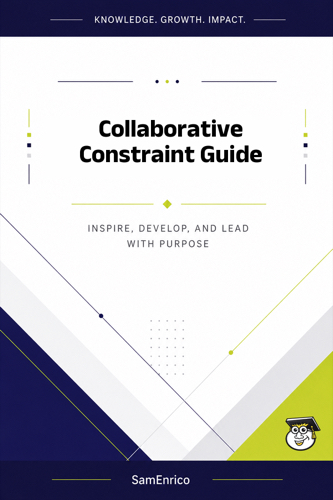
Collaborative Constraint Guide eBook
Uses artificial limitations to channel group creat
by Givens Jolyn
Uses artificial limitations to channel group creativity into innovative directions.
Formats
Free sample
Chapter 1: The Blank Canvas Lie--–- In 2007, a team of twelve engineers at a famous Silicon Valley company was given what every creative team claims to want: unlimited budget, no deadline, and complete freedom. They were tasked with redesigning the core user interface for a product used by half a billion people. The vice president gathered them in a gleaming conference room with floor-to-ceiling windows, a fully stocked kitchenette, and a whiteboard the size of a garage door. He wrote three words on that whiteboard: “Anything is possible.” Then he left.For six months, that team produced nothing.Well, that is not entirely true. They produced forty-seven different direction documents.
They produced eleven competing prototypes. They produced three hundred hours of debate about whether the button should be blue or green or maybe a shade of teal that one designer’s cousin had used on a portfolio website. They produced analysis paralysis, decision fatigue, and something that looked remarkably like depression. The project was quietly canceled. The engineers were reassigned.
The vice president never mentioned the initiative again.Across town, in a cramped converted garage with a leaking water heater, a different team was building the same type of product. They had no budget. They had a deadline of eight weeks because their seed funding would run out. They had a constraint that seemed absurd: the entire user interface had to work on a screen the size of a credit card because their first customer had demanded a mobile solution. They also had a self-imposed rule that no meeting could last longer than fifteen minutes, and that every idea had to be drawn on a single sticky note.They launched on time.
Their product was acquired eighteen months later for nine figures.This is the paradox that most teams never learn until it is too late: unlimited freedom does not unlock creativity. It destroys it.The Intoxication of Open Space There is a seductive myth embedded deep in the culture of modern work. It whispers that creativity requires liberation from constraints, that rules are the enemy of innovation, that the best ideas emerge when we remove all barriers and let genius flow unbounded. This myth is taught in business schools, repeated in leadership seminars, and enshrined in the architecture of open-plan offices with their high ceilings and their blank white walls and their implicit promise that today, finally, today someone will have a breakthrough.The myth is wrong.What actually happens when a team faces limitless choice is something psychologists call choice overload. First documented in a famous 2000 study by Sheena Iyengar and Mark Lepper, choice overload describes the paradox that while people say they want more options, having more options leads to lower satisfaction, higher anxiety, and a dramatically reduced likelihood of making any decision at all.
In Iyengar's original experiment, shoppers at a gourmet food market were offered samples of jam. One group saw a display with six flavors. Another group saw a display with twenty-four flavors. The display with more flavors attracted more attention—people stopped and looked. But shoppers who saw the twenty-four-flavor display were one-tenth as likely to actually buy jam as those who saw only six options.This is not a quirk of consumer behavior.
This is a fundamental feature of how the human brain processes choice under uncertainty. When the number of possible paths exceeds our cognitive bandwidth, we freeze. We do not become more creative. We become more anxious, more conservative, and more likely to fall back on the safest possible option—which is usually the option that has worked before, which is usually not innovative at all.Now multiply this effect by the dynamics of a team.The Three Killers of Group Creativity When a team faces an open-ended problem with no constraints, three distinct pathologies emerge. Understanding these pathologies is the first step toward building the box that sets your team free.Pathology One: Decision Fatigue The human brain has a finite capacity for making choices.
Every decision, from what to eat for breakfast to which strategic direction to pursue, depletes a psychological resource that researchers call ego depletion. When a team faces an unbounded problem—"redesign the user interface," "create a new marketing campaign," "invent a product for a market we have not yet identified"—the sheer number of decisions required is exhausting before any real work begins.Should we start with research or with ideation? Should we focus on mobile or desktop? Should we prioritize new customers or existing ones? Should we use agile or waterfall or something in between?
Each of these questions is reasonable. Each of them requires a decision. But each decision consumes cognitive energy that will not be available for actual creative work.The result is a team that spends its first three meetings just deciding how to decide. By the time they finally start generating ideas, they are already mentally depleted. They default to the obvious, the safe, the previously successful.
They do not innovate. They replicate.Pathology Two: Free-Riding Social Loafing In the 1970s, a psychologist named Bibb Latané conducted a series of experiments that revealed a disturbing feature of group dynamics. He asked participants to clap and cheer as loudly as they could. When people clapped alone, they produced a certain level of noise. When they clapped in groups, you might expect the noise to increase proportionally.
It did not. In groups of six, people produced less than half the per-person noise they produced alone.Latané called this social loafing—the tendency for individuals to exert less effort when working collectively than when working individually. The mechanism is simple: when responsibility is distributed, accountability evaporates. In a team facing an unbounded problem, social loafing is catastrophic. Because there is no clear definition of success, no timeline, no resource constraint, any individual can reasonably say to themselves, "Someone else will figure it out."The tragedy is that social loafing is often invisible.
No one is actively shirking. Everyone shows up to meetings. Everyone nods along. But the intensity of effort, the willingness to push through difficulty, the stubborn refusal to accept a mediocre idea—these are distributed so thinly across the group that they effectively vanish.Pathology Three: Analysis Paralysis The third pathology is the most visible and the most frustrating. Analysis paralysis occurs when a team becomes so focused on evaluating options that they never actually choose one.
They gather more data. They run another survey. They schedule a follow-up meeting to discuss the findings from the previous follow-up meeting.Analysis paralysis is driven by a rational fear: what if we choose wrong? When there are no constraints, the cost of a wrong choice seems infinite because the alternatives are infinite. If we choose direction A, we are forever closing the door on directions B through Z.
The team becomes trapped in what decision theorists call the maximizing mindset—the belief that the optimal choice exists and that we have an obligation to find it.The maximizing mindset is the enemy of creativity because creativity requires commitment. You cannot create a prototype, test an idea, or launch a product without choosing a path. Analysis paralysis is a form of procrastination disguised as rigor.…
This is the end of the free sample. Get the eBook to keep going. Buy now
About this book
Details
- Author
- Givens Jolyn
- Publisher
- SamEnrico
- Language
- English
- Genre
- Non-Fiction, Self-Help, Creative Constraints
- Released
- 2026-06-11
- Pages (approx.)
- 145
- Available as
- eBook, Audiobook

Read better in the ZLOADR app
Your eBooks on your phone or tablet. Sign in with your SamEnrico account and start reading.
More by Givens Jolyn
 Senior Affirmation GuideGivens Jolyn$11.99
 Golf Hypnosis For Lower ScoresGivens Jolyn$11.99
 The Dubai Culture GuideGivens Jolyn$11.99
 Cold Case Dental IDGivens Jolyn$11.99
 Tuina Chinese MassageGivens Jolyn$11.99
 Acupuncture for Skin HealthGivens Jolyn$11.99
 Self Hypnosis for OverthinkingGivens Jolyn$11.99
 The Shadow of the White Lotus: China's First Serial Killer and His Deadly LegacyGivens Jolyn$11.99
 Siamese Fighting Fish: Betta CareGivens Jolyn$11.99
 How to Produce DehumidifiersGivens Jolyn$11.99
 A Collector's Handbook to the Volvo 145sGivens Jolyn$11.99
 Internet and Power Reliability GuideGivens Jolyn$12.99