
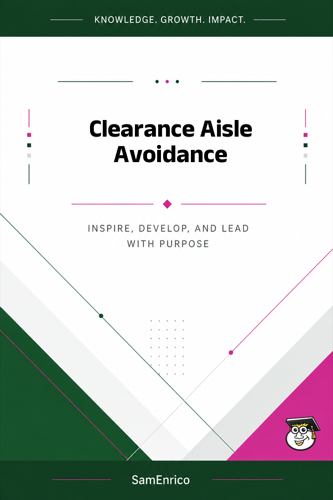
Clearance Aisle Avoidance eBook
Skip sales racks that trigger false bargains.
Skip sales racks that trigger false bargains.
Formats
Free sample
Chapter 1: The Ghost Price Trick--The moment you see a red clearance tag, something invisible happens inside your skull. Before you have consciously registered the item, before you have asked whether you need it, before your rational brain has said a single word, your ancient reward circuitry has already fired. A signal races from your visual cortex to your nucleus accumbens, releasing a small flood of dopamine. You are not yet happy. You are not yet satisfied.
You are, for the next few seconds, chemically primed to want something—not the thing itself, but the idea of a bargain. This is the ghost price trick, and it is the single most effective psychological manipulation in retail history. It works because it bypasses logic entirely, speaking directly to a part of your brain that evolved to evaluate resources in a world without price tags, without stores, and without marketers. And once you understand how it works, you can never unsee it. This chapter dissects the illusion of the original price, reveals how manufacturers and retailers collude to create fake anchors, and gives you a simple mathematical weapon—cost per use—that cuts through the trick like a scalpel.The Anatomy of a Fake Anchor Imagine you are walking through a home goods store.
You did not come here for storage bins, but there they are: a stack of clear plastic containers with red tags. The tag reads “Was $24.99, Now $7.99.” Your brain immediately performs a calculation—$17 saved, 68 percent off—and that calculation feels like math. It feels objective. But it is not. The “was” price is almost certainly a fiction.
Retailers routinely inflate original prices or use manufacturer-suggested retail prices (MSRPs) that no store actually charges. In some cases, the “was” price was never in effect at that store. In others, it applied for a single day months ago. In many cases, the item was manufactured specifically for the clearance cycle, with a fake original price printed on the tag before it ever touched a shelf. The technique is called anchoring, and it was first documented by the psychologists Amos Tversky and Daniel Kahneman in a series of experiments that changed economics forever.
In one famous study, they spun a wheel of fortune in front of participants and asked them to estimate the percentage of African nations in the United Nations. The wheel was rigged to land on either 10 or 65. Participants who saw 10 guessed around 25 percent. Participants who saw 65 guessed around 45 percent. A completely random number had anchored their judgment.
The clearance anchor works the same way: your brain grabs the first number it sees ($24.99) and treats it as the truth, then measures everything else against it.The deception goes deeper. Many retailers use a practice called “price partitioning,” where the original price is displayed prominently and the sale price is displayed in smaller type. This visual hierarchy reinforces the anchor: big number equals important, small number equals opportunity. Some stores also use a tactic called “strikethrough pricing,” where the original price is printed, then physically crossed out with a line. The strikethrough creates a sense of violence against the old price, as if the retailer is doing you a favor by destroying it.
Your brain interprets the strikethrough as evidence of a one-time event, a markdown that will not last. But strikethrough pricing is often permanent. The item was never meant to sell at the crossed-out price. The strike is theater. The entire clearance section is theater.
And you have been buying tickets.The MSRP Myth The Manufacturer’s Suggested Retail Price is one of the most misunderstood numbers in commerce. Most consumers assume it represents something real—the price the manufacturer thinks the item is worth, or the price a typical store would charge. Neither is true. The MSRP is a marketing tool, set intentionally high to create room for “discounts” that make the consumer feel smart. In many industries, the MSRP is set at three to five times the manufacturing cost.
That markup covers not only production but also distribution, marketing, returns, and—critically—the illusion of savings. Consider a clearance item with an MSRP of $100 and a clearance price of $30. You think you saved $70. The retailer knows they paid $20 to manufacture and ship it. They are thrilled with a $10 profit and a customer who feels like a bargain-hunting genius.
The only person who lost was you, because you spent $30 on something you did not plan to buy.The furniture industry provides a particularly egregious example. Many furniture stores run perpetual “going out of business” sales that last for years. The MSRP on a sofa might be $1,200. The “clearance” price is $599. The store has never sold that sofa for $1,200, not once.
The sofa cost $300 to make. The store is making a 100 percent profit and calling it a bargain. This is not illegal in most jurisdictions, provided the store can show that the MSRP was at some point offered somewhere, by someone, for some duration. Consumer protection laws have largely failed to keep pace with anchoring tactics. The Federal Trade Commission requires that a “was” price be the actual price at which the item was offered for a reasonable period, but “reasonable” is loosely defined, and enforcement is rare.
A 2018 investigation by the Consumer Federation of America found that 97 percent of “was/now” clearance tags in major retail chains could not be verified as accurate. Ninety-seven percent. That is not a rounding error. That is the system working exactly as designed.The Neuroscience of Discount Perception Your brain does not process discounts rationally. It processes them emotionally, then rationalizes them after the fact.
Neuroimaging studies have shown that when a consumer sees a discount, the insula—a region associated with pain and aversion—becomes less active than when they see a full price. The discount literally hurts less. But the same studies show that the ventral striatum, a reward center, lights up more brightly for discounted items than for full-price items of identical quality. Your brain is not evaluating the item. It is evaluating the difference between two numbers, and that difference feels good regardless of whether the numbers are real.This effect is amplified by a phenomenon called the “left-digit effect.” When a price drops from $3.00 to $2.99, your brain registers the left digit changing from 3 to 2, and that feels like a meaningful drop even though the difference is one cent.
Clearance pricing exploits this mercilessly. A $19.99 clearance item feels significantly cheaper than a $20.01 item, even though the difference is two cents. The left digit is a cognitive shortcut that overrides rational calculation. Retailers know this, which is why clearance prices almost always end in .99, .97, or .88. Those endings are not accidental.
They are engineered to maximize the left-digit effect while signaling a “marked down” aesthetic.The most pernicious aspect of discount perception is something economists call “transaction utility.” When you buy something, you experience two kinds of utility: acquisition utility (the value of the item itself) and transaction utility (the pleasure of getting a good deal). For clearance items, transaction utility often dwarfs acquisition utility. You are not buying the storage bin because you need a storage bin. You are buying the feeling of having saved $17. That feeling is real—it is…
This is the end of the free sample. Get the eBook to keep going. Buy now
About this book
Details
- Author
- Ripley Melina
- Publisher
- SamEnrico
- Language
- English
- Genre
- Non-Fiction, Self-Help, Sales Avoidance
- Released
- 2026-06-09
- Pages (approx.)
- 144
- Available as
- eBook, Audiobook

Read better in the ZLOADR app
Your eBooks on your phone or tablet. Sign in with your SamEnrico account and start reading.
More by Ripley Melina
 Constipation Relief On MATRipley Melina$11.99
 The Abraham Lincoln EmancipationRipley Melina$11.99
 Listening For Trauma SurvivorsRipley Melina$11.99
 The Clockwork Cosmos: Galileo, Kepler, and the Birth of Modern ScienceRipley Melina$11.99
 Learn to Play the RyutekiRipley Melina$11.99
 How to Start a Fish Eater Business (Beginners Guide)Ripley Melina$11.99
 Debugging with AI AssistantsRipley Melina$12.99
 Devops ArchitectRipley Melina$11.99