
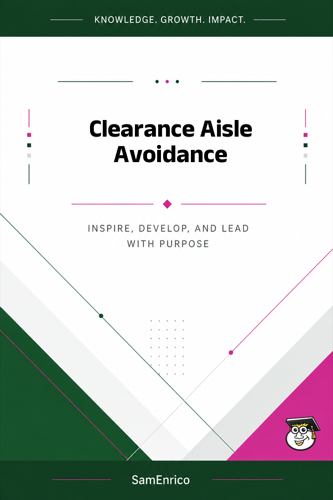
Clearance Aisle Avoidance Audiobook
Skip sales racks that trigger false bargains.
Skip sales racks that trigger false bargains.
Formats
Free sample
Chapter 1: The Ghost Price Trick--The moment you see a red clearance tag, something invisible happens inside your skull. Before you have consciously registered the item, before you have asked whether you need it, before your rational brain has said a single word, your ancient reward circuitry has already fired. A signal races from your visual cortex to your nucleus accumbens, releasing a small flood of dopamine. You are not yet happy. You are not yet satisfied.
You are, for the next few seconds, chemically primed to want something—not the thing itself, but the idea of a bargain. This is the ghost price trick, and it is the single most effective psychological manipulation in retail history. It works because it bypasses logic entirely, speaking directly to a part of your brain that evolved to evaluate resources in a world without price tags, without stores, and without marketers. And once you understand how it works, you can never unsee it. This chapter dissects the illusion of the original price, reveals how manufacturers and retailers collude to create fake anchors, and gives you a simple mathematical weapon—cost per use—that cuts through the trick like a scalpel.The Anatomy of a Fake Anchor Imagine you are walking through a home goods store.
You did not come here for storage bins, but there they are: a stack of clear plastic containers with red tags. The tag reads “Was $24.99, Now $7.99.” Your brain immediately performs a calculation—$17 saved, 68 percent off—and that calculation feels like math. It feels objective. But it is not. The “was” price is almost certainly a fiction.
Retailers routinely inflate original prices or use manufacturer-suggested retail prices (MSRPs) that no store actually charges. In some cases, the “was” price was never in effect at that store. In others, it applied for a single day months ago. In many cases, the item was manufactured specifically for the clearance cycle, with a fake original price printed on the tag before it ever touched a shelf. The technique is called anchoring, and it was first documented by the psychologists Amos Tversky and Daniel Kahneman in a series of experiments that changed economics forever.
In one famous study, they spun a wheel of fortune in front of participants and asked them to estimate the percentage of African nations in the United Nations. The wheel was rigged to land on either 10 or 65. Participants…
This is the end of the free sample. Get the Audiobook to keep going. Buy now
About this book
Details
- Author
- Ripley Melina
- Publisher
- SamEnrico
- Language
- English
- Genre
- Non-Fiction, Self-Help, Sales Avoidance
- Released
- 2026-06-09
- Pages (approx.)
- 144
- Available as
- eBook, Audiobook

Listen in the VoxFlicks app
Audiobooks and audio dramas wherever you go. Sign in with your SamEnrico account and press play.
More by Ripley Melina
 Constipation Relief On MATRipley Melina$11.99
 The Abraham Lincoln EmancipationRipley Melina$11.99
 Listening For Trauma SurvivorsRipley Melina$11.99
 The Clockwork Cosmos: Galileo, Kepler, and the Birth of Modern ScienceRipley Melina$11.99
 Learn to Play the RyutekiRipley Melina$11.99
 How to Start a Fish Eater Business (Beginners Guide)Ripley Melina$11.99
 Debugging with AI AssistantsRipley Melina$12.99
 Devops ArchitectRipley Melina$11.99