
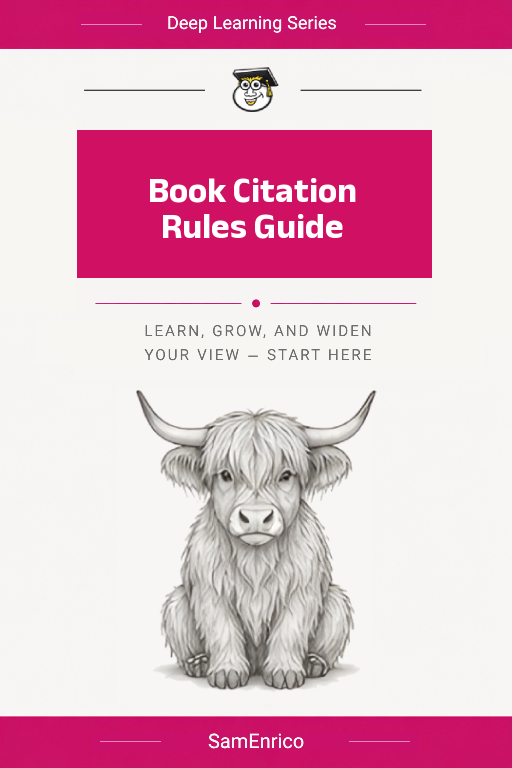
Book Citation Rules Guide
Cite print ebooks and chapters across all major ci
by Tejada Dina
Cite print ebooks and chapters across all major citation styles.
Formats
About this book
Free sample
Chapter 1: Academic Tribes...-- Every student remembers the moment. You are staring at your professor’s feedback on a paper you worked on for weeks. The grade is a B-plus. The comment in the margin, circled in red ink three times, says simply: “Citation style?” You have no idea what that means. You used citations.
You put the author names and the dates and the page numbers. What more does this person want?That moment—the moment of confusion, frustration, and quiet panic—is why this book exists. And that moment is almost certainly not your fault. No one ever taught you that citation styles are not interchangeable. No one explained that the way you cite a book in an English class would get you failed in a psychology class.
No one told you that professors in different departments are looking for entirely different things when they scan your references. That silence, that unspoken set of assumptions about what you should already know, ends right here.This chapter is called “Academic Tribes” because that is precisely what we are dealing with. Universities are not single communities with a single set of rules. They are collections of tribes—disciplines with their own histories, their own values, their own rituals, and their own citation styles. Understanding those tribes is the first and most important step to mastering citations.
Once you understand why a historian cites sources differently from a psychologist, the rules stop feeling arbitrary. They start making sense. And when they make sense, you stop losing points.Let us begin with a fundamental truth that no citation manual will ever tell you directly: citation styles are not about grammar. They are about authority. Every time you cite a source, you are making a claim about what kind of evidence counts as trustworthy.
The way you format that citation is a signal to your reader about which academic tribe you belong to and which rules of evidence you are playing by. Get the format wrong, and you are sending the wrong signal. You are telling a psychologist that you think like a…
This is the end of the free sample. Get the eBook to keep going. Buy now
Contents
- Chapter 1
- Chapter 2
- Chapter 3
- Chapter 4
- Chapter 5
- Chapter 6
- Chapter 7
- Chapter 8
- Chapter 9
- Chapter 10
- Chapter 11
- Chapter 12
Details
- Author
- Tejada Dina
- Publisher
- SamEnrico
- Language
- English
- Genre
- Non-Fiction, Student's Shortcut
- Released
- 2026-05-30
- Pages (approx.)
- 135
- Available as
- eBook, Audiobook

Read better in the ZLOADR app
Your eBooks on your phone or tablet. Sign in with your SamEnrico account and start reading.
More by Tejada Dina
 Letter Of Intent Validation GuideTejada Dina$11.99
 Talking About Prenuptial AgreementsTejada Dina$11.99
 Everett DirksenTejada Dina$11.99
 Workplace Stress App ToolkitTejada Dina$11.99
 Habit Apps GuideTejada Dina$11.99
 Carson Cancer BattleTejada Dina$11.99
 Dream Incubation for HealingTejada Dina$11.99
 Bipolar Pharmacogenomics PrimerTejada Dina$11.99
 Gig Economy Burnout GuideTejada Dina$11.99
 The Vanishing Act: The Disappearance of the Mary CelesteTejada Dina$11.99
 Tangaroa’s Deep: The Birth of the Ocean’s SongTejada Dina$11.99
 The Jade Serpent's Lament: How a Dragon's Tears Shaped the YangtzeTejada Dina$11.99
You may also like
 LSE Online Program LengthAgee Letisha$11.99
 Harvard Extension School for Working AdultsRoush Yer$11.99
 LSE Online Reading ListAshford Ludivina$11.99
 LSE Online Language RequirementsWhitten Daphine$11.99
 LSE Online Class SizeHughey Garret$11.99
 LSE Online Alumni MentorshipWild Lyla$11.99
 London School of Economics Alumni NetworkDutton Chantal$11.99
 Harvard Extension School Student SupportCantrell Christene$11.99
 Harvard Extension School Library AccessSantana Adah$11.99
 Harvard Extension School Degree CompletionBray Wyatt$11.99
 Harvard Extension School Course AuditingAbbott Craig$11.99
 Harvard Extension School Extension DiplomaNew Joane$11.99