
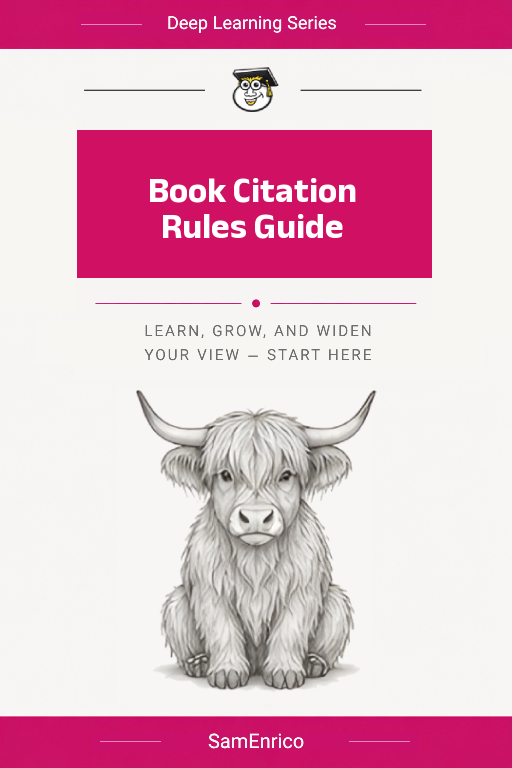
Book Citation Rules Guide eBook
Cite print ebooks and chapters across all major ci
by Tejada Dina
Cite print ebooks and chapters across all major citation styles.
Formats
Free sample
Chapter 1: Academic Tribes...-- Every student remembers the moment. You are staring at your professor’s feedback on a paper you worked on for weeks. The grade is a B-plus. The comment in the margin, circled in red ink three times, says simply: “Citation style?” You have no idea what that means. You used citations.
You put the author names and the dates and the page numbers. What more does this person want?That moment—the moment of confusion, frustration, and quiet panic—is why this book exists. And that moment is almost certainly not your fault. No one ever taught you that citation styles are not interchangeable. No one explained that the way you cite a book in an English class would get you failed in a psychology class.
No one told you that professors in different departments are looking for entirely different things when they scan your references. That silence, that unspoken set of assumptions about what you should already know, ends right here.This chapter is called “Academic Tribes” because that is precisely what we are dealing with. Universities are not single communities with a single set of rules. They are collections of tribes—disciplines with their own histories, their own values, their own rituals, and their own citation styles. Understanding those tribes is the first and most important step to mastering citations.
Once you understand why a historian cites sources differently from a psychologist, the rules stop feeling arbitrary. They start making sense. And when they make sense, you stop losing points.Let us begin with a fundamental truth that no citation manual will ever tell you directly: citation styles are not about grammar. They are about authority. Every time you cite a source, you are making a claim about what kind of evidence counts as trustworthy.
The way you format that citation is a signal to your reader about which academic tribe you belong to and which rules of evidence you are playing by. Get the format wrong, and you are sending the wrong signal. You are telling a psychologist that you think like a historian, or telling a literary critic that you think like a scientist. That is not a small error. That is a category mistake.So let us meet the four major tribes.The APA Tribe The first tribe, and the one you are most likely to encounter if you are in the social sciences, education, nursing, or psychology, is the APA tribe.
APA stands for the American Psychological Association, and its citation style is the product of a discipline that cares deeply about one thing above all others: recency.Think about what psychologists study. They study human behavior, which changes across time. They study treatments and interventions, which are constantly being refined. A psychology paper from 1985 that claims to have found an effective treatment for depression is not necessarily wrong, but it is almost certainly obsolete. New research has refined, challenged, or replaced it.
So when you cite a source in APA style, the most important piece of information is the date. That is why APA puts the date right after the author’s name, in parentheses, where you cannot miss it. Smith (2024) is more valuable to an APA reader than Jones (1999).But the APA tribe cares about more than just dates. This tribe also cares about precision and replicability. APA style requires that you provide enough information for another researcher to find your exact source and verify your claims.
That is why APA is obsessive about DOIs (Digital Object Identifiers) and page numbers for direct quotes. It is also why APA has extremely detailed rules about headings, tables, figures, and statistics formatting. The entire style is designed to make research transparent and reproducible.If you are in education, psychology, nursing, social work, communication studies, business, or any of the health sciences, APA is almost certainly your tribe. Some engineering and computer science fields also use APA or a close variant. The rule of thumb: if your discipline conducts experiments on human subjects or surveys living populations, you are probably in the APA tribe.The MLA Tribe The second tribe could not be more different.
MLA, which stands for the Modern Language Association, dominates the humanities—literature, film, philosophy, rhetoric, composition, and sometimes history (though history has its own complicated relationship with Chicago, as we will see). Where APA worships recency, MLA worships the text itself.Think about what a literary scholar studies. She studies Shakespeare’s Hamlet, written around 1600. The date matters—of course it matters—but the play has not changed in four centuries. What matters to the literary scholar is the specific location in the text where a particular idea appears.
That is why MLA uses author-page parenthetical citations. When you write (Shakespeare 52), you are telling your reader: go to page 52 of the edition I have listed in my works cited, and you will find the exact passage I am referencing. The date is secondary because the authority of the source comes from the enduring text, not from its place on a timeline.The MLA tribe also cares deeply about the distinction between the author’s original work and the reader’s interpretation. That is why MLA uses signal phrases like “Smith argues” or “Jones claims” rather than just dropping a parenthetical citation at the end of a sentence. The signal phrase keeps the author front and center, which is appropriate for a discipline that treats authors as creative agents rather than as data points.If you are in literature, film studies, creative writing, cultural studies, rhetoric, or any field that analyzes texts as artistic or rhetorical artifacts, you are likely in the MLA tribe.
Philosophy is a hybrid—many philosophy journals use MLA or a close variant, but some prefer Chicago. The rule of thumb: if you spend your time interpreting the meaning of existing texts rather than generating new data, you are probably in the MLA tribe.The Chicago Tribe The third tribe is the oldest and, in some ways, the most complex. The Chicago Manual of Style is not one style but two, and understanding the difference is crucial. Chicago offers Notes-Bibliography (often called Chicago NB or simply “Chicago style” in history departments) and Author-Date (which looks similar to APA but with different punctuation).Chicago Notes-Bibliography is the standard for history and many humanities disciplines outside of literature. It uses superscript numbers in the text that correspond to footnotes or endnotes, where the full citation appears.
This system has one overwhelming advantage for historians: it allows for commentary. In a footnote, you do not just cite your source; you can also explain it, qualify it, or argue with it. You can write something like: “Smith argues X, but I have found archival evidence that contradicts him on this point.” That kind of scholarly conversation is impossible in APA or MLA, where citations are stripped of any interpretive content.Historians love footnotes because historians love evidence. The discipline of history is built on primary sources—letters, diaries, government records, newspaper archives. A historian needs to show her reader not just what she claims but where she found every piece of evidence.
Footnotes allow her to do that without cluttering the main text. The main text tells the story; the footnotes prove…
This is the end of the free sample. Get the eBook to keep going. Buy now
About this book
Details
- Author
- Tejada Dina
- Publisher
- SamEnrico
- Language
- English
- Genre
- Non-Fiction, Student's Shortcut
- Released
- 2026-05-30
- Pages (approx.)
- 135
- Available as
- eBook, Audiobook

Read better in the ZLOADR app
Your eBooks on your phone or tablet. Sign in with your SamEnrico account and start reading.
More by Tejada Dina
 Letter Of Intent Validation GuideTejada Dina$11.99
 Talking About Prenuptial AgreementsTejada Dina$11.99
 Everett DirksenTejada Dina$11.99
 Workplace Stress App ToolkitTejada Dina$11.99
 Habit Apps GuideTejada Dina$11.99
 Carson Cancer BattleTejada Dina$11.99
 Dream Incubation for HealingTejada Dina$11.99
 Bipolar Pharmacogenomics PrimerTejada Dina$11.99
 Gig Economy Burnout GuideTejada Dina$11.99
 The Vanishing Act: The Disappearance of the Mary CelesteTejada Dina$11.99
 Tangaroa’s Deep: The Birth of the Ocean’s SongTejada Dina$11.99
 The Jade Serpent's Lament: How a Dragon's Tears Shaped the YangtzeTejada Dina$11.99
You may also like
 Hong Kong Handover 1997Dunn Johnnie$11.99
 Zumba For Postnatal Recovery CourseNeal Christian$11.99
 Zumba for BeginnersLadner Nikia$11.99
 YouTube Comment Mining GuideHumes Pandora$12.99
 Worry Box MeditationCarlin Rudy$11.99
 Workplace Stress MeditationNguyen Lynn$11.99
 Workplace Stress and Sleep RepairHawley Ivory$11.99
 Workplace Perfectionism CureDelaney Jeffry$11.99
 Workplace Injustice Anger GuideWallen Isabelle$11.99
 Work Addiction and Burnout LinkGreenwood Ester$11.99
 Women in Yoga and WellnessBeattie Galina$11.99
 Women in Stand Up ComedyChun Evangeline$11.99