
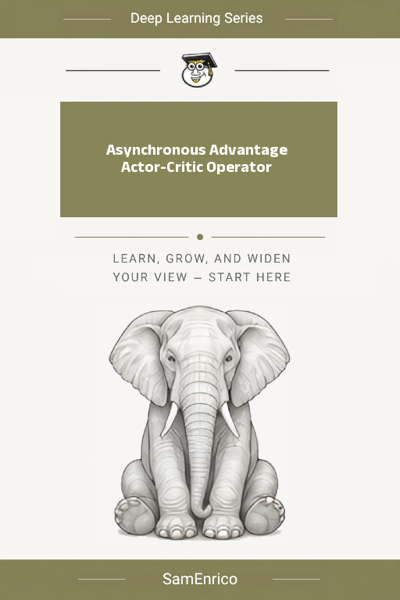
Non-FictionInformativeEducational
Asynchronous Advantage Actor-Critic Operator
A Coursebook on Asynchronous Advantage Actor-Criti
by Fisk Marcelo
A Coursebook on Asynchronous Advantage Actor-Critic Operator
Formats
About this book
Free sample
Chapter 1: The Two Deaths--–- In the winter of 2016, two algorithms died. The first was Quick Draw, a production recommendation engine at a mid-sized e-commerce company that had worked flawlessly for eighteen months. Then, without warning, it stopped recommending anything at all. Not bad recommendations—no recommendations. The product team gathered around a dashboard showing flatlines where healthy oscillations once danced.
The second death was quieter: a promising autonomous navigation system that had mastered a simulated warehouse environment, earning praise in a conference paper, only to freeze completely when deployed on real hardware with continuous steering controls.These were not bugs in the conventional sense. No null pointer exceptions. No memory leaks. No obvious typos in the loss functions. These were architectural deaths—the kind that occur when an algorithm meets a problem it was never designed to solve, and rather than fail gracefully, it simply...
stops learning.The engineers who built Quick Draw had used DQN, Deep Mind's celebrated breakthrough that had mastered Atari games with superhuman proficiency. Their logic was impeccable: if DQN can learn to play Breakout, surely it can learn to recommend products. What they discovered, too late, was that DQN works beautifully when actions are discrete and few—left, right, fire, jump. It fails catastrophically when you need to select a continuous value like a recommendation score threshold, a steering angle, or a torque setting. The action space of the real world is not a menu.
It is a dial, a slider, an infinite spectrum of possibilities between zero and one.The robotics team made a different mistake. They had used REINFORCE, the classic policy gradient method that directly optimizes the policy function without needing a value estimator. On paper, REINFORCE handles continuous actions elegantly—the policy outputs the parameters of a probability distribution over actions. In practice, REINFORCE suffers from variance so high that it resembles random search more than learning. A single lucky episode can push the policy in a completely wrong direction.
A single unlucky episode can undo weeks of training. Their warehouse robot worked in simulation because simulation rewards had no…
This is the end of the free sample. Get the eBook to keep going. Buy now
Contents
- Chapter 1
- Chapter 2
- Chapter 3
- Chapter 4
- Chapter 5
- Chapter 6
- Chapter 7
- Chapter 8
- Chapter 9
- Chapter 10
- Chapter 11
- Chapter 12
Details
- Author
- Fisk Marcelo
- Publisher
- SamEnrico
- Language
- English
- Genre
- Non-Fiction, Informative, Educational
- Released
- 2026-05-04
- Pages (approx.)
- 149
- Available as
- eBook, Audiobook

Read better in the ZLOADR app
Your eBooks on your phone or tablet. Sign in with your SamEnrico account and start reading.
More by Fisk Marcelo
 Sleep Meditation for InfantsFisk Marcelo$11.99
 Physical Exercise NeuroprotectionFisk Marcelo$11.99
 Public Speaking Assertiveness GuideFisk Marcelo$11.99
 Lonely Expat Connection GuideFisk Marcelo$11.99
 The Social Creative AccountabilityFisk Marcelo$11.99
 Verdict of the Sphinx: How an Ancient Judge Solved a Murder That Stumped Modern ForensicsFisk Marcelo$11.99
 How to Start a First Aid Boxes (wholesale) Business (Beginners Guide)Fisk Marcelo$11.99
 Learn to Play the BawuFisk Marcelo$11.99
 Category Based Express EntryFisk Marcelo$12.99
 Pre Launch Community ToolsFisk Marcelo$12.99
You may also like
 Hong Kong Handover 1997Dunn Johnnie$11.99
 Zumba For Postnatal Recovery CourseNeal Christian$11.99
 Zumba for BeginnersLadner Nikia$11.99
 YouTube Comment Mining GuideHumes Pandora$12.99
 Worry Box MeditationCarlin Rudy$11.99
 Workplace Stress MeditationNguyen Lynn$11.99
 Workplace Stress and Sleep RepairHawley Ivory$11.99
 Workplace Perfectionism CureDelaney Jeffry$11.99
 Workplace Injustice Anger GuideWallen Isabelle$11.99
 Work Addiction and Burnout LinkGreenwood Ester$11.99
 Women in Yoga and WellnessBeattie Galina$11.99
 Women in Stand Up ComedyChun Evangeline$11.99