
Non-FictionSelf-HelpEmpathyCBT
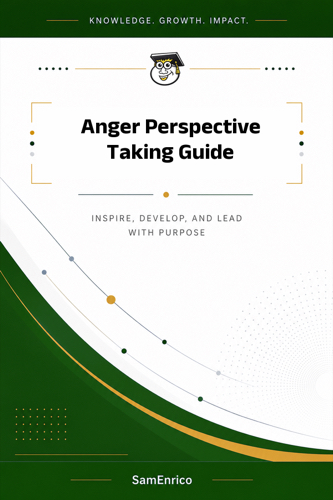
Anger Perspective Taking Guide eBook
See the situation from the other person's point of
See the situation from the other person's point of view.
Formats
Free sample
Chapter 1: The Story Trap--You are about to discover something that will unsettle you.Not because it is complicated. It is not. Not because it requires years of therapy or a spiritual awakening. It does not. This will unsettle you because once you see it, you cannot unsee it.
And what you will see is this: almost everything you think you know about why you are angry is wrong.Not exaggerated. Not oversimplified. Wrong.The person who cut you off in traffic probably was not trying to ruin your day. Your partner who left the dishes in the sink probably was not sending a secret message about your value as a human being. Your boss who dismissed your idea in the meeting probably was not orchestrating a campaign to destroy your career.But in the moment, it feels that way, does it not?
It feels personal. It feels intentional. It feels like a direct attack on your dignity, your time, your worth.That feeling is the Story Trap. And it is the single biggest obstacle to taking someone else's perspective.The Anatomy of a Lie Let me tell you a true story about a woman named Sarah. Sarah was driving home from work on a Friday evening.
She had worked late three days that week. She was exhausted. She was looking forward to a glass of wine and absolutely nothing else.As she merged onto the highway, a silver sedan cut her off. No turn signal. No warning.
Just a sudden, aggressive swerve into her lane that forced her to slam on her brakes. Her coffee spilled. Her heart raced. Her hands gripped the steering wheel so hard her knuckles went white.In that instant, Sarah did not think, "That was a dangerous driving maneuver." She thought, "What an entitled, selfish asshole." She thought, "He saw me. He did it on purpose.
He thinks his time is more important than mine." She honked. She flashed her lights. She tailgated him for the next two miles, rehearsing what she would say if they ended up at the same red light.Here is what Sarah did not know.The man in the silver sedan was named David. David was not an entitled asshole. David was on his way to the hospital because his four-year-old daughter had just stopped breathing.
He had not seen Sarah when he changed lanes. He was not thinking about traffic at all. He was thinking about whether his daughter would still be alive when he arrived.Sarah learned this three hours later, when she saw the news report about the child who had died on the way to the hospital. She recognized the car. She recognized the time.
She recognized the intersection.She sat on her couch and wept.Not because she had been wrong about David. Because she had been so certain. Because she had spent two miles filled with righteous fury at a man whose daughter was dying in the back seat. Because her anger—which had felt so justified, so real, so true—was built on a story that existed only in her head.The ABC Model That Will Change Everything Sarah's story is not an exception. It is an illustration of how anger works every single day, in small ways and large ones.
The psychological framework that explains this is called the ABC model, and it comes from Cognitive Behavioral Therapy, one of the most rigorously tested approaches in the history of psychology.Here is the ABC model in its simplest form:A is the Activating Event. Something happens. The phone rings. Someone speaks. A car changes lanes.
An email arrives.B is the Belief. This is your interpretation of the event. The story you tell yourself about what happened, why it happened, and what it means about you, the other person, and the world.C is the Consequence. This is your emotional and behavioral response. In our case: anger.
Honking. Tailgating. Snapping. Sending the email.Here is what most people believe: A causes C. The event causes the anger.
He cut me off, so I got angry. She criticized me, so I got angry. They ignored me, so I got angry.This is wrong.A does not cause C. B causes C. Your Belief—your interpretation, your story—causes your anger.
The same event can produce completely different emotional responses depending on the story you attach to it.Consider this. You are walking down the street. A stranger bumps into you hard enough to knock you off balance. What do you feel? It depends entirely on your story about why they bumped you.If your story is "They did it on purpose to be aggressive," you feel angry.
Your body floods with adrenaline. Your jaw clenches. You are ready to fight.If your story is "They are blind and did not see me," you feel concern. You step aside. You might offer an arm.If your story is "They are rushing to catch a bus and did not notice me," you feel mild annoyance at most.
You shake your head and keep walking.Same event. Different stories. Different emotions.The event does not cause the anger. The story causes the anger.This is not opinion. This is neuroscience.
Your brain processes sensory information, compares it to past experiences and stored beliefs, and generates a story about what is happening. That story happens so fast—milliseconds—that you never see it happening. You only experience the result: the anger. And because you do not see the story creation process, you assume the anger came directly from the event.You are wrong. And until you accept that you are wrong, you will remain trapped in the Story Trap.The Hostile Attribution Bias Now we arrive at an uncomfortable truth.
Some people are more likely than others to fall into the Story Trap. And if you are reading this book, there is a good chance you are one of them.Psychologists call it Hostile Attribution Bias. It is the tendency to interpret ambiguous behavior as hostile, aggressive, or intentionally harmful. When someone bumps into you, you assume they did it on purpose. When someone does not text you back, you assume they are ignoring you.
When someone disagrees with you, you assume they are attacking you.Hostile Attribution Bias is not a character flaw. It is a cognitive pattern, often learned in childhood from environments where people actually were hostile. If you grew up around unpredictable aggression, your brain learned to assume the worst because assuming the worst kept you safe. The problem is that this pattern follows you into adulthood, where it poisons relationships that are not actually hostile.Let me give you a quick self-assessment. Answer each question honestly, rating yourself from 1 (almost never) to 5 (almost always):When someone cancels plans with me, I assume they found something better to do.When someone disagrees with me, I feel personally attacked.When someone does not laugh at my joke, I assume they do not like me.When someone takes a long time to reply to my text, I assume they are annoyed with me.When someone gives me feedback at work, I look for the hidden criticism.When my partner is quiet…
This is the end of the free sample. Get the eBook to keep going. Buy now
About this book
Details
- Author
- Lennon Lavenia
- Publisher
- SamEnrico
- Language
- English
- Genre
- Non-Fiction, Self-Help, Empathy, CBT
- Released
- 2026-06-11
- Pages (approx.)
- 126
- Available as
- eBook, Audiobook

Read better in the ZLOADR app
Your eBooks on your phone or tablet. Sign in with your SamEnrico account and start reading.
More by Lennon Lavenia
 Mirror Affirmation PracticeLennon Lavenia$11.99
 Calm Exam Preparation HandbookLennon Lavenia$11.99
 The HGH and Skin Aging GuideLennon Lavenia$11.99
 Thai Business NegotiationLennon Lavenia$11.99
 Love and the Long Game: The Secret Tennis Courts of Medieval New ZealandLennon Lavenia$11.99
 10 Ways to Use Flounder (Recipe Book)Lennon Lavenia$11.99
 BOP Franchise Models GuideLennon Lavenia$12.99
 Promotion Executive Summary GuideLennon Lavenia$12.99
 Understanding Uveitis, AnteriorLennon Lavenia$17.99
You may also like
 Hong Kong Handover 1997Dunn Johnnie$11.99
 Zumba For Postnatal Recovery CourseNeal Christian$11.99
 Zumba for BeginnersLadner Nikia$11.99
 YouTube Comment Mining GuideHumes Pandora$12.99
 Worry Box MeditationCarlin Rudy$11.99
 Workplace Stress MeditationNguyen Lynn$11.99
 Workplace Stress and Sleep RepairHawley Ivory$11.99
 Workplace Perfectionism CureDelaney Jeffry$11.99
 Workplace Injustice Anger GuideWallen Isabelle$11.99
 Work Addiction and Burnout LinkGreenwood Ester$11.99
 Women in Yoga and WellnessBeattie Galina$11.99
 Women in Stand Up ComedyChun Evangeline$11.99