
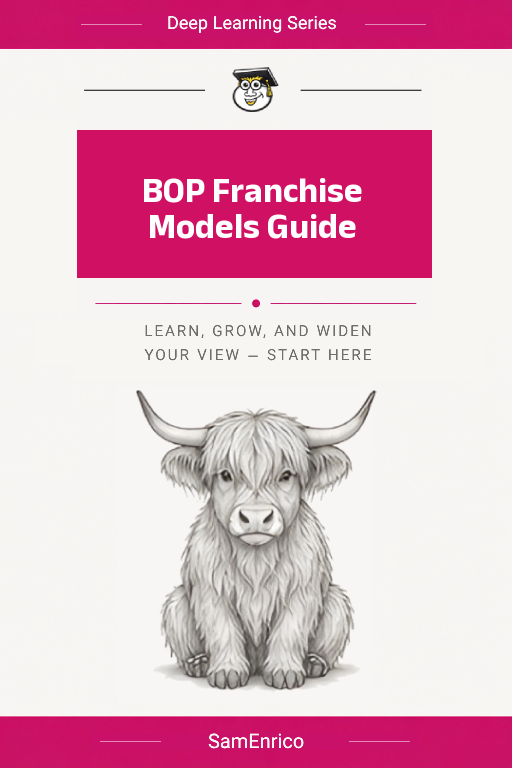
Non-FictionStartup GuideBOP Strategy
BOP Franchise Models Guide
Use franchise models for low-income market expansi
Use franchise models for low-income market expansion. Micro-franchising for last-mile reach.
Formats
About this book
Free sample
Chapter 1: The $8 Lie--–- The sun had not yet risen over Kibera, Nairobi’s largest informal settlement, when Fatima woke to the sound of rain leaking through her corrugated tin roof. She was forty-two years old, a widow, and the sole provider for three children. Her business was a wooden table balanced on cinderblocks, placed at the intersection of two muddy footpaths. On that table, she sold tomatoes, onions, and loose tea leaves—each purchased that morning from a wholesaler who charged her a 40% markup because she could only afford to buy in tiny quantities.Fatima was not lazy. She was not unintelligent.
She worked fourteen hours a day, six days a week. And at the end of each month, after paying for stock, transport, and the unofficial “fees” demanded by local gatekeepers, she had less than two dollars left. Some months, she lost money. Some months, she could not afford to restock at all. She was trapped.Her story is not unusual.
It is the story of more than 4 billion people on this planet—the Base of the Pyramid (Bo P)—who live on less than eight dollars per day. And for decades, we have been told a seductive lie about them.The Lie That Launched a Thousand Ventures In 2004, the late C.K. Prahalad published The Fortune at the Bottom of the Pyramid, a book that electrified boardrooms from Manhattan to Mumbai. His argument was simple, elegant, and irresistible: the world’s poorest people, aggregated together, represented a $5 trillion market. Multinational corporations, he argued, could make vast profits while simultaneously lifting billions out of poverty.
All they had to do was shrink their products (single-use shampoo sachets), lower their prices, and distribute through existing informal channels.It was a beautiful theory. It was also, for the most part, wrong.Not because Prahalad’s math was incorrect. The 4 billion people at the Bo P do indeed control trillions in purchasing power. But the assumption that they behave like “consumers” in any traditional sense—that they respond to branding, that they value convenience over price, that they can be reached through mass media—has…
This is the end of the free sample. Get the eBook to keep going. Buy now
Contents
- Chapter 1
- Chapter 2
- Chapter 3
- Chapter 4
- Chapter 5
- Chapter 6
- Chapter 7
- Chapter 8
- Chapter 9
- Chapter 10
- Chapter 11
- Chapter 12
Details
- Author
- Lennon Lavenia
- Publisher
- SamEnrico
- Language
- English
- Genre
- Non-Fiction, Startup Guide, BOP Strategy
- Released
- 2026-06-01
- Pages (approx.)
- 153
- Available as
- eBook, Audiobook

Read better in the ZLOADR app
Your eBooks on your phone or tablet. Sign in with your SamEnrico account and start reading.
More by Lennon Lavenia
 Anger Perspective Taking GuideLennon Lavenia$11.99
 Mirror Affirmation PracticeLennon Lavenia$11.99
 Calm Exam Preparation HandbookLennon Lavenia$11.99
 The HGH and Skin Aging GuideLennon Lavenia$11.99
 Thai Business NegotiationLennon Lavenia$11.99
 Love and the Long Game: The Secret Tennis Courts of Medieval New ZealandLennon Lavenia$11.99
 10 Ways to Use Flounder (Recipe Book)Lennon Lavenia$11.99
 Promotion Executive Summary GuideLennon Lavenia$12.99
 Understanding Uveitis, AnteriorLennon Lavenia$17.99
You may also like
 Hong Kong Handover 1997Dunn Johnnie$11.99
 Zumba For Postnatal Recovery CourseNeal Christian$11.99
 Zumba for BeginnersLadner Nikia$11.99
 YouTube Comment Mining GuideHumes Pandora$12.99
 Worry Box MeditationCarlin Rudy$11.99
 Workplace Stress MeditationNguyen Lynn$11.99
 Workplace Stress and Sleep RepairHawley Ivory$11.99
 Workplace Perfectionism CureDelaney Jeffry$11.99
 Workplace Injustice Anger GuideWallen Isabelle$11.99
 Work Addiction and Burnout LinkGreenwood Ester$11.99
 Women in Yoga and WellnessBeattie Galina$11.99
 Women in Stand Up ComedyChun Evangeline$11.99