
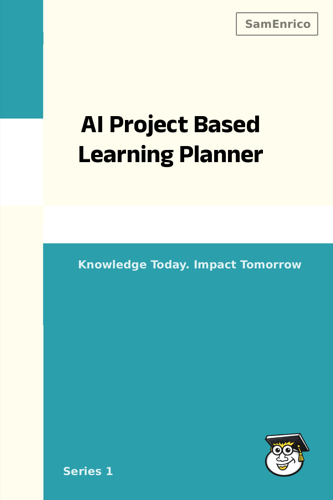
Non-FictionAI OperatorProject Based Learning
AI Project Based Learning Planner eBook
Design multi-week PBL units with driving questions
by Belton Mark
Design multi-week PBL units with driving questions and assessment checkpoints.
Formats
Free sample
Chapter 1: The Confidence Machine--The first time a teacher watches a student copy a paragraph from Chat GPT and paste it into a document without reading a single word, something cracks. It is not just trust. It is the assumption that effort and learning are still connected. That crack is real, and it runs through every faculty meeting, every grading session, and every late-night conversation about whether this job just got impossibly harder.Let us name that fear directly: generative AI will make student thinking obsolete, turning multi-week projects into copy-paste exercises that no amount of rubrics can fix.This book exists because that fear, while understandable, is built on a misunderstanding of both AI and project based learning. The truth is the opposite.
AI does not make PBL obsolete. AI makes PBL essential. And PBL makes AI literacy teachable in ways that no worksheet or digital citizenship module ever could.Before this chapter goes any further, a promise: you will never be asked to write Python code, understand neural network architecture, or debug a machine learning model. This is not a computer science book. It is a teaching book.
The only technology you need is the ability to type a sentence into a chat box and the willingness to experiment alongside your students.What this chapter will do is reframe the entire conversation. You will learn why the co-intelligent classroom, where humans and AI work as partners rather than adversaries, is not a dystopian future but a practical present. You will understand the eight essential characteristics of large language models that every PBL teacher must know, explained in classroom language not engineering jargon. You will shift your mindset from policing cheating, an exhausting and largely futile activity, to verifying process, a teachable and fair set of habits. And you will leave with a concrete example unit, "Is This Art?", that you could adapt for your grade level by the end of this chapter.The crack in your assumptions is not a flaw.
It is an opening. Let us walk through it together.The Two Pain Points That Have Always Plagued PBLProject based learning has been the gold standard of engaged pedagogy for decades. The research is clear: students in well-designed PBL classrooms retain more, transfer skills more readily, and report higher levels of motivation than peers in traditional instruction. But ask any teacher why they do not run PBL units every month, and you will hear the same two answers.Pain point one: time. Designing a rigorous multi-week project from scratch requires hours of work.
You must generate a driving question that is both standards-aligned and genuinely interesting. You must design an entry event that hooks every student, not just the intrinsically motivated ones. You must create rubrics, checkpoints, scaffolds, and contingency plans. And you must do all of this while also teaching five classes, attending meetings, grading assignments, and communicating with parents. Most teachers do not have those hours.
So they buy pre-made units, adapt them poorly, or default to worksheets.Pain point two: scale. Even when a teacher finds the time to design a great project, personalized feedback remains nearly impossible. A class of thirty students produces thirty unique drafts, thirty sets of questions, thirty different places where they get stuck. The teacher can give deep feedback to perhaps five students per day. The rest receive a checkmark, a generic comment, or nothing at all.
The promise of PBL, that every student works on something meaningful at the edge of their ability, collides with the reality of one human being responsible for too many humans.Here is the claim this book makes: AI solves both of these pain points. Not in some distant future. Right now.AI can generate ten variations of a driving question in thirty seconds, each aligned to your specific standards and grade level. AI can draft a rubric, create an entry event, suggest scaffolds for struggling learners, and produce extension activities for advanced students. What used to take a weekend now takes fifteen minutes.
That is not hyperbole. It is the lived experience of teachers who have integrated AI into their planning workflow.And for scale? AI can analyze twenty exit tickets, identify the three most common misconceptions, and suggest targeted mini-lessons for each small group. AI can give every student immediate, specific feedback on a draft, not to replace the teacher's feedback but to prepare students to receive it more productively. AI can translate complex texts into multiple reading levels, generate sentence starters for English language learners, and create role cards for every member of a team.
The bottleneck of one teacher to thirty students is not eliminated, but it is dramatically widened.The chapters that follow will teach you exactly how to realize both of these promises. But first, we need a shared understanding of what AI actually is and is not. Because the fear of copy-paste cheating comes from a misconception that treating AI as a magical answer machine. It is not magic. It is math.
And understanding that math changes everything.The Eight Essentials: What Every PBL Teacher Must Know About AIArtificial intelligence, specifically the large language models that power tools like Chat GPT, Claude, and Gemini, is not a brain. It is not sentient. It does not understand anything it says. This sounds contradictory, because the outputs can be stunningly coherent. But coherence is not comprehension.
And that distinction is the single most important concept in this entire book.Here are the eight essential characteristics of LLMs, translated from engineering jargon into classroom language. You do not need to memorize them. You need to internalize them enough to explain them to a curious eighth grader.One: LLMs are confident guessers. Every time you prompt an AI, it calculates the most statistically probable next word based on the billions of examples it consumed during training. That is all.
It is not retrieving a fact from a database. It is playing a very sophisticated game of "what word usually comes next?" This explains why AI can sound so authoritative while being completely wrong. It is not lying. It is guessing confidently.Two: LLMs have no memory of truth. The AI does not know what is true or false.
It knows what is common, frequent, and coherent. In the training data, there are many more examples of "the Earth is round" than "the Earth is flat," so the AI will almost always produce the round Earth answer. But if you ask about an obscure historical event, the AI might confidently produce a plausible-sounding fabrication because that fabrication follows the statistical patterns of historical writing. This is called hallucination, and it is not a bug. It is a feature of how the technology works.Three: Training data has limitations.
AI models are trained on the public internet, which means they reflect the biases, gaps, and errors of that internet. An AI asked to generate images of a doctor will produce disproportionately white male doctors unless explicitly instructed otherwise. An AI asked about ancient Egyptian mathematics may have less training data than it has about Greek mathematics, leading to thinner or less accurate responses. Teachers must treat AI outputs as products of a biased…
This is the end of the free sample. Get the eBook to keep going. Buy now
About this book
Details
- Author
- Belton Mark
- Publisher
- SamEnrico
- Language
- English
- Genre
- Non-Fiction, AI Operator, Project Based Learning
- Released
- 2026-06-06
- Pages (approx.)
- 151
- Available as
- eBook, Audiobook

Read better in the ZLOADR app
Your eBooks on your phone or tablet. Sign in with your SamEnrico account and start reading.
More by Belton Mark
 Stress and Shingles Reactivation GuideBelton Mark$11.99
 Exhausted Parent Self Care GuideBelton Mark$11.99
 Xray Fear Radiology WalkthroughBelton Mark$11.99
 French Resistance Safe HousesBelton Mark$11.99
 The Angel of Death: The Chilling Case of Genene JonesBelton Mark$11.99
 Understanding Marshall SyndromeBelton Mark$17.99
 How to Become a Diver HelperBelton Mark$11.99
 Remote Review Compensation ConversationsBelton Mark$12.99
 Operations Management and OptimizationBelton Mark$11.99
You may also like
 Hong Kong Handover 1997Dunn Johnnie$11.99
 Zumba For Postnatal Recovery CourseNeal Christian$11.99
 Zumba for BeginnersLadner Nikia$11.99
 YouTube Comment Mining GuideHumes Pandora$12.99
 Worry Box MeditationCarlin Rudy$11.99
 Workplace Stress MeditationNguyen Lynn$11.99
 Workplace Stress and Sleep RepairHawley Ivory$11.99
 Workplace Perfectionism CureDelaney Jeffry$11.99
 Workplace Injustice Anger GuideWallen Isabelle$11.99
 Work Addiction and Burnout LinkGreenwood Ester$11.99
 Women in Yoga and WellnessBeattie Galina$11.99
 Women in Stand Up ComedyChun Evangeline$11.99