
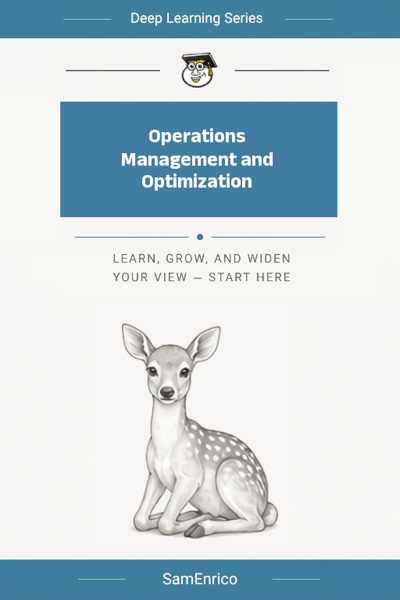
Non-FictionInformativeEducational
Operations Management and Optimization
A Coursebook on Operations Management and Optimiza
by Belton Mark
A Coursebook on Operations Management and Optimization
Formats
About this book
Free sample
Chapter 1: The Improvement Paradox...--Every morning, Maria Villanueva walked past the same bottleneck.It was 7:45 AM when she entered the custom furniture factory she had managed for eleven years. The air smelled of walnut dust and coffee. Forty-three employees would arrive within the hour. And every single day, by 10:30 AM, the same thing happened: Work would pile up at the CNC router station while the assembly tables sat idle.Maria knew this. She had known it for years.
She had hired consultants who drew colorful charts. She had bought scheduling software that no one used correctly. She had even tried motivational speeches about "working smarter, not harder." Nothing changed.The problem was not that Maria was lazy or unintelligent. The problem was that Maria, like most operations managers across every industry, was making decisions based on intuition, tradition, and whatever worked last time. She was guessing.And guessing, it turns out, is extraordinarily expensive.This book is about what happens when you stop guessing.The Hidden Cost of Intuition Let us stay with Maria for a moment.
Her factory makes two products: dining tables and bookshelves. The tables sell for 500eachandrequire4hoursoflaborand2hoursofmachinetime.Thebookshelvessellfor500 each and require 4 hours of labor and 2 hours of machine time. The bookshelves sell for 500eachandrequire4hoursoflaborand2hoursofmachinetime.Thebookshelvessellfor300 each and require 2 hours of labor and 1 hour of machine time. Each day, Maria has 40 hours of labor available and 30 hours of machine time.If you ask Maria how many tables and bookshelves she should make each day, she will likely say something like: "Well, tables are more profitable, so we should make as many tables as possible."This sounds reasonable. It is also completely wrong.If Maria makes ten tables (using all 40 labor hours, but only 20 machine hours), she leaves 10 machine hours unused.
Her profit is 5,000.Butifshemakeseighttablesandfourbookshelves?Thatusesall40laborhoursandall30machinehours.Herprofitis5,000. But if she makes eight tables and four bookshelves? That uses all 40 labor hours and all 30 machine hours. Her profit is 5,000.Butifshemakeseighttablesandfourbookshelves?Thatusesall40laborhoursandall30machinehours.Herprofitis5,200.Four hundred dollars per day. One hundred forty-six thousand dollars per year.
Lost because of a simple arithmetic error that any optimization model would have caught in seconds.This is the Improvement Paradox…
This is the end of the free sample. Get the eBook to keep going. Buy now
Contents
- Chapter 1
- Chapter 2
- Chapter 3
- Chapter 4
- Chapter 5
- Chapter 6
- Chapter 7
- Chapter 8
- Chapter 9
- Chapter 10
- Chapter 11
- Chapter 12
Details
- Author
- Belton Mark
- Publisher
- SamEnrico
- Language
- English
- Genre
- Non-Fiction, Informative, Educational
- Released
- 2026-05-11
- Pages (approx.)
- 155
- Available as
- eBook, Audiobook

Read better in the ZLOADR app
Your eBooks on your phone or tablet. Sign in with your SamEnrico account and start reading.
More by Belton Mark
 Stress and Shingles Reactivation GuideBelton Mark$11.99
 Exhausted Parent Self Care GuideBelton Mark$11.99
 Xray Fear Radiology WalkthroughBelton Mark$11.99
 French Resistance Safe HousesBelton Mark$11.99
 AI Project Based Learning PlannerBelton Mark$11.99
 The Angel of Death: The Chilling Case of Genene JonesBelton Mark$11.99
 Understanding Marshall SyndromeBelton Mark$17.99
 How to Become a Diver HelperBelton Mark$11.99
 Remote Review Compensation ConversationsBelton Mark$12.99
You may also like
 Hong Kong Handover 1997Dunn Johnnie$11.99
 Zumba For Postnatal Recovery CourseNeal Christian$11.99
 Zumba for BeginnersLadner Nikia$11.99
 YouTube Comment Mining GuideHumes Pandora$12.99
 Worry Box MeditationCarlin Rudy$11.99
 Workplace Stress MeditationNguyen Lynn$11.99
 Workplace Stress and Sleep RepairHawley Ivory$11.99
 Workplace Perfectionism CureDelaney Jeffry$11.99
 Workplace Injustice Anger GuideWallen Isabelle$11.99
 Work Addiction and Burnout LinkGreenwood Ester$11.99
 Women in Yoga and WellnessBeattie Galina$11.99
 Women in Stand Up ComedyChun Evangeline$11.99