
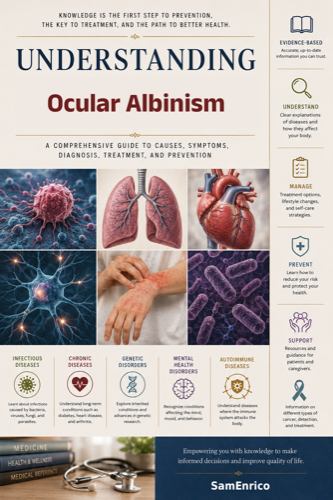
Non-FictionInformativeEducational
Understanding Ocular Albinism
This disease publication, published by SamEnrico,
by Cass Zandra
This disease publication, published by SamEnrico, covers Understanding Ocular Albinism
Formats
About this book
Free sample
Chapter 1: Beyond the Stereotype...--The child sat on the examination table, legs swinging, dark brown hair falling across her face. She was four years old, with skin that tanned easily in the summer and eyes that never seemed to stay still. Her mother, Elena, sat beside her, clutching a folder of medical records already three inches thick. "She's been to four pediatricians," Elena said, her voice carrying the particular exhaustion of a parent who has been told too many times that nothing is wrong. "They all say the same thing.
Her eyes are healthy. She just needs glasses. But I know something is different."The ophthalmologist leaned forward, looking through the slit lamp, and then sat back. "Has anyone ever mentioned the word 'albinism' to you?"Elena blinked. "But she has dark hair.
She tans. I tan. How could she have albinism?"That moment—the collision between a parent's lived experience and a medical reality that contradicts every stereotype—is the starting point for understanding Ocular Albinism. It is a condition defined not by what is visible on the outside, but by what is missing on the inside. And because of that invisibility, it remains one of the most underdiagnosed and misunderstood genetic vision disorders affecting children and adults today.The Problem of the Pink-Eyed Stereotype For most people, the word "albinism" conjures a specific image: white hair, pale skin, pink or blue eyes, and significant vision problems.
This image, reinforced by decades of film, literature, and even medical textbooks, is accurate for one form of the condition—specifically, Oculocutaneous Albinism (OCA) type 1, the most severe form where melanin production is completely absent across the entire body. But this stereotype has become a diagnostic prison, trapping thousands of people with Ocular Albinism (OA) in a no-man's-land where their visual struggles are real but their appearance offers no explanation.The word "albinism" derives from the Latin "albus," meaning white. First used in the early 17th century, the term was applied broadly to any person or animal with unusually pale coloration. For centuries, medical understanding of albinism was entirely superficial—it was defined by…
This is the end of the free sample. Get the eBook to keep going. Buy now
Contents
- Chapter 1
- Chapter 2
- Chapter 3
- Chapter 4
- Chapter 5
- Chapter 6
- Chapter 7
- Chapter 8
- Chapter 9
- Chapter 10
- Chapter 11
- Chapter 12
Details
- Author
- Cass Zandra
- Publisher
- SamEnrico
- Language
- English
- Genre
- Non-Fiction, Informative, Educational
- Released
- 2026-05-09
- Pages (approx.)
- 156
- Available as
- eBook, Audiobook

Read better in the ZLOADR app
Your eBooks on your phone or tablet. Sign in with your SamEnrico account and start reading.
More by Cass Zandra
 Walking Meditation For Multiple Sclerosis HandbookCass Zandra$11.99
 Support Group Memory SharingCass Zandra$11.99
 Jhansi Rani Lakshmibai BiographyCass Zandra$11.99
 The Forgiveness for Narcissistic AbuseCass Zandra$11.99
 Anger Ladder Cognitive MethodCass Zandra$11.99
 Love and Ambush: The Siege of Dien Bien Phu (1954)Cass Zandra$11.99
 How to Become a Order DetailerCass Zandra$11.99
 Production Sequencing AlgorithmsCass Zandra$12.99
 German Student Banking GuideCass Zandra$12.99
 Trophy and Award EngraverCass Zandra$11.99
You may also like
 Hong Kong Handover 1997Dunn Johnnie$11.99
 Zumba For Postnatal Recovery CourseNeal Christian$11.99
 Zumba for BeginnersLadner Nikia$11.99
 YouTube Comment Mining GuideHumes Pandora$12.99
 Worry Box MeditationCarlin Rudy$11.99
 Workplace Stress MeditationNguyen Lynn$11.99
 Workplace Stress and Sleep RepairHawley Ivory$11.99
 Workplace Perfectionism CureDelaney Jeffry$11.99
 Workplace Injustice Anger GuideWallen Isabelle$11.99
 Work Addiction and Burnout LinkGreenwood Ester$11.99
 Women in Yoga and WellnessBeattie Galina$11.99
 Women in Stand Up ComedyChun Evangeline$11.99