
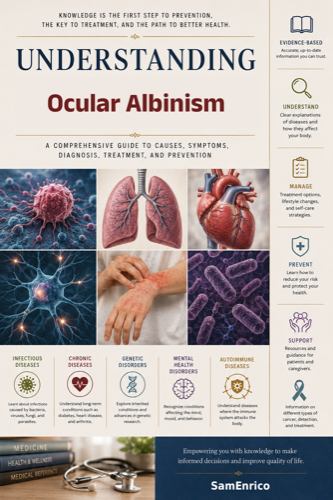
Non-FictionInformativeEducational
Understanding Ocular Albinism eBook
This disease publication, published by SamEnrico,
by Cass Zandra
This disease publication, published by SamEnrico, covers Understanding Ocular Albinism
Formats
Free sample
Chapter 1: Beyond the Stereotype...--The child sat on the examination table, legs swinging, dark brown hair falling across her face. She was four years old, with skin that tanned easily in the summer and eyes that never seemed to stay still. Her mother, Elena, sat beside her, clutching a folder of medical records already three inches thick. "She's been to four pediatricians," Elena said, her voice carrying the particular exhaustion of a parent who has been told too many times that nothing is wrong. "They all say the same thing.
Her eyes are healthy. She just needs glasses. But I know something is different."The ophthalmologist leaned forward, looking through the slit lamp, and then sat back. "Has anyone ever mentioned the word 'albinism' to you?"Elena blinked. "But she has dark hair.
She tans. I tan. How could she have albinism?"That moment—the collision between a parent's lived experience and a medical reality that contradicts every stereotype—is the starting point for understanding Ocular Albinism. It is a condition defined not by what is visible on the outside, but by what is missing on the inside. And because of that invisibility, it remains one of the most underdiagnosed and misunderstood genetic vision disorders affecting children and adults today.The Problem of the Pink-Eyed Stereotype For most people, the word "albinism" conjures a specific image: white hair, pale skin, pink or blue eyes, and significant vision problems.
This image, reinforced by decades of film, literature, and even medical textbooks, is accurate for one form of the condition—specifically, Oculocutaneous Albinism (OCA) type 1, the most severe form where melanin production is completely absent across the entire body. But this stereotype has become a diagnostic prison, trapping thousands of people with Ocular Albinism (OA) in a no-man's-land where their visual struggles are real but their appearance offers no explanation.The word "albinism" derives from the Latin "albus," meaning white. First used in the early 17th century, the term was applied broadly to any person or animal with unusually pale coloration. For centuries, medical understanding of albinism was entirely superficial—it was defined by what the observer could see. If you looked pale, you had albinism.
If you looked normally pigmented, you did not.That superficial definition persisted well into the twentieth century. As late as the 1980s, medical textbooks described albinism primarily as a "lack of pigment in the skin, hair, and eyes," with little distinction between the various genetic subtypes. Families who had children with the classic pink-eyed appearance sought answers and found them. Families whose children had dark hair, normal skin tone, and perplexing vision problems were often told they were overreacting, that their child simply had "nystagmus" or "lazy eye" or "astigmatism"—treating the symptoms while missing the underlying condition entirely.The shift began in the 1990s, when genetic research revealed that albinism is not one condition but a family of related disorders caused by mutations in different genes affecting melanin production. Some of these mutations affect melanin production everywhere in the body (the OCA types).
Others, specifically the GPR143 mutation that causes the most common form of Ocular Albinism, affect melanin production primarily in the eyes—leaving skin and hair largely or completely unaffected.This genetic discovery should have revolutionized diagnosis. Instead, it created a new problem: the medical community was slow to update its stereotypes. Even today, a parent who searches "albinism" online will see images of children with white hair and pale skin. A pediatrician who last studied albinism in medical school will remember the pink-eyed presentation. And a child with dark hair, normal skin, and unexplained visual problems will continue to be dismissed.The case study at the opening of this chapter—the dark-haired child with dancing eyes—is not a hypothetical.
It is a composite of hundreds of real diagnostic journeys documented in patient registries, support group forums, and clinical case reports. The details vary, but the pattern is consistent: multiple doctor visits, normal skin findings, misdiagnosis, frustration, and finally—often years later—a referral to an ophthalmologist who knows what to look for inside the eye.What Ocular Albinism Actually Is Let us clear the ground immediately. Ocular Albinism is a genetic condition characterized by reduced pigmentation in the eyes, specifically in the retinal pigment epithelium (RPE)—the single layer of cells beneath the retina that normally contains high concentrations of melanin. This reduction in ocular melanin leads to three fundamental problems:First, without normal melanin levels in the RPE during fetal development, the retina does not wire itself correctly. The fovea, the tiny pit in the center of the retina responsible for sharp central vision, fails to form properly—a condition called foveal hypoplasia.
This is permanent and non-progressive; the fovea does not get worse over time, but it also does not improve.Second, the lack of melanin in the iris—the colored part of the eye—allows light to pass through where it should be blocked, a phenomenon called iris transillumination. This causes photophobia (extreme sensitivity to light) because scattered light within the eye creates visual "noise" that overwhelms the already compromised retinal signal.Third, the melanin deficiency during development disrupts the normal routing of optic nerve fibers at the chiasm (the junction where nerves from both eyes meet before traveling to the brain). In OA, an excessive number of fibers cross to the wrong side of the brain, disrupting binocular vision and depth perception.Notice what is not on that list: skin changes, hair changes, or any externally visible feature that would distinguish a person with OA from anyone else in a crowd. A person with OA may have very fair skin and light hair, or they may have dark skin and very dark hair. They may tan easily or burn easily.
There is no external "look" of Ocular Albinism because the condition is defined by what happens inside the eye, not on the surface.This is the single most important fact about OA, and it bears repeating: Ocular Albinism is an eye condition, not a skin condition. It is caused by the same family of genes as Oculocutaneous Albinism, but the expression of those genes is different. In OCA, the mutation affects melanin production throughout the body. In OA, the mutation specifically affects melanin production in the eyes. The distinction is not merely academic—it shapes every aspect of diagnosis, management, and lived experience.The Two Genetic Forms There are two genetic forms of Ocular Albinism, and understanding which form you or your child has is essential for prognosis, family planning, and connecting with appropriate resources.The most common form, accounting for approximately 80 to 85 percent of all OA cases, is X-linked Ocular Albinism (XLOA), caused by mutations in the GPR143 gene located on the X chromosome.
Because males have only one X chromosome (inherited from their mother), a single mutation is sufficient to cause the full condition. Females have two X chromosomes; if they inherit one mutated copy, they are usually carriers with minimal or no symptoms, though some carriers experience visual difficulties due to X-inactivation patterns.XLOA follows a clear inheritance pattern that often provides the first clue to diagnosis. If a mother carries the GPR143 mutation, each…
This is the end of the free sample. Get the eBook to keep going. Buy now
About this book
Details
- Author
- Cass Zandra
- Publisher
- SamEnrico
- Language
- English
- Genre
- Non-Fiction, Informative, Educational
- Released
- 2026-05-09
- Pages (approx.)
- 156
- Available as
- eBook, Audiobook

Read better in the ZLOADR app
Your eBooks on your phone or tablet. Sign in with your SamEnrico account and start reading.
More by Cass Zandra
 Walking Meditation For Multiple Sclerosis HandbookCass Zandra$11.99
 Support Group Memory SharingCass Zandra$11.99
 Jhansi Rani Lakshmibai BiographyCass Zandra$11.99
 The Forgiveness for Narcissistic AbuseCass Zandra$11.99
 Anger Ladder Cognitive MethodCass Zandra$11.99
 Love and Ambush: The Siege of Dien Bien Phu (1954)Cass Zandra$11.99
 How to Become a Order DetailerCass Zandra$11.99
 Production Sequencing AlgorithmsCass Zandra$12.99
 German Student Banking GuideCass Zandra$12.99
 Trophy and Award EngraverCass Zandra$11.99
You may also like
 Hong Kong Handover 1997Dunn Johnnie$11.99
 Zumba For Postnatal Recovery CourseNeal Christian$11.99
 Zumba for BeginnersLadner Nikia$11.99
 YouTube Comment Mining GuideHumes Pandora$12.99
 Worry Box MeditationCarlin Rudy$11.99
 Workplace Stress MeditationNguyen Lynn$11.99
 Workplace Stress and Sleep RepairHawley Ivory$11.99
 Workplace Perfectionism CureDelaney Jeffry$11.99
 Workplace Injustice Anger GuideWallen Isabelle$11.99
 Work Addiction and Burnout LinkGreenwood Ester$11.99
 Women in Yoga and WellnessBeattie Galina$11.99
 Women in Stand Up ComedyChun Evangeline$11.99