
Non-FictionInformativeEducational
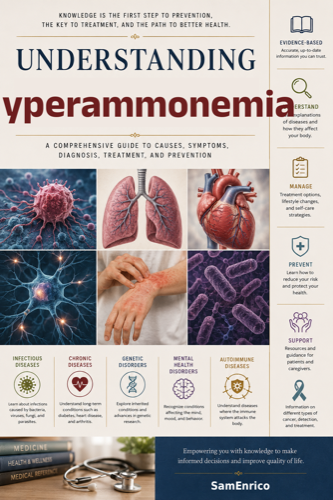
Understanding Hyperammonemia Audiobook
This disease publication, published by SamEnrico,
This disease publication, published by SamEnrico, covers Understanding Hyperammonemia
Formats
Free sample
Chapter 1: The Silent Flood...--The human body is a master of balance. It maintains temperature within a fraction of a degree, blood p H with exquisite precision, and electrolyte concentrations that would make a Swiss watchmaker envious. But every so often, evolution leaves a vulnerability—a single point of failure where the machinery can catastrophically break down. For ammonia, that point is the brain.Ammonia is everywhere in biology. It is the unavoidable exhaust of protein metabolism, the pungent molecule that makes cleaning products smell sharp and rotting fish repulsive.
Inside the human body, it is produced constantly, relentlessly, by every cell that burns amino acids for fuel. Under normal conditions, you never notice it. Your liver sweeps it away so efficiently that the average person walking down the street has an ammonia level below 50 micromoles per liter—a concentration so low that laboratory instruments struggle to measure it accurately.But when that clearance system fails, ammonia accumulates. And when ammonia accumulates, it floods the brain.This chapter begins where all clinical reasoning must begin: with the fundamentals. You cannot diagnose hyperammonemia if you do not understand where ammonia comes from, how the body normally disposes of it, and why the brain is uniquely vulnerable to its toxic effects.
The chapters that follow will take you through the differential diagnosis, the emergency protocols, and the long-term management strategies. But first, you must understand the terrain.The Nitrogen Cycle of the Human Body To understand hyperammonemia, you must first understand nitrogen balance. Every day, the average adult consuming a standard Western diet ingests approximately 70 to 100 grams of protein. That protein contains roughly 11 to 16 grams of nitrogen, locked within the amino acid building blocks that make up muscle, enzymes, and structural tissues. The body cannot store excess nitrogen.
It has no nitrogen "savings account." Instead, it must either incorporate nitrogen into new proteins or eliminate it entirely.The elimination pathway produces ammonia.When an amino acid is broken down—whether from dietary protein, the normal turnover of your own muscles, or the catabolism that occurs during illness and fasting—the nitrogen-containing amino group must be removed. This process, called deamination, releases ammonia (NH3) or its ionized form ammonium (NH4+). The liver immediately captures this ammonia and funnels it into the urea cycle, where it is converted into urea—a much less toxic molecule that travels through the bloodstream to the kidneys and is excreted in urine.This system…
This is the end of the free sample. Get the Audiobook to keep going. Buy now
About this book
Details
- Author
- Robson Shoshana
- Publisher
- SamEnrico
- Language
- English
- Genre
- Non-Fiction, Informative, Educational
- Released
- 2026-06-03
- Pages (approx.)
- 148
- Available as
- eBook, Audiobook

Listen in the VoxFlicks app
Audiobooks and audio dramas wherever you go. Sign in with your SamEnrico account and press play.
More by Robson Shoshana
 Governor of PrisonsRobson Shoshana$11.99
 Brand Ranking Social ListeningRobson Shoshana$11.99
 Complex Regional Pain PNERobson Shoshana$11.99
 Financial Stress and Parenting GuideRobson Shoshana$11.99
 The Vanishing of the USS Cyclops: The Navy's Greatest Unsolved MysteryRobson Shoshana$11.99
 The Unseen Letters: Alan Turing's Hidden Love in CodeRobson Shoshana$11.99
 Associate Technical Account ManagerRobson Shoshana$11.99
 Stealth Freelance Income ManualRobson Shoshana$12.99
 Telehealth Technology OutlookRobson Shoshana$12.99
 How to Start a Casements Made of Metal Business (Beginners Guide)Robson Shoshana$11.99
You may also like
 Hong Kong Handover 1997Dunn Johnnie$11.99
 Zumba For Postnatal Recovery CourseNeal Christian$11.99
 Zumba for BeginnersLadner Nikia$11.99
 YouTube Comment Mining GuideHumes Pandora$12.99
 Worry Box MeditationCarlin Rudy$11.99
 Workplace Stress MeditationNguyen Lynn$11.99
 Workplace Stress and Sleep RepairHawley Ivory$11.99
 Workplace Perfectionism CureDelaney Jeffry$11.99
 Workplace Injustice Anger GuideWallen Isabelle$11.99
 Work Addiction and Burnout LinkGreenwood Ester$11.99
 Women in Yoga and WellnessBeattie Galina$11.99
 Women in Stand Up ComedyChun Evangeline$11.99