
Non-FictionInformativeEducational
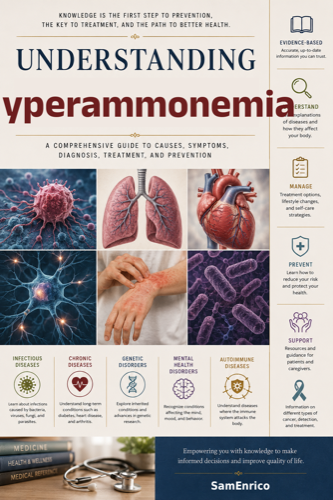
Understanding Hyperammonemia eBook
This disease publication, published by SamEnrico,
This disease publication, published by SamEnrico, covers Understanding Hyperammonemia
Formats
Free sample
Chapter 1: The Silent Flood...--The human body is a master of balance. It maintains temperature within a fraction of a degree, blood p H with exquisite precision, and electrolyte concentrations that would make a Swiss watchmaker envious. But every so often, evolution leaves a vulnerability—a single point of failure where the machinery can catastrophically break down. For ammonia, that point is the brain.Ammonia is everywhere in biology. It is the unavoidable exhaust of protein metabolism, the pungent molecule that makes cleaning products smell sharp and rotting fish repulsive.
Inside the human body, it is produced constantly, relentlessly, by every cell that burns amino acids for fuel. Under normal conditions, you never notice it. Your liver sweeps it away so efficiently that the average person walking down the street has an ammonia level below 50 micromoles per liter—a concentration so low that laboratory instruments struggle to measure it accurately.But when that clearance system fails, ammonia accumulates. And when ammonia accumulates, it floods the brain.This chapter begins where all clinical reasoning must begin: with the fundamentals. You cannot diagnose hyperammonemia if you do not understand where ammonia comes from, how the body normally disposes of it, and why the brain is uniquely vulnerable to its toxic effects.
The chapters that follow will take you through the differential diagnosis, the emergency protocols, and the long-term management strategies. But first, you must understand the terrain.The Nitrogen Cycle of the Human Body To understand hyperammonemia, you must first understand nitrogen balance. Every day, the average adult consuming a standard Western diet ingests approximately 70 to 100 grams of protein. That protein contains roughly 11 to 16 grams of nitrogen, locked within the amino acid building blocks that make up muscle, enzymes, and structural tissues. The body cannot store excess nitrogen.
It has no nitrogen "savings account." Instead, it must either incorporate nitrogen into new proteins or eliminate it entirely.The elimination pathway produces ammonia.When an amino acid is broken down—whether from dietary protein, the normal turnover of your own muscles, or the catabolism that occurs during illness and fasting—the nitrogen-containing amino group must be removed. This process, called deamination, releases ammonia (NH3) or its ionized form ammonium (NH4+). The liver immediately captures this ammonia and funnels it into the urea cycle, where it is converted into urea—a much less toxic molecule that travels through the bloodstream to the kidneys and is excreted in urine.This system works remarkably well. In a healthy adult, the liver clears approximately 80 to 90 percent of all ammonia produced by the body. The remaining 10 to 20 percent is handled by other tissues, primarily muscle and the brain, through an alternative pathway involving the enzyme glutamine synthetase.
As long as the liver is functioning and the urea cycle enzymes are intact, ammonia never rises above the normal range.But the system has limits. And when those limits are exceeded—whether because the liver is damaged, the urea cycle enzymes are deficient, or the body is producing ammonia faster than the clearance pathways can handle—the flood begins.The Three Sources: Where Ammonia Comes From Understanding hyperammonemia requires a clear map of ammonia production. Clinicians often ask, "Why is this patient's ammonia high?" The answer lies in one of three major sources, each of which becomes dominant under different circumstances.The Gut: The Bacterial Factory The gastrointestinal tract is the single largest source of systemic ammonia under normal conditions. Every day, the colon houses trillions of bacteria that possess an enzyme called urease. Urease breaks down urea—the very molecule your liver worked so hard to produce—into ammonia and carbon dioxide.
This may sound counterproductive: your liver detoxifies ammonia into urea, only for gut bacteria to convert some of that urea back into ammonia. But this recycling is actually part of normal physiology. Approximately 25 to 30 percent of the urea produced by the liver is broken down by gut bacteria, and the resulting ammonia is either excreted in stool or reabsorbed into the portal circulation, where the liver recaptures it.This enteric cycle becomes clinically important when the liver cannot keep up. In patients with cirrhosis or portal hypertension, blood flow through the liver is reduced, and ammonia-laden blood from the gut bypasses the liver entirely through portosystemic shunts. The ammonia reaches the systemic circulation—and the brain—without ever seeing a functioning urea cycle.Dietary protein adds another layer.
When you eat a steak or a bowl of beans, the proteins are digested into amino acids and absorbed in the small intestine. Some of those amino acids are metabolized by intestinal cells, producing ammonia directly. The rest travel to the liver, where they are either incorporated into new proteins or deaminated, releasing more ammonia. This is why dietary protein restriction is a cornerstone of hyperammonemia management: less protein in means less ammonia out.Skeletal Muscle: The Hidden Reservoir Muscle is often overlooked in discussions of ammonia metabolism, but it plays two critical roles: production and clearance.During exercise, contracting muscles produce ammonia as a byproduct of adenosine monophosphate (AMP) deamination. This is normal and transient; the liver clears the ammonia within minutes after exercise stops.
But during prolonged catabolism—such as in starvation, severe illness, or the hypermetabolic state of critical injury—muscle tissue breaks down its own proteins to supply amino acids for energy. This endogenous protein catabolism releases a steady stream of ammonia that can overwhelm even a healthy liver if it persists long enough.More importantly, muscle contains glutamine synthetase, the same enzyme found in the brain. This enzyme converts ammonia and glutamate into glutamine, effectively trapping ammonia in a less toxic form. In patients with chronic hyperammonemia, muscle becomes a critical "sink" for excess ammonia. This is why patients with cirrhosis often have elevated muscle glutamine levels, and why sarcopenia (muscle wasting) is associated with worse outcomes in hepatic encephalopathy: less muscle means less capacity to buffer ammonia.For clinicians, the muscle connection provides a diagnostic clue.
A patient with a normal liver but elevated ammonia is catabolizing protein—usually from fasting, infection, trauma, or an undiagnosed metabolic disorder. The ammonia is coming from the patient's own muscles. Finding and stopping that catabolic stressor is often the key to treatment.The Kidneys: The Acid-Base Regulators The kidneys contribute to ammonia production in a way that is intimately tied to acid-base balance. Renal tubular cells produce ammonia from glutamine—the very glutamine that muscle and brain synthesized earlier. This ammonia is normally excreted into the urine, where it buffers hydrogen ions and helps the body eliminate acid.In metabolic acidosis (such as diabetic ketoacidosis or starvation ketosis), the kidneys dramatically increase ammonia production to excrete more acid.
This is a normal adaptive response. But in a patient with impaired liver function or a urea cycle defect, the increased renal ammonia production can push systemic levels over the threshold for neurotoxicity.This explains why patients with hyperammonemia often worsen during intercurrent illnesses that cause acidosis. The kidneys are trying to help, but their help backfires.The Two Sinks: Where Ammonia Goes If ammonia production were a faucet, the body would need drains. The two major sinks—the liver and the brain—could not be more different in their roles and…
This is the end of the free sample. Get the eBook to keep going. Buy now
About this book
Details
- Author
- Robson Shoshana
- Publisher
- SamEnrico
- Language
- English
- Genre
- Non-Fiction, Informative, Educational
- Released
- 2026-06-03
- Pages (approx.)
- 148
- Available as
- eBook, Audiobook

Read better in the ZLOADR app
Your eBooks on your phone or tablet. Sign in with your SamEnrico account and start reading.
More by Robson Shoshana
 Governor of PrisonsRobson Shoshana$11.99
 Brand Ranking Social ListeningRobson Shoshana$11.99
 Complex Regional Pain PNERobson Shoshana$11.99
 Financial Stress and Parenting GuideRobson Shoshana$11.99
 The Vanishing of the USS Cyclops: The Navy's Greatest Unsolved MysteryRobson Shoshana$11.99
 The Unseen Letters: Alan Turing's Hidden Love in CodeRobson Shoshana$11.99
 Associate Technical Account ManagerRobson Shoshana$11.99
 Stealth Freelance Income ManualRobson Shoshana$12.99
 Telehealth Technology OutlookRobson Shoshana$12.99
 How to Start a Casements Made of Metal Business (Beginners Guide)Robson Shoshana$11.99
You may also like
 Hong Kong Handover 1997Dunn Johnnie$11.99
 Zumba For Postnatal Recovery CourseNeal Christian$11.99
 Zumba for BeginnersLadner Nikia$11.99
 YouTube Comment Mining GuideHumes Pandora$12.99
 Worry Box MeditationCarlin Rudy$11.99
 Workplace Stress MeditationNguyen Lynn$11.99
 Workplace Stress and Sleep RepairHawley Ivory$11.99
 Workplace Perfectionism CureDelaney Jeffry$11.99
 Workplace Injustice Anger GuideWallen Isabelle$11.99
 Work Addiction and Burnout LinkGreenwood Ester$11.99
 Women in Yoga and WellnessBeattie Galina$11.99
 Women in Stand Up ComedyChun Evangeline$11.99