
Non-FictionInformativeEducational
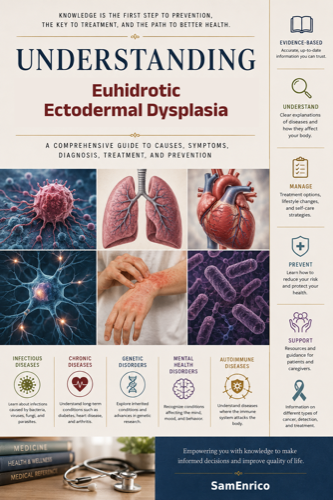
Understanding Euhidrotic Ectodermal Dysplasia eBook
This disease publication, published by SamEnrico,
by Tomlin Sana
This disease publication, published by SamEnrico, covers Understanding Euhidrotic Ectodermal Dysplasia
Formats
Free sample
Chapter 1: The Missing Smile...--The first time a parent notices something different about their child, it rarely arrives as a dramatic revelation. There is no sirens, no emergency room declaration, no moment of catastrophic collapse. Instead, it comes quietly, often in the form of a question asked by someone who means no harm: “How old is she? Eighteen months? Oh, what a sweetheart.
And how many teeth does she have?” The mother hesitates. She counts silently. Two teeth. Maybe three. The other mother at the playground smiles sympathetically and says, “Don’t worry, my nephew was late teething too.” But something does not feel right.
Three months later, there are still only three teeth. The pediatrician says, “Some children are late bloomers.” At the two-year checkup, the dentist takes an X-ray and goes quiet. Then he turns the monitor toward the parents. The image shows empty spaces where tooth buds should be. Not one or two missing.
Nearly all of them. The mother asks, “Is this normal?” The dentist removes his glasses and says something no parent ever wants to hear: “I think we need to refer you to a geneticist.”This is how Euhidrotic Ectodermal Dysplasia (EED) announces itself. Not with a bang, but with a missing tooth. Then another. Then the slow, dawning realization that the child’s hair is not just fine—it is sparse.
The nails are not just soft—they are ridged and thin. And yet, the child sweats. She runs around the playground, cheeks flushed, forehead glistening with perfectly normal perspiration. This last detail—the ability to sweat normally—is the quiet clue that separates EED from the more common and more dangerous forms of ectodermal dysplasia. It is also the reason EED so often goes undiagnosed for years, mislabeled as “late teething” or “fine hair runs in the family” or “some kids just look different.” The tragedy is not that EED is untreatable.
It is that so few people know what to look for.The Most Common Rare Disease You Have Never Heard Of Let us begin with a paradox. Euhidrotic Ectodermal Dysplasia is simultaneously very rare and almost certainly underdiagnosed. The most widely cited prevalence estimates suggest that all forms of ectodermal dysplasia combined affect approximately 1 in 10,000 to 1 in 100,000 live births. Within that spectrum, the hypohidrotic (sweat-deficient) form is the most common, accounting for perhaps 70 to 80 percent of all ED diagnoses. Euhidrotic variants—those with normal sweating—make up a much smaller fraction.
Some genetic registries estimate the prevalence of all non-hypohidrotic EDs at roughly 1 in 200,000 to 1 in 500,000 births. But these numbers come with a critical caveat: they count only diagnosed cases. And EED, for reasons we will explore throughout this chapter, is exceptionally good at hiding in plain sight.Consider the diagnostic journey of a typical child with EED. A 2023 retrospective analysis of ectodermal dysplasia patient registries found that the average time from first parental concern to definitive genetic diagnosis was 4.2 years for children with EED, compared to just 1.8 years for children with the hypohidrotic form. Why the discrepancy?
The answer lies in the very feature that gives EED its name: normal sweating. Children with hypohidrotic ED cannot cool themselves effectively. They experience unexplained fevers, heat intolerance, and episodes of hyperthermia that send parents to emergency rooms. These dramatic symptoms trigger genetic workups early. Children with EED, by contrast, sweat normally.
They run and play and overheat exactly as any other child would. Their only visible differences are dental, hair, and nail findings—features that parents and even pediatricians often dismiss as normal variations.A child with EED typically sees an average of 4.7 different healthcare providers before receiving a correct diagnosis. The most common misdiagnoses include isolated hypodontia (a dental condition with no systemic implications), alopecia areata (an autoimmune hair loss condition), and various forms of nail dystrophy labeled as fungal infections that never respond to treatment. One patient in the National Foundation for Ectodermal Dysplasias registry saw eleven dentists over eight years before anyone considered that her missing teeth might be part of a broader genetic syndrome. That patient was thirty-four years old at the time of diagnosis.
She had spent three decades believing she was simply unlucky with her teeth.The Crucial Distinction That Changes Everything At the heart of understanding EED lies a single Greek root: hidros, meaning sweat. The prefix eu means normal or good. Hypo means deficient or below. An means without. These three prefixes divide the ectodermal dysplasias into fundamentally different clinical realities:– Anhidrotic (without sweat): These patients cannot sweat at all.
They face life-threatening hyperthermia with even mild exertion or warm weather. Cooling vests, air conditioning, and constant temperature monitoring are not conveniences but survival necessities.– Hypohidrotic (deficient sweat): These patients produce significantly reduced sweat. They face similar risks, though often with slightly more margin for error. Many will develop some sweating in limited areas, but never enough for normal thermoregulation.– Euhidrotic (normal sweat): These patients sweat normally. Their sweat glands form, develop, and function exactly as they should.
They do not overheat. They do not need cooling vests. They can exercise, play sports, live in warm climates, and work outdoors without special precautions regarding temperature.This last category is EED. And the implications of normal sweating cannot be overstated. A child with EED can run track.
Join the soccer team. Go to summer camp in Texas. Work construction in Arizona. From a thermoregulatory perspective, they are entirely ordinary. This is the message that must be shouted from every diagnostic encounter, because the single most common mistake clinicians make is to hear “ectodermal dysplasia” and automatically assume “sweating problem.” That assumption is wrong for EED, and it leads to unnecessary restrictions, parental anxiety, and missed opportunities for correct management.What EED Actually Affects: Hair, Teeth, Nails, and More If sweat glands are spared in EED, what structures are affected?
The answer requires a brief journey into developmental biology, but we will keep it practical. The ectoderm—the outermost layer of the early embryo—gives rise to a remarkable array of adult structures: hair follicles, teeth, nails, sweat glands (except in EED), parts of the eyes (cornea, conjunctiva, meibomian glands), parts of the ears, and the mucous membranes of the nose and respiratory tract. In EED, specific genetic mutations disrupt the formation of some of these structures while leaving others intact. The pattern of involvement is not random. It follows predictable pathways.Hair (Hypotrichosis): Almost all individuals with EED have sparse scalp hair.
The hair that does grow is often fine, light-colored, and slow-growing. Eyebrows and eyelashes are also affected, though typically to a lesser degree. Some patients have normal hair density on the sides and back of the scalp with thinning on top. Others have diffuse thinning everywhere. A few—particularly those with certain TP63 mutations—may have nearly normal hair.
The variability is enormous, which contributes to diagnostic confusion.Teeth (Hypodontia, Oligodontia, Anodontia): Dental involvement is the most consistent feature of EED. The vast majority of patients are missing at least some teeth. The term hypodontia refers to the absence of one to six teeth (excluding third molars/wisdom teeth). Oligodontia means six or more missing teeth. Anodontia—complete absence of all teeth—is rare in EED…
This is the end of the free sample. Get the eBook to keep going. Buy now
About this book
Details
- Author
- Tomlin Sana
- Publisher
- SamEnrico
- Language
- English
- Genre
- Non-Fiction, Informative, Educational
- Released
- 2026-06-02
- Pages (approx.)
- 147
- Available as
- eBook, Audiobook

Read better in the ZLOADR app
Your eBooks on your phone or tablet. Sign in with your SamEnrico account and start reading.
More by Tomlin Sana
 Accessible Home ModificationsTomlin Sana$11.99
 Shift Work Partner Support GuideTomlin Sana$11.99
 Self Esteem After Retirement WorkbookTomlin Sana$11.99
 Peg System for Memorizing PoetryTomlin Sana$11.99
 The Remote Worker NetworkTomlin Sana$11.99
 The Quantum Gardener: How a Forgotten Genius Grew the FutureTomlin Sana$11.99
 The Forgotten Cartographer: Diogo Cão and the Secrets of the CongoTomlin Sana$11.99
 ToS for Educational SitesTomlin Sana$12.99
 CV Writer Intensive RetreatsTomlin Sana$12.99
 Motorcycle StuntsTomlin Sana$11.99
 How to Become a MosaicistTomlin Sana$11.99
You may also like
 Hong Kong Handover 1997Dunn Johnnie$11.99
 Zumba For Postnatal Recovery CourseNeal Christian$11.99
 Zumba for BeginnersLadner Nikia$11.99
 YouTube Comment Mining GuideHumes Pandora$12.99
 Worry Box MeditationCarlin Rudy$11.99
 Workplace Stress MeditationNguyen Lynn$11.99
 Workplace Stress and Sleep RepairHawley Ivory$11.99
 Workplace Perfectionism CureDelaney Jeffry$11.99
 Workplace Injustice Anger GuideWallen Isabelle$11.99
 Work Addiction and Burnout LinkGreenwood Ester$11.99
 Women in Yoga and WellnessBeattie Galina$11.99
 Women in Stand Up ComedyChun Evangeline$11.99