
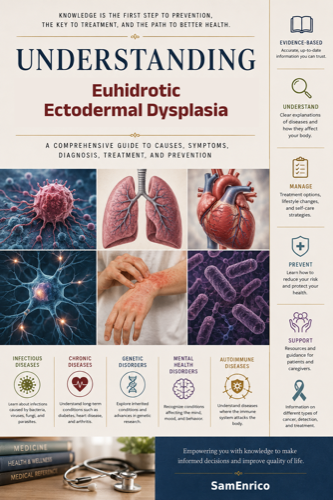
Understanding Euhidrotic Ectodermal Dysplasia Audiobook
This disease publication, published by SamEnrico,
by Tomlin Sana
This disease publication, published by SamEnrico, covers Understanding Euhidrotic Ectodermal Dysplasia
Formats
Free sample
Chapter 1: The Missing Smile...--The first time a parent notices something different about their child, it rarely arrives as a dramatic revelation. There is no sirens, no emergency room declaration, no moment of catastrophic collapse. Instead, it comes quietly, often in the form of a question asked by someone who means no harm: “How old is she? Eighteen months? Oh, what a sweetheart.
And how many teeth does she have?” The mother hesitates. She counts silently. Two teeth. Maybe three. The other mother at the playground smiles sympathetically and says, “Don’t worry, my nephew was late teething too.” But something does not feel right.
Three months later, there are still only three teeth. The pediatrician says, “Some children are late bloomers.” At the two-year checkup, the dentist takes an X-ray and goes quiet. Then he turns the monitor toward the parents. The image shows empty spaces where tooth buds should be. Not one or two missing.
Nearly all of them. The mother asks, “Is this normal?” The dentist removes his glasses and says something no parent ever wants to hear: “I think we need to refer you to a geneticist.”This is how Euhidrotic Ectodermal Dysplasia (EED) announces itself. Not with a bang, but with a missing tooth. Then another. Then the slow, dawning realization that the child’s hair is not just fine—it is sparse.
The nails are not just soft—they are ridged and thin. And yet, the child sweats. She runs around the playground, cheeks flushed, forehead glistening with perfectly normal perspiration. This last detail—the ability to sweat normally—is the quiet clue that separates EED from the more common and more dangerous forms of ectodermal dysplasia. It is also the reason EED so often goes undiagnosed for years, mislabeled as “late teething” or “fine hair runs in the family” or “some kids just look different.” The tragedy is not that EED is untreatable.
It is that so few people know what to look for.The Most Common Rare Disease You Have Never Heard Of Let us begin with a paradox. Euhidrotic Ectodermal Dysplasia is simultaneously very rare and almost certainly underdiagnosed. The most widely cited prevalence estimates suggest that all forms of ectodermal dysplasia combined affect approximately 1 in 10,000 to 1 in 100,000 live births. Within that spectrum, the hypohidrotic (sweat-deficient) form is the most common, accounting for perhaps 70 to 80 percent…
This is the end of the free sample. Get the Audiobook to keep going. Buy now
About this book
Details
- Author
- Tomlin Sana
- Publisher
- SamEnrico
- Language
- English
- Genre
- Non-Fiction, Informative, Educational
- Released
- 2026-06-02
- Pages (approx.)
- 147
- Available as
- eBook, Audiobook

Listen in the VoxFlicks app
Audiobooks and audio dramas wherever you go. Sign in with your SamEnrico account and press play.
More by Tomlin Sana
 Accessible Home ModificationsTomlin Sana$11.99
 Shift Work Partner Support GuideTomlin Sana$11.99
 Self Esteem After Retirement WorkbookTomlin Sana$11.99
 Peg System for Memorizing PoetryTomlin Sana$11.99
 The Remote Worker NetworkTomlin Sana$11.99
 The Quantum Gardener: How a Forgotten Genius Grew the FutureTomlin Sana$11.99
 The Forgotten Cartographer: Diogo Cão and the Secrets of the CongoTomlin Sana$11.99
 ToS for Educational SitesTomlin Sana$12.99
 CV Writer Intensive RetreatsTomlin Sana$12.99
 Motorcycle StuntsTomlin Sana$11.99
 How to Become a MosaicistTomlin Sana$11.99