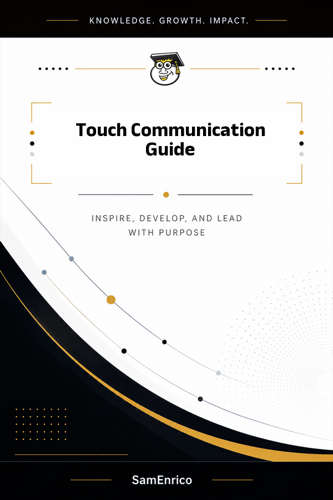
Touch Communication Guide Audiobook
Understand appropriate touch in professional and p
by Amaya Verlie
Understand appropriate touch in professional and personal settings.
Formats
Free sample
Chapter 1: The Hungry Hand...--The first time I understood that touch could be dangerous, I was thirty-two years old, standing in a hotel lobby, watching a colleague flinch.I had reached out to pat her shoulder—a gesture I had performed thousands of times before, always read as friendly, always received with a smile. But this time, something was different. Her body recoiled before her face could arrange itself into politeness. She stepped back, tucked her arms across her chest, and said, "Please don't."Those three words stopped me cold. Not because I had intended anything harmful—I hadn't.
Not because we had a difficult history—we didn't. But because in that single moment, I realized that my understanding of touch was entirely one-sided. I knew what I meant when I reached out. I had no idea what she felt when I arrived.That night, I began a journey that would take me through neuroscience labs, workplace harassment lawsuits, cultural studies across forty-two countries, and hundreds of interviews with people who had been hurt by touch—and people who had been healed by it. What I discovered changed everything I thought I knew about the silent language we use every day without ever being taught.This book is what I learned.
And Chapter 1 is where we begin: with the hand that reaches out, and the body that decides, in a fraction of a second, whether to welcome it or fear it.The Most Primitive Sense You Never Studied Before you could see clearly, before you could recognize your mother's face or understand her words, you knew her touch. The skin is the first organ to develop in the human embryo—at just eight weeks gestation, your lips and nose became sensitive to touch while your eyes were still sealed shut and your ears had not yet formed their inner structures. Touch is not just one sense among many. It is the foundational sense, the one upon which all others are built.Consider this: a baby born prematurely at twenty-four weeks can feel pain. That same baby cannot see, cannot hear meaningfully, and cannot regulate its own body temperature.
But it can feel. The neural pathways for touch are so ancient, so deeply wired into the mammalian brain, that they operate before almost every other cognitive function.This primacy has profound implications for how touch continues to shape us across our entire…
This is the end of the free sample. Get the Audiobook to keep going. Buy now
About this book
Details
- Author
- Amaya Verlie
- Publisher
- SamEnrico
- Language
- English
- Genre
- Non-Fiction, Self-Help, Touch
- Released
- 2026-06-06
- Pages (approx.)
- 137
- Available as
- eBook, Audiobook

Listen in the VoxFlicks app
Audiobooks and audio dramas wherever you go. Sign in with your SamEnrico account and press play.
More by Amaya Verlie
 Saint Benedict AccountAmaya Verlie$11.99
 Pet Loss and RoutineAmaya Verlie$11.99
 ER Nurse Burnout Prevention WorkbookAmaya Verlie$11.99
 The Self Esteem for Single Parents GuideAmaya Verlie$11.99
 The Forge of Hephaestus: Fire and Fury Beneath OlympusAmaya Verlie$11.99
 How to Start a Steel Foundries BusinessAmaya Verlie$11.99
 Bias Mitigation Reviewer PrimerAmaya Verlie$12.99
 Alternative Protein Market GuideAmaya Verlie$12.99
 Balloon Sword MakerAmaya Verlie$11.99
 Understanding KwashiorkorAmaya Verlie$17.99