
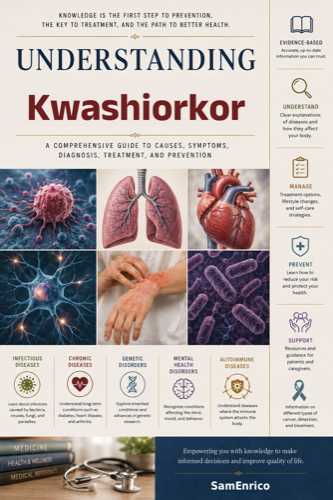
Non-FictionInformativeEducational
Understanding Kwashiorkor
This disease publication, published by SamEnrico,
by Amaya Verlie
This disease publication, published by SamEnrico, covers Understanding Kwashiorkor
Formats
About this book
Free sample
Chapter 1: The Deposed Child...--–- The child arrived at the Gold Coast hospital on a Tuesday afternoon in 1929, carried in her mother’s arms. She was two years old, maybe three—malnutrition made it difficult to know. Her feet had swollen to twice their normal size, the skin stretched tight and shiny over the dorsum of each foot. Her face was round and full, a disturbing contrast to the thin, brittle arms that hung limply at her sides. Her hair, once black and coarse like her mother’s, had turned a strange reddish-brown and grew in thin, wispy patches.
Worst of all was the skin on her buttocks and the backs of her thighs: dark, cracked, weeping patches that peeled away in flakes, revealing raw, pink tissue underneath. The mother called the condition kwashiorkor—a Ga word from her people along the coast of what is now Ghana. She explained to the British doctor that the word meant, roughly, “the disease of the deposed child.” The child had been weaned from the breast because another baby had come. She had been “sent away” from the mother’s milk. And now she was dying.The doctor who listened to this explanation was a thirty-four-year-old British woman named Cicely Williams.
She had arrived in the Gold Coast in 1929, one of the first female physicians to serve in the British Colonial Medical Service. She was short, energetic, and famously impatient with orthodoxy. When she examined the child, she noted something puzzling: the child was not simply starving. In marasmus, the disease of total caloric deprivation, children become skeletal—their fat disappears, their muscles waste, their faces become shrunken and old. But this child looked almost plump.
The edema masked the wasting. She appeared, to an untrained eye, to be adequately fed. Yet she was dying in plain sight.Williams had seen this syndrome before. In her first weeks at the hospital in Accra, she had admitted dozens of children with the same presentation: edema, dermatosis, hair changes, apathy, and a heartbreaking tendency to die despite appearing well-nourished. She had read the colonial medical…
This is the end of the free sample. Get the eBook to keep going. Buy now
Contents
- Chapter 1
- Chapter 2
- Chapter 3
- Chapter 4
- Chapter 5
- Chapter 6
- Chapter 7
- Chapter 8
- Chapter 9
- Chapter 10
- Chapter 11
- Chapter 12
Details
- Author
- Amaya Verlie
- Publisher
- SamEnrico
- Language
- English
- Genre
- Non-Fiction, Informative, Educational
- Released
- 2026-05-08
- Pages (approx.)
- 152
- Available as
- eBook, Audiobook

Read better in the ZLOADR app
Your eBooks on your phone or tablet. Sign in with your SamEnrico account and start reading.
More by Amaya Verlie
 Saint Benedict AccountAmaya Verlie$11.99
 Pet Loss and RoutineAmaya Verlie$11.99
 ER Nurse Burnout Prevention WorkbookAmaya Verlie$11.99
 Touch Communication GuideAmaya Verlie$11.99
 The Self Esteem for Single Parents GuideAmaya Verlie$11.99
 The Forge of Hephaestus: Fire and Fury Beneath OlympusAmaya Verlie$11.99
 How to Start a Steel Foundries BusinessAmaya Verlie$11.99
 Bias Mitigation Reviewer PrimerAmaya Verlie$12.99
 Alternative Protein Market GuideAmaya Verlie$12.99
 Balloon Sword MakerAmaya Verlie$11.99
You may also like
 Hong Kong Handover 1997Dunn Johnnie$11.99
 Zumba For Postnatal Recovery CourseNeal Christian$11.99
 Zumba for BeginnersLadner Nikia$11.99
 YouTube Comment Mining GuideHumes Pandora$12.99
 Worry Box MeditationCarlin Rudy$11.99
 Workplace Stress MeditationNguyen Lynn$11.99
 Workplace Stress and Sleep RepairHawley Ivory$11.99
 Workplace Perfectionism CureDelaney Jeffry$11.99
 Workplace Injustice Anger GuideWallen Isabelle$11.99
 Work Addiction and Burnout LinkGreenwood Ester$11.99
 Women in Yoga and WellnessBeattie Galina$11.99
 Women in Stand Up ComedyChun Evangeline$11.99