
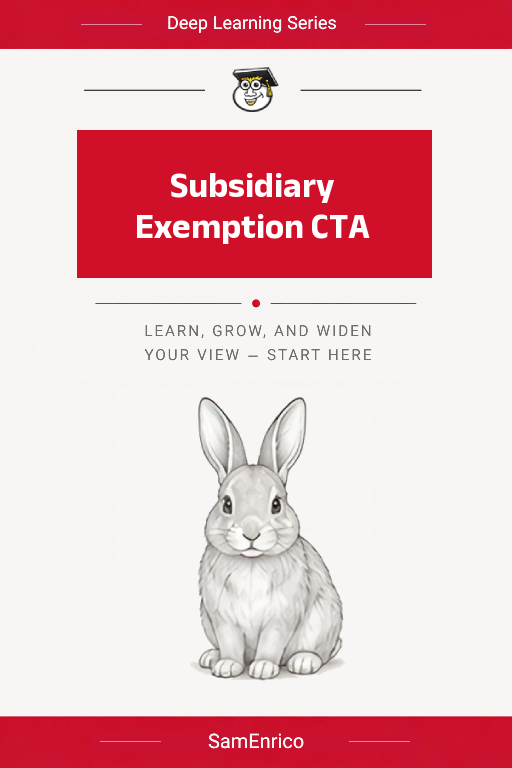
Non-FictionAnnual CheckupSubsidiary Rules
Subsidiary Exemption CTA
Claim subsidiary exemption for entities wholly own
Claim subsidiary exemption for entities wholly owned by exempt companies under CTA rules.
Formats
About this book
Free sample
Chapter 1: The Eighteen Doors--The letter arrived on a Tuesday, tucked between a utility bill and a fundraising appeal. The executive director of a mid-sized national nonprofit, whom we will call Sarah, almost tossed it in the recycling bin. The envelope bore the return address of the US Department of Treasury, Financial Crimes Enforcement Network — Fin CEN. Sarah had never heard of Fin CEN. She assumed it was a mistake, perhaps a scam.
It was not a scam.The letter informed Sarah that her organization, which operated fifty-two subsidiaries across seventeen states, had failed to file Beneficial Ownership Information reports for forty-seven of those subsidiaries. The potential penalties, the letter explained in cold bureaucratic language, were 591perday,perviolation.Sarahdidthemathquickly.Forty−sevensubsidiaries,eachnon−compliantforanaverageoftwohundreddays,times591 per day, per violation. Sarah did the math quickly. Forty-seven subsidiaries, each non-compliant for an average of two hundred days, times 591perday,perviolation.Sarahdidthemathquickly.Forty−sevensubsidiaries,eachnon−compliantforanaverageoftwohundreddays,times591. The number on her notepad was over 5.5million.Herorganizationdidnothave5.5 million.
Her organization did not have 5.5million.Herorganizationdidnothave5.5 million. She did not know what the term "subsidiary exemption" meant, but she was about to learn, and her entire career depended on getting it right.This chapter exists because Sarah's story is not rare. It is repeated every week in boardrooms, law offices, and finance departments across the United States. The Corporate Transparency Act of 2021 (CTA) created a new compliance regime that has caught thousands of organizations off guard. But within that regime lies a powerful tool: the subsidiary exemption.
Understanding this exemption — and more importantly, understanding which entities can actually use it — is the difference between Sarah's $5.5 million nightmare and a clean bill of compliance.The Legislative Earthquake: Why Congress Created the CTATo understand the subsidiary exemption, one must first understand the problem Congress was trying to solve. For decades, anonymous shell companies have been the vehicle of choice for money launderers, drug traffickers, terrorist financiers, and tax evaders. The United States, ironically, had become one of the easiest places in the world to form an anonymous company. In Delaware, Wyoming, and Nevada, an individual could form…
This is the end of the free sample. Get the eBook to keep going. Buy now
Contents
- Chapter 1
- Chapter 2
- Chapter 3
- Chapter 4
- Chapter 5
- Chapter 6
- Chapter 7
- Chapter 8
- Chapter 9
- Chapter 10
- Chapter 11
- Chapter 12
Details
- Author
- Castillo Rogelio
- Publisher
- SamEnrico
- Language
- English
- Genre
- Non-Fiction, Annual Checkup, Subsidiary Rules
- Released
- 2026-05-29
- Pages (approx.)
- 136
- Available as
- eBook, Audiobook

Read better in the ZLOADR app
Your eBooks on your phone or tablet. Sign in with your SamEnrico account and start reading.
More by Castillo Rogelio
 Meditation for Whiplash PainCastillo Rogelio$11.99
 Metta for Foster Care Alumni GuideCastillo Rogelio$11.99
 Calm Down Anger ToolkitCastillo Rogelio$11.99
 Loneliness After Religious DeconstructionCastillo Rogelio$11.99
 Beginner Fitness Holiday GuideCastillo Rogelio$11.99
 Wings Over the Pacific: The Balloon Pioneers Who Mapped the UnknownCastillo Rogelio$11.99
 Burning Secrets: The Great Chicago Fire’s Hidden ArsonistCastillo Rogelio$11.99
 Understanding Diabetes, Insulin DependentCastillo Rogelio$17.99
 CTA Enforcement UpdateCastillo Rogelio$12.99
 How to Start a Hobby in Jiu JitsuCastillo Rogelio$11.99
 Advanced AnalyticsCastillo Rogelio$11.99
You may also like
 Hong Kong Handover 1997Dunn Johnnie$11.99
 Zumba For Postnatal Recovery CourseNeal Christian$11.99
 Zumba for BeginnersLadner Nikia$11.99
 YouTube Comment Mining GuideHumes Pandora$12.99
 Worry Box MeditationCarlin Rudy$11.99
 Workplace Stress MeditationNguyen Lynn$11.99
 Workplace Stress and Sleep RepairHawley Ivory$11.99
 Workplace Perfectionism CureDelaney Jeffry$11.99
 Workplace Injustice Anger GuideWallen Isabelle$11.99
 Work Addiction and Burnout LinkGreenwood Ester$11.99
 Women in Yoga and WellnessBeattie Galina$11.99
 Women in Stand Up ComedyChun Evangeline$11.99