
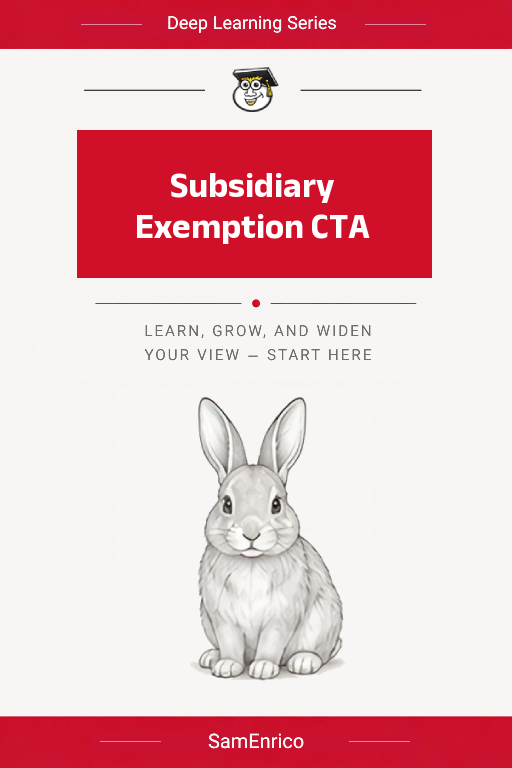
Non-FictionAnnual CheckupSubsidiary Rules
Subsidiary Exemption CTA eBook
Claim subsidiary exemption for entities wholly own
Claim subsidiary exemption for entities wholly owned by exempt companies under CTA rules.
Formats
Free sample
Chapter 1: The Eighteen Doors--The letter arrived on a Tuesday, tucked between a utility bill and a fundraising appeal. The executive director of a mid-sized national nonprofit, whom we will call Sarah, almost tossed it in the recycling bin. The envelope bore the return address of the US Department of Treasury, Financial Crimes Enforcement Network — Fin CEN. Sarah had never heard of Fin CEN. She assumed it was a mistake, perhaps a scam.
It was not a scam.The letter informed Sarah that her organization, which operated fifty-two subsidiaries across seventeen states, had failed to file Beneficial Ownership Information reports for forty-seven of those subsidiaries. The potential penalties, the letter explained in cold bureaucratic language, were 591perday,perviolation.Sarahdidthemathquickly.Forty−sevensubsidiaries,eachnon−compliantforanaverageoftwohundreddays,times591 per day, per violation. Sarah did the math quickly. Forty-seven subsidiaries, each non-compliant for an average of two hundred days, times 591perday,perviolation.Sarahdidthemathquickly.Forty−sevensubsidiaries,eachnon−compliantforanaverageoftwohundreddays,times591. The number on her notepad was over 5.5million.Herorganizationdidnothave5.5 million.
Her organization did not have 5.5million.Herorganizationdidnothave5.5 million. She did not know what the term "subsidiary exemption" meant, but she was about to learn, and her entire career depended on getting it right.This chapter exists because Sarah's story is not rare. It is repeated every week in boardrooms, law offices, and finance departments across the United States. The Corporate Transparency Act of 2021 (CTA) created a new compliance regime that has caught thousands of organizations off guard. But within that regime lies a powerful tool: the subsidiary exemption.
Understanding this exemption — and more importantly, understanding which entities can actually use it — is the difference between Sarah's $5.5 million nightmare and a clean bill of compliance.The Legislative Earthquake: Why Congress Created the CTATo understand the subsidiary exemption, one must first understand the problem Congress was trying to solve. For decades, anonymous shell companies have been the vehicle of choice for money launderers, drug traffickers, terrorist financiers, and tax evaders. The United States, ironically, had become one of the easiest places in the world to form an anonymous company. In Delaware, Wyoming, and Nevada, an individual could form a limited liability company in under an hour for a few hundred dollars, without ever disclosing who actually owned or controlled the entity. This was not a bug in the system; it was a feature, deliberately designed to attract business formation revenue.The numbers are staggering.
The Financial Accountability and Corporate Transparency Coalition estimates that over two million shell companies are formed in the United States each year. Of those, a significant percentage are used for illicit purposes. The Panama Papers, the Paradise Papers, and numerous other leaks revealed that anonymous US companies were being used to hide assets, launder money, and evade sanctions. The United States was rated as one of the worst jurisdictions in the world for corporate transparency by the Tax Justice Network, earning the unfortunate nickname "the world's premier offshore haven" from the Global Financial Integrity organization.Congress finally acted. In January 2021, the Corporate Transparency Act was passed as part of the National Defense Authorization Act, overriding President Trump's veto.
For the first time in American history, many companies would be required to disclose their true beneficial owners to the federal government. The message was clear: the era of anonymous shell companies in the United States was ending.The CTA's core mechanism is simple on its face but devastating in its reach. Any "reporting company" — generally defined as any corporation, limited liability company, or similar entity created by filing a document with a secretary of state or similar office — must file a report with Fin CEN disclosing its beneficial owners. A beneficial owner is any individual who either (1) owns or controls twenty-five percent or more of the entity's ownership interests, or (2) exercises "substantial control" over the entity. Substantial control includes senior officers, individuals who appoint or remove directors, and anyone with significant influence over important decisions such as mergers, asset sales, or changes to governing documents.But the CTA contains something else: twenty-three exemptions.
Twenty-three categories of entities that are completely exempt from filing these reports. Some exemptions are obvious: publicly traded companies already disclose their owners to the SEC. Banks and credit unions are already heavily regulated by federal and state banking authorities. Others are less obvious but equally important for this book: large operating companies with more than twenty employees, tax-exempt entities under Section 501(c) of the Internal Revenue Code, and — critically for our purposes — subsidiaries of exempt entities.Exemption #22: The Subsidiary Exemption The subsidiary exemption is technically the twenty-second exemption listed in the CTA's implementing regulations, codified at 31 C.F.R. § 1010.380(e)(2)(xxii).
The language appears deceptively simple: an entity is exempt if its "ownership interests are controlled or wholly owned, directly or indirectly, by one or more exempt entities."That is it. Twelve words that have generated thousands of hours of legal analysis and millions of dollars in compliance costs. Those twelve words are the difference between Sarah's $5.5 million penalty and a clean compliance file.The logic of the exemption is straightforward. If the parent entity is already exempt from filing BOI reports — because it is a public company, a bank, a large operating company, or a tax-exempt nonprofit — then the subsidiary should not have to file separate reports about the same beneficial owners. The information would be duplicative.
The exemption prevents that duplication and reduces the regulatory burden on organizations that are already transparent.But here is where most organizations get into trouble. They assume that if their parent is exempt, their subsidiary is automatically exempt. That assumption is wrong. Dangerously wrong. It is the equivalent of assuming that because you have a key to one door in a building, you have a key to every door.
You do not.The subsidiary exemption only works if the parent is the right kind of exempt entity. And there are twenty-three exemptions total, but only eighteen of them can serve as qualifying parents for the subsidiary exemption. The other five cannot. They are exempt themselves, but they cannot pass that exemption down to their subsidiaries. This distinction is the single most misunderstood aspect of the entire CTA, and misunderstanding it has cost organizations millions of dollars in penalties.The Critical Distinction: Twenty-Three Total, Eighteen Qualifying Let us be absolutely clear, because this is the foundation upon which everything else in this book rests.
The CTA recognizes twenty-three distinct categories of exempt entities. They are listed in the regulations and summarized in Appendix B of this book. But when it comes to the subsidiary exemption — the ability to claim that your subsidiary does not need to file a BOI report because your parent is exempt — only eighteen of those twenty-three categories work.Think of it this way. Imagine a large office building with twenty-three doors. Behind each door is a different type of exempt entity.
Eighteen of those doors are labeled "Parent Qualified" — meaning if your parent is behind one of those doors, you can claim the subsidiary exemption for your downstream entities. The other five doors are labeled "Parent Not Qualified" — meaning if your parent is behind one of those doors, your parent is exempt, but your subsidiary is not.The eighteen qualifying exempt…
This is the end of the free sample. Get the eBook to keep going. Buy now
About this book
Details
- Author
- Castillo Rogelio
- Publisher
- SamEnrico
- Language
- English
- Genre
- Non-Fiction, Annual Checkup, Subsidiary Rules
- Released
- 2026-05-29
- Pages (approx.)
- 136
- Available as
- eBook, Audiobook

Read better in the ZLOADR app
Your eBooks on your phone or tablet. Sign in with your SamEnrico account and start reading.
More by Castillo Rogelio
 Meditation for Whiplash PainCastillo Rogelio$11.99
 Metta for Foster Care Alumni GuideCastillo Rogelio$11.99
 Calm Down Anger ToolkitCastillo Rogelio$11.99
 Loneliness After Religious DeconstructionCastillo Rogelio$11.99
 Beginner Fitness Holiday GuideCastillo Rogelio$11.99
 Wings Over the Pacific: The Balloon Pioneers Who Mapped the UnknownCastillo Rogelio$11.99
 Burning Secrets: The Great Chicago Fire’s Hidden ArsonistCastillo Rogelio$11.99
 Understanding Diabetes, Insulin DependentCastillo Rogelio$17.99
 CTA Enforcement UpdateCastillo Rogelio$12.99
 How to Start a Hobby in Jiu JitsuCastillo Rogelio$11.99
 Advanced AnalyticsCastillo Rogelio$11.99
You may also like
 Hong Kong Handover 1997Dunn Johnnie$11.99
 Zumba For Postnatal Recovery CourseNeal Christian$11.99
 Zumba for BeginnersLadner Nikia$11.99
 YouTube Comment Mining GuideHumes Pandora$12.99
 Worry Box MeditationCarlin Rudy$11.99
 Workplace Stress MeditationNguyen Lynn$11.99
 Workplace Stress and Sleep RepairHawley Ivory$11.99
 Workplace Perfectionism CureDelaney Jeffry$11.99
 Workplace Injustice Anger GuideWallen Isabelle$11.99
 Work Addiction and Burnout LinkGreenwood Ester$11.99
 Women in Yoga and WellnessBeattie Galina$11.99
 Women in Stand Up ComedyChun Evangeline$11.99