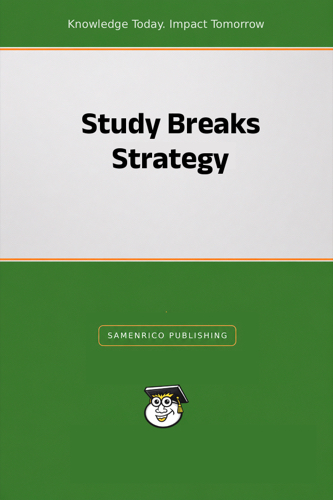
Study Breaks Strategy eBook
Use effective rest periods to maintain memory and
by Burris Ira
Use effective rest periods to maintain memory and attention.
Formats
Free sample
Chapter 1: The More You Cram, The Less You Learn--–- Maria was a straight-A student who did everything wrong. She woke up at 4:00 AM before her final exams, brewed a pot of coffee, and sat down for an eight-hour study marathon. She reviewed the same chapter of organic chemistry six times. She highlighted nearly every paragraph in yellow. She felt exhausted but virtuous—after all, she was sacrificing sleep and comfort for her grades.
Her roommate, by contrast, studied in short bursts, took walks outside, and even watched an episode of a sitcom the night before the test. Maria was certain she would outperform her roommate. When grades came back, Maria scored a 74. Her roommate scored a 91. Maria’s first reaction was anger: “She didn’t even study as hard as I did.” Her second reaction was confusion: “How is that possible?” Her third reaction—the one that changed her life—was curiosity: “What if I have been misunderstanding studying my entire life?”This chapter is for every Maria who has ever believed that more hours equal better results.
That exhaustion is a badge of honor. That taking a break means you are weak. These beliefs are not just harmless myths. They are actively damaging your memory, your attention, and your grades. The research is unanimous and uncomfortable: beyond a very short window of focused work, every additional hour of continuous studying produces less and less retention, until eventually you are learning nothing at all while still feeling like you are working hard.
The most successful learners in the world—from Olympic athletes to concert pianists to Nobel Prize-winning scientists—do something that most students find almost unthinkable. They rest on purpose. They schedule breaks the way they schedule study sessions. And they have discovered a truth that will transform how you learn: a study break is not a reward for studying. It is part of the study system itself.The Law of Diminishing Returns in Learning Let us begin with a simple question.
If you study for one hour, how much do you remember? If you study for two hours straight, do you remember twice as much? Almost never. In fact, research on the law of diminishing returns—a concept borrowed from economics but perfectly applicable to cognitive science—shows that the relationship between study time and retention is not linear but curved. The first 30 to 45 minutes of focused study produce the highest yield of memory encoding per minute.
The next 30 minutes produce less. The hour after that produces even less. By the time you have been studying continuously for three or four hours, you may be adding almost nothing to your long-term memory while still feeling like you are working.A landmark study from the University of Illinois asked two groups of students to learn a complex statistical concept. The first group studied for 50 minutes and then took a 10-minute break before continuing. The second group studied for 100 minutes straight without any interruption.
At the end of the day, both groups had spent the same total amount of time studying—but the group that took breaks remembered 42 percent more of the material. That is not a small difference. That is the difference between a C and an A. The researchers measured not just recall but also comprehension, problem-solving speed, and the ability to apply the concept to new situations. The break-taking group outperformed the no-break group on every single metric.Why does this happen?
The answer lies in the difference between time spent studying and quality of attention during that time. After about 45 minutes of continuous focus, the brain begins to experience what psychologists call “attentional drift.” You are still looking at the page. You are still moving your eyes across the words. But the deep processing that transforms information into memory has started to shut down. You enter a state of low-grade cognitive autopilot.
Most students cannot even detect this shift—they feel like they are still studying, but their retention has dropped by more than half. The breaks in the University of Illinois study allowed the first group’s attention to reset, so that each 50-minute block was as effective as the first one. The second group’s attention degraded steadily over time, so that the final 50 minutes of their session produced almost no learning at all.This is the first and most important truth of the Study Breaks Strategy: studying continuously does not work. You cannot outlast your brain’s biology. The students who seem to study less but remember more are not cheating.
They are respecting the laws of cognitive physics while you are fighting them.The Forgetting Curve: Why Your Brain Deletes Information Without Permission If diminishing returns were the only problem, you could simply study in shorter blocks and still succeed. But there is a second, even more insidious force at work: your brain is actively trying to forget what you just learned. This is not a design flaw. Your brain is bombarded with millions of pieces of sensory information every second. To function, it must constantly decide what to keep and what to discard.
Without a strategic signal to “save this information,” your brain will treat most of what you study as background noise and delete it within hours.In the late 19th century, German psychologist Hermann Ebbinghaus conducted the first systematic experiments on human memory. He taught himself lists of nonsense syllables (like “DAX” and “BIP”) and tested his own recall at different time intervals. What he discovered became one of the most replicated findings in all of psychology: the forgetting curve. Ebbinghaus found that without any reinforcement or review, people forget approximately 50 percent of new information within the first hour. Within 24 hours, they forget up to 70 percent.
Within a week, unless they have done something to interrupt the curve, they remember less than 20 percent of what they originally learned.Let us pause to appreciate how devastating this is. You can sit in a lecture for an hour, take careful notes, and feel like you have learned a great deal. Then you walk out of the classroom, go to your next class, eat lunch, check your phone, and by the time you sit down to study that evening, half of the lecture has already vanished from your memory. You did not forget because you are lazy or unintelligent. You forgot because that is what brains do unless you give them a reason not to.The forgetting curve is not a suggestion.
It is a biological fact. And most students accidentally accelerate it by how they study. When you cram for hours without breaks, you are not just suffering from diminishing returns. You are also ensuring that the forgetting curve will strike hardest right before your exam. The information never had a chance to consolidate because you never gave your brain the one thing it needs to move information from temporary storage to permanent memory: strategic rest.The Spacing Effect: The Most Powerful Learning Tool You Are Not Using If the forgetting curve is bad news, the spacing effect is the good news that most students have never heard of.
The spacing effect is the counterintuitive discovery that you remember more when you study less—as long as you spread that…
This is the end of the free sample. Get the eBook to keep going. Buy now
About this book
Details
- Author
- Burris Ira
- Publisher
- SamEnrico
- Language
- English
- Genre
- Non-Fiction, Self-Help, Rest
- Released
- 2026-06-09
- Pages (approx.)
- 141
- Available as
- eBook, Audiobook

Read better in the ZLOADR app
Your eBooks on your phone or tablet. Sign in with your SamEnrico account and start reading.
More by Burris Ira
 The Uncle's AliasBurris Ira$11.99
 Crematorium Operator StressBurris Ira$11.99
 Senior Progressive RelaxationBurris Ira$11.99
 Action Planning for EngineersBurris Ira$11.99
 Night Shift Sleep Recovery PlanBurris Ira$11.99
 Rock Climber Self HypnosisBurris Ira$11.99
 CPR for Dialysis PatientsBurris Ira$11.99
 The Silent Lens: Felice Beato's War Through a Camera (1850s-1860s)Burris Ira$11.99
 The Golden Aria: Black Voices That Conquered the Grand StageBurris Ira$11.99
 How to Produce EggplantsBurris Ira$11.99
 How to Produce Printed Circuit BoardsBurris Ira$11.99
 Packaging for European Export GuideBurris Ira$12.99