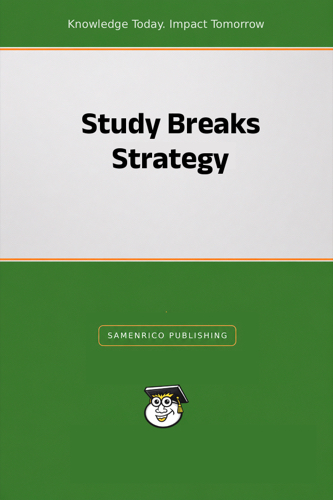
Study Breaks Strategy Audiobook
Use effective rest periods to maintain memory and
by Burris Ira
Use effective rest periods to maintain memory and attention.
Formats
Free sample
Chapter 1: The More You Cram, The Less You Learn--–- Maria was a straight-A student who did everything wrong. She woke up at 4:00 AM before her final exams, brewed a pot of coffee, and sat down for an eight-hour study marathon. She reviewed the same chapter of organic chemistry six times. She highlighted nearly every paragraph in yellow. She felt exhausted but virtuous—after all, she was sacrificing sleep and comfort for her grades.
Her roommate, by contrast, studied in short bursts, took walks outside, and even watched an episode of a sitcom the night before the test. Maria was certain she would outperform her roommate. When grades came back, Maria scored a 74. Her roommate scored a 91. Maria’s first reaction was anger: “She didn’t even study as hard as I did.” Her second reaction was confusion: “How is that possible?” Her third reaction—the one that changed her life—was curiosity: “What if I have been misunderstanding studying my entire life?”This chapter is for every Maria who has ever believed that more hours equal better results.
That exhaustion is a badge of honor. That taking a break means you are weak. These beliefs are not just harmless myths. They are actively damaging your memory, your attention, and your grades. The research is unanimous and uncomfortable: beyond a very short window of focused work, every additional hour of continuous studying produces less and less retention, until eventually you are learning nothing at all while still feeling like you are working hard.
The most successful learners in the world—from Olympic athletes to concert pianists to Nobel Prize-winning scientists—do something that most students find almost unthinkable. They rest on purpose. They schedule breaks the way they schedule study sessions. And they have discovered a truth that will transform how you learn: a study break is not a reward for studying. It is part of the study system itself.The Law of Diminishing Returns in Learning Let us begin with a simple question.
If you study for one hour, how much do you remember? If you study for two hours straight, do you remember twice as much? Almost never. In fact, research on the law of diminishing returns—a concept borrowed from economics but perfectly applicable to cognitive science—shows that the relationship between study time and retention is not linear but curved. The first 30 to 45 minutes of focused…
This is the end of the free sample. Get the Audiobook to keep going. Buy now
About this book
Details
- Author
- Burris Ira
- Publisher
- SamEnrico
- Language
- English
- Genre
- Non-Fiction, Self-Help, Rest
- Released
- 2026-06-09
- Pages (approx.)
- 141
- Available as
- eBook, Audiobook

Listen in the VoxFlicks app
Audiobooks and audio dramas wherever you go. Sign in with your SamEnrico account and press play.
More by Burris Ira
 The Uncle's AliasBurris Ira$11.99
 Crematorium Operator StressBurris Ira$11.99
 Senior Progressive RelaxationBurris Ira$11.99
 Action Planning for EngineersBurris Ira$11.99
 Night Shift Sleep Recovery PlanBurris Ira$11.99
 Rock Climber Self HypnosisBurris Ira$11.99
 CPR for Dialysis PatientsBurris Ira$11.99
 The Silent Lens: Felice Beato's War Through a Camera (1850s-1860s)Burris Ira$11.99
 The Golden Aria: Black Voices That Conquered the Grand StageBurris Ira$11.99
 How to Produce EggplantsBurris Ira$11.99
 How to Produce Printed Circuit BoardsBurris Ira$11.99
 Packaging for European Export GuideBurris Ira$12.99