
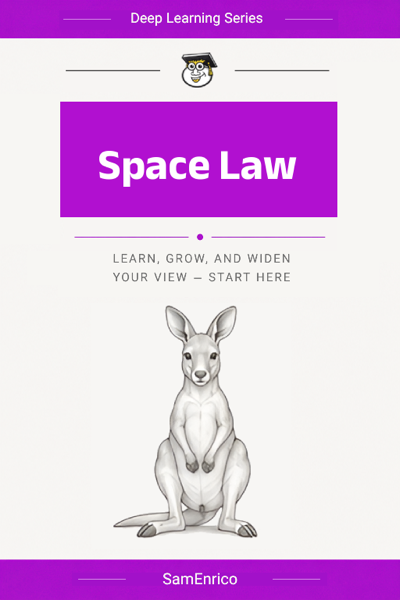
Non-FictionInformativeEducational
Space Law
A Coursebook on Space Law
A Coursebook on Space Law
Formats
About this book
Free sample
Chapter 1: The Day the Beep Changed Everything--–- At 10:28 PM on October 4, 1957, a Polish-American engineer named Frank Mc Clure stood in a cramped radar station in New Jersey, listening to a sound no human had ever heard. A faint beep. Then another. Then another, each one separated by precisely 0.3 seconds of silence. Mc Clure grabbed the phone and called his superiors at the Johns Hopkins Applied Physics Laboratory.
His message was not the triumphant announcement of a scientific breakthrough. It was something far more unsettling: "They've done it. The Russians are overhead. And we have no idea what the legal rules are up there."That night, the Space Age began not with a bang but with a beep. And beneath that beep, a quiet panic spread through every government on Earth.
The Soviet Union's Sputnik 1, a polished metal sphere weighing just 184 pounds, was hurtling through the void at 18,000 miles per hour, crossing the borders of every nation on the planet every ninety minutes. As it passed over the United States, Canada, France, India, and Australia, it raised a question no treaty had ever answered: what right did any country have to fly something over another country's territory without permission?For centuries, the law of the skies had been clear. The Chicago Convention of 1944, negotiated in the final months of World War II, had enshrined the principle of absolute national sovereignty over airspace. Every country owned the air above its territory, and no foreign aircraft could enter without permission. Violate that rule, and you risked being shot down.
But Sputnik was not flying through the air. It was flying above it, at altitudes where the atmosphere thinned to nothing and the laws of aerodynamics gave way to the laws of orbital mechanics. Was 100 miles up still "airspace"? What about 200 miles? What about the geostationary belt, 22,236 miles above the equator, where satellites seemed to hang motionless like stars awaiting a claim?No one knew.
And in that uncertainty, the United States faced a terrifying geopolitical problem: if it protested the Soviet overflights, it would legitimize the very principle that American reconnaissance planes…
This is the end of the free sample. Get the eBook to keep going. Buy now
Contents
- Chapter 1
- Chapter 2
- Chapter 3
- Chapter 4
- Chapter 5
- Chapter 6
- Chapter 7
- Chapter 8
- Chapter 9
- Chapter 10
- Chapter 11
- Chapter 12
Details
- Author
- Gould Bernetta
- Publisher
- SamEnrico
- Language
- English
- Genre
- Non-Fiction, Informative, Educational
- Released
- 2026-05-09
- Pages (approx.)
- 129
- Available as
- eBook, Audiobook

Read better in the ZLOADR app
Your eBooks on your phone or tablet. Sign in with your SamEnrico account and start reading.
More by Gould Bernetta
 Envy in Weight LossGould Bernetta$11.99
 TM for Workaholism GuideGould Bernetta$11.99
 Empathic Listening GuideGould Bernetta$11.99
 The Self Talk for MistakesGould Bernetta$11.99
 The Psychopaths Charm WeaponGould Bernetta$11.99
 The Star Keepers of Nubia: Astronomy and the Legacy of the Kushite Royal AstronomersGould Bernetta$11.99
 Understanding Tolosa–hunt SyndromeGould Bernetta$17.99
 Factoring Legal Framework GuideGould Bernetta$12.99
 Audacity Replaces Pro Tools GuideGould Bernetta$12.99
 How to Become a Dry-end OperatorGould Bernetta$11.99
You may also like
 Hong Kong Handover 1997Dunn Johnnie$11.99
 Zumba For Postnatal Recovery CourseNeal Christian$11.99
 Zumba for BeginnersLadner Nikia$11.99
 YouTube Comment Mining GuideHumes Pandora$12.99
 Worry Box MeditationCarlin Rudy$11.99
 Workplace Stress MeditationNguyen Lynn$11.99
 Workplace Stress and Sleep RepairHawley Ivory$11.99
 Workplace Perfectionism CureDelaney Jeffry$11.99
 Workplace Injustice Anger GuideWallen Isabelle$11.99
 Work Addiction and Burnout LinkGreenwood Ester$11.99
 Women in Yoga and WellnessBeattie Galina$11.99
 Women in Stand Up ComedyChun Evangeline$11.99