
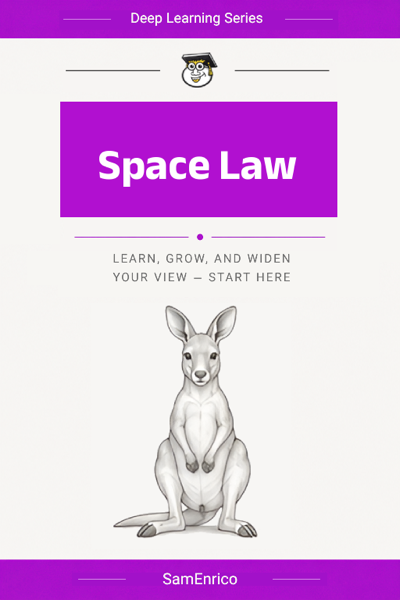
Non-FictionInformativeEducational
Space Law eBook
A Coursebook on Space Law
A Coursebook on Space Law
Formats
Free sample
Chapter 1: The Day the Beep Changed Everything--–- At 10:28 PM on October 4, 1957, a Polish-American engineer named Frank Mc Clure stood in a cramped radar station in New Jersey, listening to a sound no human had ever heard. A faint beep. Then another. Then another, each one separated by precisely 0.3 seconds of silence. Mc Clure grabbed the phone and called his superiors at the Johns Hopkins Applied Physics Laboratory.
His message was not the triumphant announcement of a scientific breakthrough. It was something far more unsettling: "They've done it. The Russians are overhead. And we have no idea what the legal rules are up there."That night, the Space Age began not with a bang but with a beep. And beneath that beep, a quiet panic spread through every government on Earth.
The Soviet Union's Sputnik 1, a polished metal sphere weighing just 184 pounds, was hurtling through the void at 18,000 miles per hour, crossing the borders of every nation on the planet every ninety minutes. As it passed over the United States, Canada, France, India, and Australia, it raised a question no treaty had ever answered: what right did any country have to fly something over another country's territory without permission?For centuries, the law of the skies had been clear. The Chicago Convention of 1944, negotiated in the final months of World War II, had enshrined the principle of absolute national sovereignty over airspace. Every country owned the air above its territory, and no foreign aircraft could enter without permission. Violate that rule, and you risked being shot down.
But Sputnik was not flying through the air. It was flying above it, at altitudes where the atmosphere thinned to nothing and the laws of aerodynamics gave way to the laws of orbital mechanics. Was 100 miles up still "airspace"? What about 200 miles? What about the geostationary belt, 22,236 miles above the equator, where satellites seemed to hang motionless like stars awaiting a claim?No one knew.
And in that uncertainty, the United States faced a terrifying geopolitical problem: if it protested the Soviet overflights, it would legitimize the very principle that American reconnaissance planes had been violating while flying over Soviet territory for years. If it stayed silent, it would concede that space was open to anyone, including the Soviets, who had just demonstrated the ability to drop a nuclear weapon from orbit with almost no warning. The United States made a calculated choice. It swallowed its objections, acknowledged that Sputnik posed no direct threat, and quietly began planning its own satellites. But the legal question refused to stay buried.
Within two years, the newly created United Nations Committee on the Peaceful Uses of Outer Space—UNCOPUOS, a name that sounds bureaucratic but whose work would shape every space activity for the next seven decades—would begin drafting the rules of a new frontier.The Birth of a Legal Frontier: From Disarmament to Commerce This chapter opens where every space law story must begin: in the intersection of Cold War paranoia, technological astonishment, and the sudden realization that the legal systems built for Earth were completely inadequate for the cosmos. To understand space law today—to grasp why Elon Musk can claim to mine asteroids but not plant a flag, why the International Space Station operates under a patchwork of criminal jurisdictions, and why no one has ever been successfully sued for a collision in orbit—you must first understand the peculiar DNA of this legal field.Space law is not commercial law dressed up in a spacesuit. It is disarmament law that has been stretched, twisted, and repurposed to accommodate billionaires and startups. The men who drafted the Outer Space Treaty in 1967 were not thinking about space tourism or satellite internet or lunar mining. They were thinking about nuclear warheads in orbit.
They were thinking about surprise attacks from above. They were thinking about how to prevent the Cold War from turning space into a shooting gallery. The fact that their treaty has managed to govern commercial activities they never imagined is less a testament to their foresight than to the strange flexibility of words like "peaceful purposes" and "province of all mankind."Consider the sequence of events. Sputnik launched in October 1957. The United States launched Explorer 1 in January 1958.
By 1959, the UN had created UNCOPUOS, with eighteen member states divided between the Western bloc, the Soviet bloc, and the Non-Aligned Movement. And by 1963, before anyone had even landed on the Moon, the world had already agreed on the Declaration of Legal Principles Governing the Activities of States in the Exploration and Use of Outer Space—a non-binding resolution that would become the blueprint for the Outer Space Treaty.That speed is astonishing. Today, the UN can barely agree on a resolution condemning space debris. In the 1960s, it produced five major treaties in twelve years. What changed?
The answer is fear. The Cuban Missile Crisis of 1962 had brought the world to the brink of nuclear war, and both superpowers understood that space—with its potential for hidden weapons, surprise attacks, and destabilizing first strikes—was a nightmare waiting to happen. They rushed to build a legal framework not because they trusted each other but because they trusted each other so little that they needed rules to avoid accidental annihilation.The Core Insight: Space Law Is Not What You Think Here is the single most important insight this book will offer you, and the key to understanding everything that follows: space law is not a coherent code designed by rational planners. It is a series of compromises, ambiguities, and deliberate omissions negotiated between enemies who agreed on only one thing—that space should not become a graveyard for human civilization. Everything else was left unclear, to be filled in later.
The problem is that "later" is now. And we are still trying to fill in the gaps while rockets launch weekly and companies file patents for Moon mining and nations test anti-satellite weapons.To understand this history, you need to meet the institutions that made it happen. UNCOPUOS, the primary treaty-drafting body, was never given the power to enforce its rules. It operates by consensus, meaning any single country can veto any provision. That structure made sense in the 1960s, when the US and USSR agreed on basic principles and the only disagreement was over details.
It makes far less sense today, when Russia and China have different visions of space governance than the United States, and when private companies have no seat at the table at all. The Legal Subcommittee of UNCOPUOS meets every year in Vienna, in a basement room that smells of coffee and aged paperwork, and for two weeks, delegates argue over whether to add a single paragraph to a non-binding set of guidelines. That is not a criticism. It is a description of how international law actually works when nations do not want to be bound.Alongside UNCOPUOS, the International Law Association (ILA) has produced influential soft-law instruments, though few outside the field have heard of it. The ILA is a group of international lawyers who meet to draft model treaties and restatements of customary law.
Their work on space law in the 1960s and 1970s helped clarify concepts like "launching state" and "space object," terms…
This is the end of the free sample. Get the eBook to keep going. Buy now
About this book
Details
- Author
- Gould Bernetta
- Publisher
- SamEnrico
- Language
- English
- Genre
- Non-Fiction, Informative, Educational
- Released
- 2026-05-09
- Pages (approx.)
- 129
- Available as
- eBook, Audiobook

Read better in the ZLOADR app
Your eBooks on your phone or tablet. Sign in with your SamEnrico account and start reading.
More by Gould Bernetta
 Envy in Weight LossGould Bernetta$11.99
 TM for Workaholism GuideGould Bernetta$11.99
 Empathic Listening GuideGould Bernetta$11.99
 The Self Talk for MistakesGould Bernetta$11.99
 The Psychopaths Charm WeaponGould Bernetta$11.99
 The Star Keepers of Nubia: Astronomy and the Legacy of the Kushite Royal AstronomersGould Bernetta$11.99
 Understanding Tolosa–hunt SyndromeGould Bernetta$17.99
 Factoring Legal Framework GuideGould Bernetta$12.99
 Audacity Replaces Pro Tools GuideGould Bernetta$12.99
 How to Become a Dry-end OperatorGould Bernetta$11.99
You may also like
 Hong Kong Handover 1997Dunn Johnnie$11.99
 Zumba For Postnatal Recovery CourseNeal Christian$11.99
 Zumba for BeginnersLadner Nikia$11.99
 YouTube Comment Mining GuideHumes Pandora$12.99
 Worry Box MeditationCarlin Rudy$11.99
 Workplace Stress MeditationNguyen Lynn$11.99
 Workplace Stress and Sleep RepairHawley Ivory$11.99
 Workplace Perfectionism CureDelaney Jeffry$11.99
 Workplace Injustice Anger GuideWallen Isabelle$11.99
 Work Addiction and Burnout LinkGreenwood Ester$11.99
 Women in Yoga and WellnessBeattie Galina$11.99
 Women in Stand Up ComedyChun Evangeline$11.99