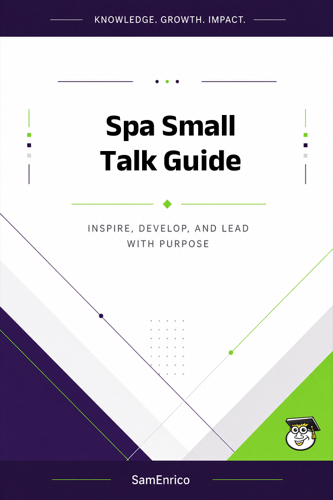
Spa Small Talk Guide
Appropriate conversation during treatments and lou
Appropriate conversation during treatments and lounges.
Formats
About this book
Free sample
Chapter 1: The Sound of Safety--–- The massage therapist had been trained to be friendly. “So,” she chirped, settling into her stance at the head of the table, “any big plans for the weekend?” The guest, face-down, naked beneath the sheet, mumbles something unintelligible into the face cradle. The therapist tries again: “Going anywhere nice this summer?” The guest’s shoulders, which had begun to soften, suddenly tighten. The therapist, now flustered, offers a third: “I love your earrings, by the way.” The guest says nothing. For the next fifty minutes, the room is filled not with relaxation but with low-grade social anxiety—two strangers trapped in a one-sided interview where only one of them consented to the conversation.This scene happens thousands of times every day in spas across the world.
And almost no one talks about it.The standard hospitality training tells spa professionals to be “warm,” “engaging,” and “personable.” The standard massage therapy curriculum spends hundreds of hours on anatomy and exactly zero on the neuropsychology of conversation during touch. The result is a catastrophic gap between intention and impact: therapists believe they are being nice, while guests experience their niceness as noise, intrusion, or even threat.This chapter argues a radical proposition: in a spa, words are not currency. Silence is.The Neuroscience of Unexpected Speech To understand why chatter destroys relaxation, we must first understand how the human brain processes sound. The auditory system evolved over millions of years to perform one primary function: threat detection. Our ancestors who heard a rustle in the bushes and ignored it did not become our ancestors.
The brain’s default setting toward unexpected sounds is not curiosity—it is hypervigilance.Dr. Nina Kraus, a neuroscientist at Northwestern University who has spent decades studying sound processing in the brain, puts it this way: “We hear what we attend to, and we attend to what threatens us.” The brain continuously scans the acoustic environment, categorizing sounds into three buckets: safe background (white noise, water, wind), signal of interest (music, a loved one’s voice), and potential threat (sudden, unexpected, or incomprehensible speech).Here is the…
This is the end of the free sample. Get the eBook to keep going. Buy now
Contents
- Chapter 1
- Chapter 2
- Chapter 3
- Chapter 4
- Chapter 5
- Chapter 6
- Chapter 7
- Chapter 8
- Chapter 9
- Chapter 10
- Chapter 11
- Chapter 12
Details
- Author
- Vetter Garfield
- Publisher
- SamEnrico
- Language
- English
- Genre
- Non-Fiction, Self-Help, Wellness
- Released
- 2026-06-06
- Pages (approx.)
- 149
- Available as
- eBook, Audiobook

Read better in the ZLOADR app
Your eBooks on your phone or tablet. Sign in with your SamEnrico account and start reading.
More by Vetter Garfield
 Retirement Housing Contractor ManagementVetter Garfield$11.99
 Plastic Free Kitchen PreventionVetter Garfield$11.99
 Daily Mental Hygiene RoutineVetter Garfield$11.99
 Parent Cancer DeathVetter Garfield$11.99
 Japanese Super Battleships GuideVetter Garfield$11.99
 Remote Work Accountability PartnerVetter Garfield$11.99
 Personal Branding for WritersVetter Garfield$11.99
 The Compass Kings: Portugal’s Navigators of the New WorldVetter Garfield$11.99
 The Alchemist of Light: Hans Holbein and the Birth of Fashion PortraitureVetter Garfield$11.99
 How to Start a Coral Gathering Business (Beginners Guide)Vetter Garfield$11.99
 How to Produce a Water CookerVetter Garfield$11.99
 US LLC for Indian Residents GuideVetter Garfield$12.99