
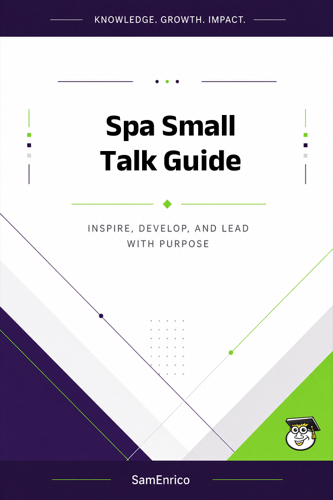
Spa Small Talk Guide eBook
Appropriate conversation during treatments and lou
Appropriate conversation during treatments and lounges.
Formats
Free sample
Chapter 1: The Sound of Safety--–- The massage therapist had been trained to be friendly. “So,” she chirped, settling into her stance at the head of the table, “any big plans for the weekend?” The guest, face-down, naked beneath the sheet, mumbles something unintelligible into the face cradle. The therapist tries again: “Going anywhere nice this summer?” The guest’s shoulders, which had begun to soften, suddenly tighten. The therapist, now flustered, offers a third: “I love your earrings, by the way.” The guest says nothing. For the next fifty minutes, the room is filled not with relaxation but with low-grade social anxiety—two strangers trapped in a one-sided interview where only one of them consented to the conversation.This scene happens thousands of times every day in spas across the world.
And almost no one talks about it.The standard hospitality training tells spa professionals to be “warm,” “engaging,” and “personable.” The standard massage therapy curriculum spends hundreds of hours on anatomy and exactly zero on the neuropsychology of conversation during touch. The result is a catastrophic gap between intention and impact: therapists believe they are being nice, while guests experience their niceness as noise, intrusion, or even threat.This chapter argues a radical proposition: in a spa, words are not currency. Silence is.The Neuroscience of Unexpected Speech To understand why chatter destroys relaxation, we must first understand how the human brain processes sound. The auditory system evolved over millions of years to perform one primary function: threat detection. Our ancestors who heard a rustle in the bushes and ignored it did not become our ancestors.
The brain’s default setting toward unexpected sounds is not curiosity—it is hypervigilance.Dr. Nina Kraus, a neuroscientist at Northwestern University who has spent decades studying sound processing in the brain, puts it this way: “We hear what we attend to, and we attend to what threatens us.” The brain continuously scans the acoustic environment, categorizing sounds into three buckets: safe background (white noise, water, wind), signal of interest (music, a loved one’s voice), and potential threat (sudden, unexpected, or incomprehensible speech).Here is the problem for spa professionals: when a guest is lying on a massage table, eyes closed, muscles softening, their brain has already categorized the ambient sounds of the spa—the trickling water feature, the low hum of the HVAC system, the soft instrumental music—as safe background. These sounds lower cortisol. They signal to the nervous system that no action is required. The guest can let go.Then the therapist speaks.Suddenly, a human voice appears from an unexpected direction (above the guest’s head, or to the side, or from a place the guest cannot see because they are face-down).
The brain cannot immediately categorize this voice. Is it safe? Is it a signal? Is it a threat? The orienting response triggers: a cascade of physiological events including increased heart rate, shallower breathing, and a spike in cortisol.
The guest’s muscles, which had been releasing, subtly re-tense. The guest’s mind, which had been drifting, snaps to attention.The therapist meant well. The therapist was trying to be “friendly.” But the therapist just interrupted the guest’s descent into relaxation as effectively as a car alarm.This is not speculation. Research on the physiological effects of unexpected speech during rest states shows that even neutral questions—“How is the pressure?”—elevate heart rate variability markers associated with vigilance. A 2019 study in the Journal of Alternative and Complementary Medicine found that massage recipients who were spoken to during treatment reported significantly lower relaxation scores than those who received the same massage in silence, regardless of the content of the conversation.The problem is not what you say.
The problem is that you said anything at all.Social Small Talk vs. Therapeutic Small Talk Before we go further, we must make a crucial distinction. Not all conversation is created equal, and the kind of conversation that works at a cocktail party is actively harmful in a treatment room.Social Small Talk is what most people mean when they say “small talk.” It is reciprocal, high-energy, and bonding-oriented. Examples include: “What do you do for work?” “Do you have kids?” “Seen any good movies lately?” “Crazy weather we’re having, right?” This type of conversation serves a social function: it establishes common ground, signals friendliness, and fills awkward silences in environments where people are expected to perform sociability.Social small talk assumes that both parties want to be there, that both parties have equal status, and that silence is a problem to be solved.None of these assumptions hold true in a spa.Therapeutic Small Talk is something else entirely. It is low-energy, one-directional (therapist to guest, not guest to therapist), and reassurance-oriented.
Its purpose is not to bond but to contain. It does not ask for information; it offers safety. It does not invite reciprocation; it invites release. Examples include: “Let your jaw soften.” “You’re safe here.” “There’s nothing you need to do right now.” “Breathe with me for a moment.”Therapeutic small talk is almost wordless. It relies on minimal encouragers—the “Mmm” vocabulary we will explore in depth in Chapter 5.
It does not demand a response. It does not require the guest to access their thinking brain. It speaks directly to the nervous system.Here is the hard truth that this book will return to again and again: most spa professionals default to Social Small Talk because it is easier to perform, requires less training, and feels more like “real conversation.” But Therapeutic Small Talk is the only kind that belongs in a treatment room.The Quiet Professional—the master of this craft—knows how to shift between these modes fluidly, but always in the direction of less language, not more.The Performer vs. The Environmental Steward Why do so many therapists default to chatter? The answer lies in how the hospitality industry has trained them.Traditional hospitality training teaches a model of service based on the performer.
The performer is warm, effusive, proactive. The performer fills silence because silence feels like failure. The performer asks questions to show interest. The performer believes that more words equal more warmth.This model works beautifully in a restaurant, where ambient noise is expected, tables are socially dense, and guests are seated upright with their eyes open. It works in a hotel lobby, where guests are fully dressed and orientation is horizontal rather than vertical.It fails catastrophically in a spa, where the guest is supine or prone, undressed, and in a deliberately quiet environment.
The performer’s chatter is not perceived as warmth. It is perceived as noise pollution. It is perceived as a demand for emotional labor from a guest who came specifically to escape emotional labor.The Quiet Professional operates under a different model: the environmental steward. The environmental steward understands that their primary job is not to entertain but to protect. They protect the guest’s nervous system from unnecessary activation.
They protect the acoustic environment from contamination. They protect the container of the treatment from intrusion.The environmental steward asks different questions. Not “What can I say to make this guest…
This is the end of the free sample. Get the eBook to keep going. Buy now
About this book
Details
- Author
- Vetter Garfield
- Publisher
- SamEnrico
- Language
- English
- Genre
- Non-Fiction, Self-Help, Wellness
- Released
- 2026-06-06
- Pages (approx.)
- 149
- Available as
- eBook, Audiobook

Read better in the ZLOADR app
Your eBooks on your phone or tablet. Sign in with your SamEnrico account and start reading.
More by Vetter Garfield
 Retirement Housing Contractor ManagementVetter Garfield$11.99
 Plastic Free Kitchen PreventionVetter Garfield$11.99
 Daily Mental Hygiene RoutineVetter Garfield$11.99
 Parent Cancer DeathVetter Garfield$11.99
 Japanese Super Battleships GuideVetter Garfield$11.99
 Remote Work Accountability PartnerVetter Garfield$11.99
 Personal Branding for WritersVetter Garfield$11.99
 The Compass Kings: Portugal’s Navigators of the New WorldVetter Garfield$11.99
 The Alchemist of Light: Hans Holbein and the Birth of Fashion PortraitureVetter Garfield$11.99
 How to Start a Coral Gathering Business (Beginners Guide)Vetter Garfield$11.99
 How to Produce a Water CookerVetter Garfield$11.99
 US LLC for Indian Residents GuideVetter Garfield$12.99
You may also like
 Hong Kong Handover 1997Dunn Johnnie$11.99
 Zumba For Postnatal Recovery CourseNeal Christian$11.99
 Zumba for BeginnersLadner Nikia$11.99
 YouTube Comment Mining GuideHumes Pandora$12.99
 Worry Box MeditationCarlin Rudy$11.99
 Workplace Stress MeditationNguyen Lynn$11.99
 Workplace Stress and Sleep RepairHawley Ivory$11.99
 Workplace Perfectionism CureDelaney Jeffry$11.99
 Workplace Injustice Anger GuideWallen Isabelle$11.99
 Work Addiction and Burnout LinkGreenwood Ester$11.99
 Women in Yoga and WellnessBeattie Galina$11.99
 Women in Stand Up ComedyChun Evangeline$11.99