
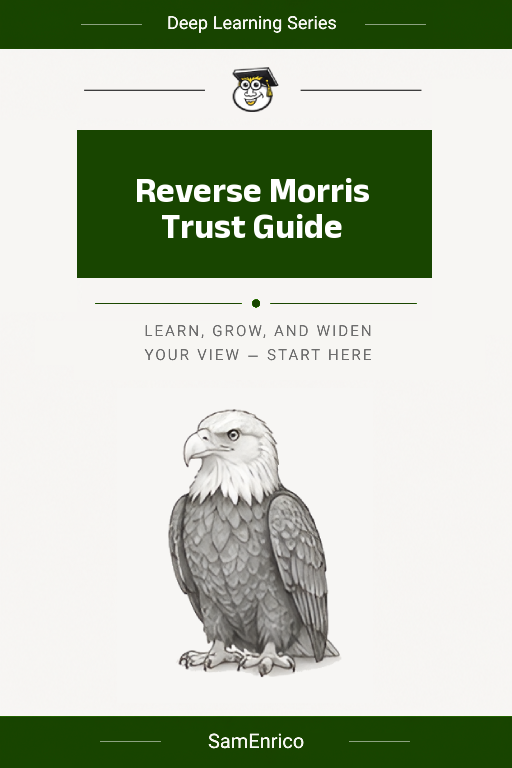
Reverse Morris Trust Guide eBook
Spin off and merge for tax free corporate separati
Spin off and merge for tax free corporate separation. This brief covers complex IRS requirements for this specialized exit structure.
Formats
Free sample
Chapter 1: The Lobster Trap--For a chief financial officer, few words inspire as much dread as “double taxation.” The scenario plays out in boardrooms across America every quarter: a division once considered core has become a distraction. It is profitable, perhaps generating 200millioninannual EBITDA,butitnolongerfitsthestrategicvision.Theboardwantstosell.Theinvestmentbankershaveidentifiedawillingbuyer.Thepriceisright—200 million in annual EBITDA, but it no longer fits the strategic vision. The board wants to sell. The investment bankers have identified a willing buyer. The price is right—200millioninannual EBITDA,butitnolongerfitsthestrategicvision.Theboardwantstosell.Theinvestmentbankershaveidentifiedawillingbuyer.Thepriceisright—2.5 billion in cash.Then the tax director speaks up.
“That 2.5billionwillbetaxedat212.5 billion will be taxed at 21% at the corporate level,” she says. “That’s 2.5billionwillbetaxedat21525 million gone immediately. Then, when we distribute the remaining 1.975billiontoshareholders,they’llpayanother23.81.975 billion to shareholders, they’ll pay another 23.8% in federal capital gains taxes on the dividend—roughly 1.975billiontoshareholders,they’llpayanother23.8470 million. Total tax bill: nearly $1 billion.”The room goes silent. A transaction that promised to unlock shareholder value now looks like a destruction of value.
The buyer walks away. The division remains. The CEO blames the tax code.This is the lobster trap. It is the reason thousands of corporate divestitures never happen. It is the reason conglomerates stay conglomerates long after their business models have become obsolete.
And it is the problem that the Reverse Morris Trust was designed to solve.The lobster trap metaphor is more apt than most tax practitioners realize. Lobster traps are designed with a simple, cruel geometry: a lobster can enter the trap easily, drawn by the promise of food, but the entrance funnels into a narrow opening lined with inward-pointing wires. The lobster can push through going in, but when it tries to exit, the wires dig in and hold it fast. The trap does not need a locking mechanism. The lobster’s own biology creates the prison.Corporate divestitures are the same.
The tax code does not explicitly prohibit the sale of a subsidiary. The door is wide open. But when a C Corporation tries to exit—trying to convert a non-core division into cash for shareholders—the tax wires dig in. Corporate-level tax. Shareholder-level tax.
A billion dollars in friction. The trap holds.The Reverse Morris Trust is the wire cutter. It is not a loophole in the sense of an unintended oversight. It is a deliberate, congressionally sanctioned structure that allows a corporation to divest a business line without triggering corporate-level tax, provided the shareholders maintain control of the combined enterprise after the transaction. The policy rationale is simple: if shareholders are simply rearranging their ownership of businesses—trading a direct stake in a conglomerate for a direct stake in two more focused companies—no taxable gain has been realized.
Only when cash leaves the system does the tax trigger.This chapter introduces the fundamental building blocks of the Reverse Morris Trust: the three-step sequence, the 50% Control Rule, and the critical distinction between a “pre-arranged” merger and “substantial negotiations.” It also resolves a tension that has confused practitioners for years: how can a merger be pre-arranged before the spin-off without triggering the IRS’s prohibition on substantial negotiations? The answer, as this chapter will show, lies in the difference between structural planning and binding commitment.By the end of this chapter, the reader will understand not only how an RMT works on paper, but also why the timing and sequencing of the three steps matter so profoundly. The remaining chapters will build on this foundation, adding layers of complexity: the 50% test in Chapter 3, the leverage strategies of Chapter 4, the shareholder overlap loophole of Chapter 5, and the legal mechanics of the Separation and Distribution Agreement in Chapter 6. But first, the anatomy.The Three-Step Sequence Every Reverse Morris Trust follows the same three-step choreography. Deviate from the sequence, and the tax-free treatment collapses.
Follow it precisely, and a billion dollars in tax liability evaporates.Step One: The Contribution The Parent corporation identifies the business line it wishes to divest. It could be a product division, a geographic subsidiary, a collection of intellectual property, or an entire operating company. The assets must be capable of operating independently—a requirement that becomes critical when we discuss the “active trade or business” test in Chapter 2.Parent contributes these assets to a newly formed, wholly owned subsidiary. This subsidiary is typically called “Spin Co” in transaction documents, though the legal name will be something more anodyne like “New Co” or “Separation Sub.” The contribution is tax-free under Section 351 of the Internal Revenue Code, provided Parent controls Spin Co immediately after the transfer. Control, for these purposes, means ownership of at least 80% of Spin Co’s voting stock and 80% of each class of non-voting stock.Why Section 351?
Because without it, the contribution would be a taxable sale of assets from Parent to Spin Co—Parent would recognize gain on the difference between the assets’ fair market value and Parent’s tax basis in those assets. Section 351 defers that gain, treating the contribution as a mere change in form rather than a realization event. Parent is not selling assets to Spin Co; Parent is merely reorganizing its ownership of those assets.In practice, the contribution takes weeks or months to execute. Legal teams must transfer real estate, assign contracts, obtain third-party consents, and re-title intellectual property. Employment agreements must be assigned.
Bank accounts must be opened. The operational complexity is substantial, which is why most RMTs take nine to twelve months from initial planning to closing.Step Two: The “Shotgun” Spin-Off After the contribution is complete, Parent distributes all of the Spin Co stock to its own shareholders on a pro-rata basis. This is called a “shotgun” spin-off because it hits every shareholder equally. If a shareholder owned 1% of Parent before the spin-off, that shareholder receives 1% of Spin Co’s stock after the spin-off. No elections.
No cash in lieu. Pure, mechanical proportionality.The spin-off is tax-free to shareholders under Section 355, provided certain requirements are met. Those requirements—the active trade or business test, the business purpose requirement, and the prohibition against the spin-off being used as a “device” to distribute earnings—are the subject of Chapter 2. For now, understand that the spin-off is the moment when Parent’s shareholders become direct owners of Spin Co.This is the moment that distinguishes a Reverse Morris Trust from a straightforward asset sale. In a taxable sale, Parent would sell the division to a buyer, receive cash, and then distribute that cash to shareholders (triggering a second tax).
In an RMT, Parent distributes stock instead of cash. The shareholders now own two companies: Parent (with its retained businesses) and Spin Co (with the divested business). No cash has changed hands. No tax has been paid.Step Three: The Merger Immediately following the spin-off—or as soon thereafter as legally permissible—Spin Co merges into the strategic partner, which we will call the Acquirer. The Acquirer could be a competitor, a private equity portfolio company, or any other corporation that wants to own Spin Co’s business.
The merger is structured as a tax-free reorganization under Section 368(a)(1)(A), typically using a reverse subsidiary merger to streamline the process.From the perspective of Parent’s shareholders, the merger looks like this: they exchange their Spin Co…
This is the end of the free sample. Get the eBook to keep going. Buy now
About this book
Details
- Author
- Williford Celestine
- Publisher
- SamEnrico
- Language
- English
- Genre
- Non-Fiction, Startup Guide, Tax Free Exit
- Released
- 2026-06-01
- Pages (approx.)
- 154
- Available as
- eBook, Audiobook

Read better in the ZLOADR app
Your eBooks on your phone or tablet. Sign in with your SamEnrico account and start reading.
More by Williford Celestine
 Affirmations for Confidence BuildingWilliford Celestine$11.99
 First Responder Stress GuideWilliford Celestine$11.99
 Goal Line Stand WillpowerWilliford Celestine$11.99
 Talking to Principal About BullyingWilliford Celestine$11.99
 Competitive Analysis Validation ToolWilliford Celestine$11.99
 Intermittent Fasting for DiabetesWilliford Celestine$11.99
 TM for PhysicistsWilliford Celestine$11.99
 Saudi Green Tax CreditsWilliford Celestine$11.99
 HGH Cycling ProtocolsWilliford Celestine$11.99
 The Last of the Mohicans: How One Man Bought Every Surviving Copy of a Lost ClassicWilliford Celestine$11.99
 Mozart's Musical Fireworks: The Boy Who Dazzled EuropeWilliford Celestine$11.99
 Chains of the Forgotten: The Lost Prisoners of Alcatraz’s Secret WingWilliford Celestine$11.99