
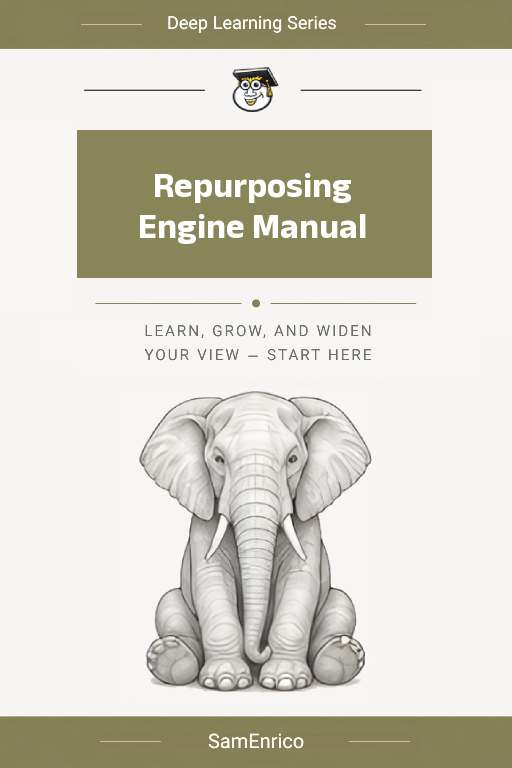
Repurposing Engine Manual eBook
Turn one podcast episode into 20+ social clips, bl
Turn one podcast episode into 20+ social clips, blog posts, and newsletter content without extra recording. Includes clip extraction prompts, caption templates, and cross-platform scheduling.
Formats
Free sample
Chapter 1: The Graveyard Shift--You have a podcast episode that took three hours to record, edit, and publish. It cost you focus, energy, and probably a small hit of delusion that this would be the one that finally breaks through.It gets 147 downloads.Then it dies.Not because it was bad. Not because you spoke poorly or picked the wrong topic. It dies because you buried it alive. You posted it once, shared the link twice, and then moved on to next week's episode like a gravedigger with a schedule.This is not a content strategy.
This is a funeral procession.Most podcasters are not creators. They are burial artists. They produce something valuable, lay it in the digital ground, throw dirt on it with a single "New Episode" post, and then act surprised when nobody shows up to the grave.The problem is not your recording quality, your microphone, or your guest. The problem is your mindset. You have been trained to think like an episodic creator: record, publish, repeat.
That model worked in 2015 when podcast listenership was growing so fast that any episode could find fresh ears. It does not work now.In 2025, the average podcaster produces 52 episodes per year. Each episode represents somewhere between three and ten hours of work. That is between 156 and 520 hours annually. And the vast majority of that labor vanishes within seventy-two hours of publication.Think about what you could have done with those hours.
A book. A course. A consulting practice. Time with your family. Sleep.But you cannot get them back.
They are gone, buried alongside every episode that nobody has listened to since the week it dropped.This book exists because that cycle is unnecessary and cruel. You do not need to record more. You need to repurpose better. You need to stop being a gravedigger and start being an engine builder.Let me show you what I mean.The Episode That Died Twice Before I wrote this book, I was exactly the podcaster I just described. Every Tuesday, I released an episode.
Every Tuesday afternoon, I shared it on Linked In, Twitter, and Instagram. Every Wednesday, I started worrying about next Tuesday.Then, six months in, I looked at my analytics. One episode had 47 downloads. Forty-seven. I had spent four hours interviewing a brilliant guest, two hours editing, and one hour writing show notes.
Seven hours for forty-seven people to listen.That episode died twice. First, when only forty-seven people heard it. Second, when I did nothing to save it.I almost quit podcasting. Instead, I spent a week doing something ridiculous: I took that dead episode and turned it into thirty-seven pieces of content. Clips for Tik Tok.
Threads for Twitter. A Linked In carousel. Two blog posts. A newsletter. An audiogram for Instagram.Those thirty-seven pieces reached over eleven thousand people.
The original episode, which had been dead for six weeks, got seven hundred new downloads in three days.I did not re-record a single word. I did not edit new audio. I did not book a better guest. I simply stopped burying my work and started building an engine to resurrect it.That week changed everything. Within ninety days, I had repurposed my first ten episodes into over two hundred assets.
My website traffic tripled. My newsletter grew by eleven hundred subscribers. And I stopped waking up on Wednesdays wondering why I was spending so many hours on something that disappeared so quickly.This book is the system I wish I had on day one.The Three Words That Will Save Your Sanity Here is the single most important sentence you will read in this entire book:Stop recording. Start repurposing.Do not misinterpret this. I am not telling you to quit your podcast.
I am telling you to quit the delusion that more episodes equal more growth. They do not. More repurposing equals more growth.The math is simple but brutal. A single episode, published once, has a half-life of approximately forty-eight hours. After that, it is discovered by almost no one unless you are Joe Rogan or you have a pre-existing audience of hundreds of thousands.But that same episode, repurposed into twenty assets spread across six platforms over sixty days, has a half-life measured in months.
Each asset is a new front door. Each platform is a new neighborhood. Each post is another chance to be discovered by someone who would never have searched for your podcast.Let me give you a concrete example from a podcaster I worked with. She had a show about sustainable fashion. Her episodes averaged two hundred downloads.
She was frustrated, exhausted, and considering quitting.I asked her to stop recording for thirty days. Instead, I asked her to take her best three episodes and repurpose them using the system you will learn in this book. She was skeptical. She did it anyway.Thirty days later, those three episodes had generated:Fifty-seven social clips across Tik Tok, Instagram, and You Tube Shorts Twelve Linked In posts Three Twitter threads (the longest of which had over forty thousand impressions)Three blog posts that ranked for keywords she had never targeted Three newsletters that drove more opens than anything she had ever sent Total new downloads from those three dead episodes: over four thousand.She did not record a single new episode during those thirty days. She just stopped burying her work and started feeding it into an engine.This is what I mean when I say stop recording.
I do not mean forever. I mean long enough to realize that you already have everything you need to grow. You are sitting on a gold mine. You just do not have a shovel. This book is your shovel.The Three Pillars of the Repurposing Engine Every system needs a structure.
The Repurposing Engine runs on three pillars. You will hear about these pillars throughout this book, so let me define them clearly now.Pillar One: Extract Extraction is the act of pulling raw materials from your episode. These raw materials include quotes, stories, statistics, frameworks, questions, comebacks, and calls to action. Extraction is not creative. It is archaeological.
You are not making new things. You are finding things that already exist inside your recording.Most podcasters skip extraction entirely. They listen to their episode once during editing and then never again. They rely on memory to tell them what was good. Memory is a liar.
You will forget the best line of your episode within twenty-four hours. I guarantee it.Extraction requires a timestamp log. You will learn exactly how to build one in Chapter 3. For now, understand that extraction is the difference between guessing what worked and knowing what worked.Pillar Two: Adapt Adaptation is the act of reshaping your raw materials for each platform. A quote that works on Twitter needs different framing for Linked In.
A story that kills on a podcast needs a visual hook for Tik Tok. A statistic that surprises your listener needs a curiosity gap for Instagram.Adaptation is translation. You are taking the same truth and speaking it in the language of each platform. This is not duplication. You should never post the exact…
This is the end of the free sample. Get the eBook to keep going. Buy now
About this book
Details
- Author
- Spradlin Jefferey
- Publisher
- SamEnrico
- Language
- English
- Genre
- Non-Fiction, Zero-to-One Creator, Creative Launch System, Repurposing Guide
- Released
- 2026-06-01
- Pages (approx.)
- 139
- Available as
- eBook, Audiobook

Read better in the ZLOADR app
Your eBooks on your phone or tablet. Sign in with your SamEnrico account and start reading.
More by Spradlin Jefferey
 The Process Church EscapeeSpradlin Jefferey$11.99
 Resentment After Botched SurgerySpradlin Jefferey$11.99
 Permaculture Design Gap GuideSpradlin Jefferey$11.99
 Sweating Fear ManagementSpradlin Jefferey$11.99
 The Workaholism and Anxiety ConnectionSpradlin Jefferey$11.99
 Gold Rush Frenzy: The Untold Story of the 1849 California Gold RushSpradlin Jefferey$11.99
 Understanding Leber Military AneurysmSpradlin Jefferey$17.99
 Chiral Acoustic Resonance TechnicianSpradlin Jefferey$11.99
 Freight Claims Management GuideSpradlin Jefferey$12.99
 How to Start a Bunting Made of Cotton Business (Beginners Guide)Spradlin Jefferey$11.99