
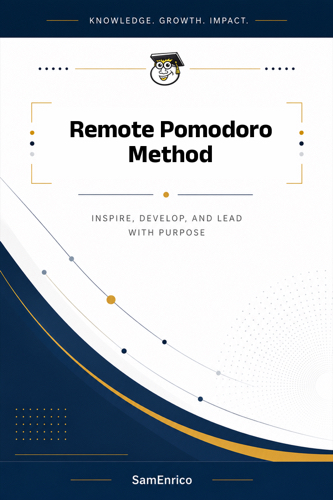
Free sample
Chapter 1: The Ghost Shift--The first time Sarah cried over a Slack message, she was sitting on her bedroom floor at 4:47 PM, still wearing pajamas, surrounded by three half-empty coffee mugs and a pile of laundry she had folded during a "quick break" that somehow lasted two hours.The message was not cruel. It was not urgent. It was a simple question from her manager: "Hey, any update on the Q3 report? No rush, just checking in."But Sarah had been "working" on that report for eleven hours spread across three days. She had opened the document twenty-seven times.
She had written exactly four sentences. She had checked email one hundred and twelve times, according to her browser history. She had watched two hours of You Tube videos about sourdough starters despite never having baked bread in her life. She had convinced herself that "thinking about work" counted as work.And now, at 4:47 PM on a Thursday, she had nothing to show for it except exhaustion, guilt, and the creeping certainty that she was somehow both overworked and utterly unproductive.Sarah is not real. But her story is told by millions of remote workers in 2026.You have felt what Sarah felt.
The peculiar exhaustion of a day where you never stopped moving but never arrived anywhere. The guilt of closing your laptop at 6 PM with a to-do list longer than when you started. The nagging suspicion that you are working harder than ever and accomplishing less than before.This book is for you.The Great Unraveling The traditional 9-to-5 workday was not designed by productivity experts or neuroscientists. It was designed by factory owners in the Industrial Revolution who needed bodies at machines for predictable shifts. It was refined by mid-century office managers who believed that visible presence equaled measurable output.
It was reinforced by decades of commuting culture, watercooler gossip, and the simple fact that when everyone leaves the building at the same time, work has an unambiguous end.Then the world went remote.Between 2020 and 2024, the percentage of fully remote workers in knowledge industries jumped from roughly 5 percent to over 40 percent. By 2026, that number has stabilized at approximately 35 percent—a permanent transformation, not a temporary pandemic blip.But here is the problem no one talks about enough: we took the factory model of work—eight consecutive hours, external supervision, social pressure, physical separation between "work" and "home"—and we…
This is the end of the free sample. Get the Audiobook to keep going. Buy now
About this book
Details
- Author
- Qualls Wilhemina
- Publisher
- SamEnrico
- Language
- English
- Genre
- Non-Fiction, Self-Help / Pomodoro
- Released
- 2026-06-06
- Pages (approx.)
- 128
- Available as
- eBook, Audiobook

Listen in the VoxFlicks app
Audiobooks and audio dramas wherever you go. Sign in with your SamEnrico account and press play.
More by Qualls Wilhemina
 Burnout Prevention For Pilates InstructorsQualls Wilhemina$11.99
 Teamster Boss Hoffa Antitrust Battles GuideQualls Wilhemina$11.99
 Stock Market Crash StressQualls Wilhemina$11.99
 Government OKR GuideQualls Wilhemina$11.99
 The Workplace Belonging WorkbookQualls Wilhemina$11.99
 Runner Injury GuideQualls Wilhemina$11.99
 Spotify Wrapped Comparison GuiltQualls Wilhemina$11.99
 The Sydney Poisoner: Australia's Deadly Domestic ConspiracyQualls Wilhemina$11.99
 The Battle of Kurukshetra: The Epic War of DharmaQualls Wilhemina$11.99
 Growing BrillantaisiaQualls Wilhemina$11.99
 EU VAT on Accommodation and EventsQualls Wilhemina$12.99
 AI Assisted Capital Expenditure AnalysisQualls Wilhemina$12.99
You may also like
 Hong Kong Handover 1997Dunn Johnnie$11.99
 Zumba For Postnatal Recovery CourseNeal Christian$11.99
 Zumba for BeginnersLadner Nikia$11.99
 YouTube Comment Mining GuideHumes Pandora$12.99
 Worry Box MeditationCarlin Rudy$11.99
 Workplace Stress MeditationNguyen Lynn$11.99
 Workplace Stress and Sleep RepairHawley Ivory$11.99
 Workplace Perfectionism CureDelaney Jeffry$11.99
 Workplace Injustice Anger GuideWallen Isabelle$11.99
 Work Addiction and Burnout LinkGreenwood Ester$11.99
 Women in Yoga and WellnessBeattie Galina$11.99
 Women in Stand Up ComedyChun Evangeline$11.99