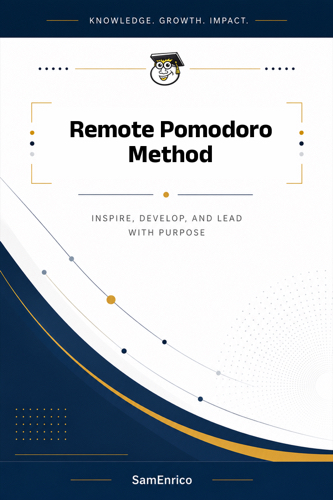
Free sample
Chapter 1: The Ghost Shift--The first time Sarah cried over a Slack message, she was sitting on her bedroom floor at 4:47 PM, still wearing pajamas, surrounded by three half-empty coffee mugs and a pile of laundry she had folded during a "quick break" that somehow lasted two hours.The message was not cruel. It was not urgent. It was a simple question from her manager: "Hey, any update on the Q3 report? No rush, just checking in."But Sarah had been "working" on that report for eleven hours spread across three days. She had opened the document twenty-seven times.
She had written exactly four sentences. She had checked email one hundred and twelve times, according to her browser history. She had watched two hours of You Tube videos about sourdough starters despite never having baked bread in her life. She had convinced herself that "thinking about work" counted as work.And now, at 4:47 PM on a Thursday, she had nothing to show for it except exhaustion, guilt, and the creeping certainty that she was somehow both overworked and utterly unproductive.Sarah is not real. But her story is told by millions of remote workers in 2026.You have felt what Sarah felt.
The peculiar exhaustion of a day where you never stopped moving but never arrived anywhere. The guilt of closing your laptop at 6 PM with a to-do list longer than when you started. The nagging suspicion that you are working harder than ever and accomplishing less than before.This book is for you.The Great Unraveling The traditional 9-to-5 workday was not designed by productivity experts or neuroscientists. It was designed by factory owners in the Industrial Revolution who needed bodies at machines for predictable shifts. It was refined by mid-century office managers who believed that visible presence equaled measurable output.
It was reinforced by decades of commuting culture, watercooler gossip, and the simple fact that when everyone leaves the building at the same time, work has an unambiguous end.Then the world went remote.Between 2020 and 2024, the percentage of fully remote workers in knowledge industries jumped from roughly 5 percent to over 40 percent. By 2026, that number has stabilized at approximately 35 percent—a permanent transformation, not a temporary pandemic blip.But here is the problem no one talks about enough: we took the factory model of work—eight consecutive hours, external supervision, social pressure, physical separation between "work" and "home"—and we simply transplanted it into people's living rooms. We expected the same behaviors to produce the same results in an entirely different environment.They did not.The Three Collapses of the 9-to-5When you remove the architecture that made the eight-hour day functional, three things collapse simultaneously.Collapse One: External Supervision In an office, your manager can see your desk. They can hear your keyboard. They might walk by and notice that you have been staring at the same spreadsheet for forty-five minutes.
This is not pleasant—most people dislike being watched—but it does provide a crude form of accountability. The simple awareness that someone might notice your absence creates a baseline level of activity.At home, that awareness evaporates. Your manager cannot see your desk. They cannot hear your keyboard over Zoom's noise suppression. They have no idea whether you spent the last hour writing a proposal or reorganizing your bookshelf by color.
The external scaffold of supervision is gone.What fills the void? For many people, it is presenteeism—the desperate need to appear working even when no one is watching. You send emails at 10 PM to prove you are dedicated. You respond to Slack messages within thirty seconds to prove you are available. You keep your laptop open during dinner "just in case." You are not working more productively.
You are working more anxiously.Collapse Two: Social Pressure In an office, you work because everyone else is working. There is a quiet, unspoken contract: we are all here, at these desks, during these hours, doing these things. The collective rhythm carries you forward even on days when your personal motivation flags.At home, that rhythm vanishes. There is no one typing next to you. No one frowning at a difficult problem.
No one packing up their bag at 5:30 PM as a gentle signal that the day is ending. You are alone with your to-do list and your fridge and your suddenly fascinating collection of houseplants.What fills the void? Isolation procrastination—the strange tendency to delay work not because you are lazy, but because the lack of social cues makes the work feel unreal. Without witnesses, tasks lose urgency. A deadline that felt concrete in an office becomes abstract in a living room.Collapse Three: Physical Boundaries In an office, work happens at work.
Home happens at home. The commute is not lost time—it is a ritual transition that signals to your brain: now you are working, now you are not. The physical space enforces the mental boundary.At home, those boundaries dissolve. Your work laptop sits six feet from your bed. Your kitchen is thirty seconds from your desk.
Your children, your partner, your laundry, your dishes, your mail—all of it coexists in the same square footage as your quarterly report. You cannot leave work at work because work is everywhere.What fills the void? Boundary burnout—the exhaustion of constantly negotiating between competing claims on your attention. You answer a work email while making lunch. You think about a household chore during a meeting.
You end the day having done both work and home tasks poorly, and you are too tired to enjoy either.The Productivity Math That Lies Here is a dangerous myth: more hours equal more output.It is seductive because it is simple. If you want to get more done, work longer. Stay later. Start earlier. Skip lunch.
Answer emails at midnight. The math seems unassailable: ten hours is more than eight, so ten hours of work must produce more than eight hours of work.But this math only works if human beings are machines. We are not.In 2024, researchers at Stanford University analyzed the work patterns of over 600,000 remote employees across sixteen industries. Their finding was stark: after approximately four to five hours of genuinely focused work per day, productivity flatlines. The fifth hour produces less than the fourth.
The sixth hour produces less than the fifth. By the eighth hour, additional time at the keyboard produces negative returns—not only do you stop making progress, but you also introduce errors that will need to be fixed later.This is not because remote workers are lazy. It is because attention is a finite biological resource, not an infinitely renewable one.Think of your focus like a fuel tank. Every minute of concentrated work burns fuel. When the tank is full—usually at the beginning of the day—you can work efficiently and accurately.
As the tank empties, your work slows down, your error rate increases, and your resistance to distraction collapses. By the time you hit hour seven or eight, you are not working. You are simulating work while your brain desperately tries to protect itself from further depletion.The tragedy is that most remote workers never fill their tank.…
This is the end of the free sample. Get the eBook to keep going. Buy now
About this book
Details
- Author
- Qualls Wilhemina
- Publisher
- SamEnrico
- Language
- English
- Genre
- Non-Fiction, Self-Help / Pomodoro
- Released
- 2026-06-06
- Pages (approx.)
- 128
- Available as
- eBook, Audiobook

Read better in the ZLOADR app
Your eBooks on your phone or tablet. Sign in with your SamEnrico account and start reading.
More by Qualls Wilhemina
 Burnout Prevention For Pilates InstructorsQualls Wilhemina$11.99
 Teamster Boss Hoffa Antitrust Battles GuideQualls Wilhemina$11.99
 Stock Market Crash StressQualls Wilhemina$11.99
 Government OKR GuideQualls Wilhemina$11.99
 The Workplace Belonging WorkbookQualls Wilhemina$11.99
 Runner Injury GuideQualls Wilhemina$11.99
 Spotify Wrapped Comparison GuiltQualls Wilhemina$11.99
 The Sydney Poisoner: Australia's Deadly Domestic ConspiracyQualls Wilhemina$11.99
 The Battle of Kurukshetra: The Epic War of DharmaQualls Wilhemina$11.99
 Growing BrillantaisiaQualls Wilhemina$11.99
 EU VAT on Accommodation and EventsQualls Wilhemina$12.99
 AI Assisted Capital Expenditure AnalysisQualls Wilhemina$12.99