
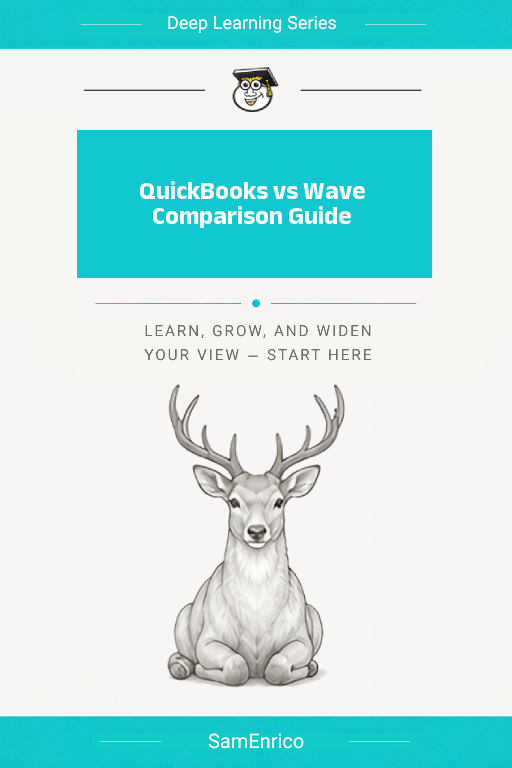
Non-FictionFirst 30 DaysBookkeeping
QuickBooks vs Wave Comparison Guide
Choose between QuickBooks and Wave for your busine
Choose between QuickBooks and Wave for your business. Features, pricing, and scalability compared side by side.
Formats
About this book
Free sample
Chapter 1: The Heavyweight Champion--The first time a business owner asks me which accounting software to choose, they almost always lead with the same question: “Is Quick Books worth the money?” They’ve seen the 38,38, 38,75, or $105 monthly price tags. They’ve heard horror stories about feature bloat and learning curves. And they’ve been tempted by the siren song of “free” from Wave.I understand the instinct. I’ve watched dozens of entrepreneurs stare at Quick Books’ pricing page like it’s a financial decision that could break them. But here is the truth that most comparison guides won’t tell you: the question isn’t whether Quick Books is worth the money.
The question is whether your business is worth the investment.Quick Books is not expensive. You are thinking too small.This chapter is not a neutral overview. It is a deep, unapologetic examination of why Quick Books has held a near-monopoly on small business accounting for three decades. You will learn its history, its product tiers, its ecosystem advantages, and—most critically—its Total Cost of Ownership (TCO). By the end of this chapter, you will understand why accountants, lenders, and investors all speak the same language: Quick Books.The Origin Story: From Desktop Dominance to Cloud Empire Quick Books launched in 1992, four years after Intuit struck gold with Quicken, the personal finance software that taught millions of Americans how to balance a checkbook on a screen.
But Quicken had a problem: it was designed for households, not businesses. Small business owners were using it anyway, forcing square pegs into round holes, manually overriding categories and kludging together workarounds for invoices, payroll, and inventory.Intuit saw the opportunity and built Quick Books from the ground up for business owners. The original version ran on DOS—a command-line interface that seems ancient now—but it introduced a concept that would become revolutionary: double-entry accounting made visual. You didn’t need to understand debits and credits. You just needed to know where money came from and where it went.By the early 2000s, Quick Books had crushed every competitor.
Peachtree (now Sage) survived in niche markets. Microsoft Money faded into irrelevance. And Quick Books Desktop became the standard installed…
This is the end of the free sample. Get the eBook to keep going. Buy now
Contents
- Chapter 1
- Chapter 2
- Chapter 3
- Chapter 4
- Chapter 5
- Chapter 6
- Chapter 7
- Chapter 8
- Chapter 9
- Chapter 10
- Chapter 11
- Chapter 12
Details
- Author
- Baugh Asuncion
- Publisher
- SamEnrico
- Language
- English
- Genre
- Non-Fiction, First 30 Days, Bookkeeping
- Released
- 2026-06-01
- Pages (approx.)
- 130
- Available as
- eBook, Audiobook

Read better in the ZLOADR app
Your eBooks on your phone or tablet. Sign in with your SamEnrico account and start reading.
More by Baugh Asuncion
 The Poverty of AbundanceBaugh Asuncion$11.99
 Cuddling MeditationBaugh Asuncion$11.99
 Synthesis Essay AI PromptsBaugh Asuncion$11.99
 Uncontested Divorce RecoveryBaugh Asuncion$11.99
 The Alcohol and Sleep Memory GuideBaugh Asuncion$11.99
 Keri Hulme: The Bone People’s Quiet RevolutionBaugh Asuncion$11.99
 Assistant SuperintendentBaugh Asuncion$11.99
 JEE Alternative Career Path GuideBaugh Asuncion$12.99JEE Alternative Career Path GuideBaugh Asuncion$12.99
 Understanding PintaBaugh Asuncion$17.99
 How to Start a Cheese Making Machines Business (Beginners Guide)Baugh Asuncion$11.99
You may also like
 Hong Kong Handover 1997Dunn Johnnie$11.99
 Zumba For Postnatal Recovery CourseNeal Christian$11.99
 Zumba for BeginnersLadner Nikia$11.99
 YouTube Comment Mining GuideHumes Pandora$12.99
 Worry Box MeditationCarlin Rudy$11.99
 Workplace Stress MeditationNguyen Lynn$11.99
 Workplace Stress and Sleep RepairHawley Ivory$11.99
 Workplace Perfectionism CureDelaney Jeffry$11.99
 Workplace Injustice Anger GuideWallen Isabelle$11.99
 Work Addiction and Burnout LinkGreenwood Ester$11.99
 Women in Yoga and WellnessBeattie Galina$11.99
 Women in Stand Up ComedyChun Evangeline$11.99