
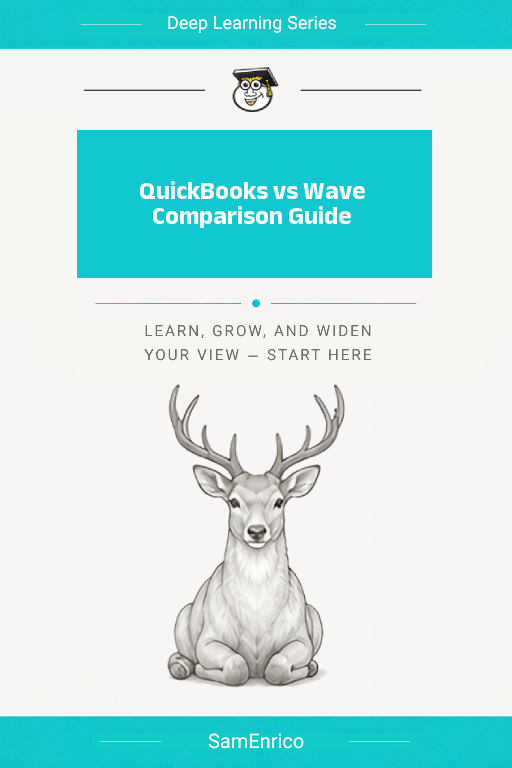
Non-FictionFirst 30 DaysBookkeeping
QuickBooks vs Wave Comparison Guide eBook
Choose between QuickBooks and Wave for your busine
Choose between QuickBooks and Wave for your business. Features, pricing, and scalability compared side by side.
Formats
Free sample
Chapter 1: The Heavyweight Champion--The first time a business owner asks me which accounting software to choose, they almost always lead with the same question: “Is Quick Books worth the money?” They’ve seen the 38,38, 38,75, or $105 monthly price tags. They’ve heard horror stories about feature bloat and learning curves. And they’ve been tempted by the siren song of “free” from Wave.I understand the instinct. I’ve watched dozens of entrepreneurs stare at Quick Books’ pricing page like it’s a financial decision that could break them. But here is the truth that most comparison guides won’t tell you: the question isn’t whether Quick Books is worth the money.
The question is whether your business is worth the investment.Quick Books is not expensive. You are thinking too small.This chapter is not a neutral overview. It is a deep, unapologetic examination of why Quick Books has held a near-monopoly on small business accounting for three decades. You will learn its history, its product tiers, its ecosystem advantages, and—most critically—its Total Cost of Ownership (TCO). By the end of this chapter, you will understand why accountants, lenders, and investors all speak the same language: Quick Books.The Origin Story: From Desktop Dominance to Cloud Empire Quick Books launched in 1992, four years after Intuit struck gold with Quicken, the personal finance software that taught millions of Americans how to balance a checkbook on a screen.
But Quicken had a problem: it was designed for households, not businesses. Small business owners were using it anyway, forcing square pegs into round holes, manually overriding categories and kludging together workarounds for invoices, payroll, and inventory.Intuit saw the opportunity and built Quick Books from the ground up for business owners. The original version ran on DOS—a command-line interface that seems ancient now—but it introduced a concept that would become revolutionary: double-entry accounting made visual. You didn’t need to understand debits and credits. You just needed to know where money came from and where it went.By the early 2000s, Quick Books had crushed every competitor.
Peachtree (now Sage) survived in niche markets. Microsoft Money faded into irrelevance. And Quick Books Desktop became the standard installed on every small business computer in America.Then came the cloud. In 2012, Intuit launched Quick Books Online, and the accounting world changed forever. No more installations.
No more backups to external hard drives. No more “I left the file on the office computer.” Suddenly, you could send an invoice from a coffee shop, check your profit and loss from an airport lounge, and give your CPA access without emailing a massive file.Today, Quick Books Online dominates the cloud accounting space with over seven million subscribers worldwide. It is not the only option. But it is the default. And there is a reason for that.The Professional Standard: Why Accountants, Lenders, and Investors Speak Quick Books Let me tell you about a conversation I had with a CPA named Sarah.
Sarah has been preparing small business tax returns for eighteen years. She works with about two hundred clients annually. I asked her what she thinks when a new client walks in using Wave.She laughed. Not a friendly laugh. A tired, I-have-seen-things-you-would-not-believe laugh.“I don’t judge out loud,” she said.
“But inside? I know I’m about to bill them for at least six hours of cleanup. A Quick Books client takes me two hours, maybe three if it’s messy. A Wave client? Six hours minimum.
Sometimes ten.”This is not snobbery. It is efficiency. Accountants are paid by the hour or by the complexity of the return. Every hour they spend fixing your books is an hour they could spend serving another client. That cost flows directly back to you.But the CPA perspective is only the beginning.
Consider what happens when you need a loan. A bank underwriter will ask for your financial statements. If you hand them reports generated by Wave, they will squint. They will ask questions. They may require additional documentation or an independent audit.
If you hand them Quick Books reports? They nod. They have seen that format a thousand times. The process moves faster.Investors are the same. Angel investors and venture capitalists receive dozens of pitch decks per week.
When they ask for your financials, they expect Quick Books exports. Anything else signals amateur hour.This is what I mean when I say Quick Books is not just software. It is a credential. It signals that you take your business seriously enough to use the professional standard.The 2026 Product Tiers: Choosing Your Weapon Quick Books Online in 2026 offers five tiers. Each tier adds features.
Each tier increases in price. And each tier is designed to match a specific stage of business growth.Solopreneur Monthly price: Approximately $20 (varies by promotion)Who it is for: Freelancers, independent contractors, and very small service businesses with simple finances.What it includes: Basic income and expense tracking, manual bank reconciliation, simple invoicing, estimate creation, basic sales tax tracking, and 1099 contractor management.What it does NOT include: Recurring invoices, bill management (tracking what you owe vendors), time tracking, inventory, project profitability, or multi-user access.The Solopreneur tier is Quick Books’ answer to very simple accounting needs. Think dog walkers, freelance graphic designers, virtual assistants. If you have fewer than fifty transactions per month and no employees, this tier may work for you.Critical warning for 2026: Solopreneur does NOT include recurring invoices. If you bill the same clients the same amount every month, you will need at least Essentials.
Do not let a salesperson tell you otherwise. I have seen too many business owners sign up for Solopreneur only to discover three weeks later that they cannot automate their monthly billing.Simple Start Monthly price: Approximately $38Who it is for: Freelancers and micro-businesses who need slightly more than Solopreneur but not full Essentials.What it adds over Solopreneur: Estimates (which Solopreneur actually has—be careful here), sales tax tracking (Solopreneur has this too), and 1099 contractor management. The main differentiator is support for multiple currencies and the ability to track unpaid invoices more robustly.What it does NOT include: Recurring invoices (same as Solopreneur), bill management, time tracking, inventory, project profitability.Honest assessment: Simple Start is the awkward middle child. It costs almost twice as much as Solopreneur but adds very little. Most businesses are better off either saving money with Solopreneur or spending a bit more for Essentials.
Unless you need multi-currency support, skip this tier.Essentials Monthly price: Approximately $75Who it is for: Growing service businesses, consultants, agencies, and any business with regular bills to pay.What it adds over Simple Start: Recurring invoices (finally), bill management (track what you owe vendors and pay them directly from Quick Books), time tracking (basic, not as robust as Quick Books Time add-on), and support for three concurrent users.Why Essentials is the sweet spot: For most service businesses, Essentials hits the perfect balance of features and price. You can set up recurring invoices for retainer clients. You can track billable hours. You can manage your accounts payable. And you have room for a bookkeeper and an accountant to access the file without…
This is the end of the free sample. Get the eBook to keep going. Buy now
About this book
Details
- Author
- Baugh Asuncion
- Publisher
- SamEnrico
- Language
- English
- Genre
- Non-Fiction, First 30 Days, Bookkeeping
- Released
- 2026-06-01
- Pages (approx.)
- 130
- Available as
- eBook, Audiobook

Read better in the ZLOADR app
Your eBooks on your phone or tablet. Sign in with your SamEnrico account and start reading.
More by Baugh Asuncion
 The Poverty of AbundanceBaugh Asuncion$11.99
 Cuddling MeditationBaugh Asuncion$11.99
 Synthesis Essay AI PromptsBaugh Asuncion$11.99
 Uncontested Divorce RecoveryBaugh Asuncion$11.99
 The Alcohol and Sleep Memory GuideBaugh Asuncion$11.99
 Keri Hulme: The Bone People’s Quiet RevolutionBaugh Asuncion$11.99
 Assistant SuperintendentBaugh Asuncion$11.99
 JEE Alternative Career Path GuideBaugh Asuncion$12.99JEE Alternative Career Path GuideBaugh Asuncion$12.99
 Understanding PintaBaugh Asuncion$17.99
 How to Start a Cheese Making Machines Business (Beginners Guide)Baugh Asuncion$11.99
You may also like
 Hong Kong Handover 1997Dunn Johnnie$11.99
 Zumba For Postnatal Recovery CourseNeal Christian$11.99
 Zumba for BeginnersLadner Nikia$11.99
 YouTube Comment Mining GuideHumes Pandora$12.99
 Worry Box MeditationCarlin Rudy$11.99
 Workplace Stress MeditationNguyen Lynn$11.99
 Workplace Stress and Sleep RepairHawley Ivory$11.99
 Workplace Perfectionism CureDelaney Jeffry$11.99
 Workplace Injustice Anger GuideWallen Isabelle$11.99
 Work Addiction and Burnout LinkGreenwood Ester$11.99
 Women in Yoga and WellnessBeattie Galina$11.99
 Women in Stand Up ComedyChun Evangeline$11.99