
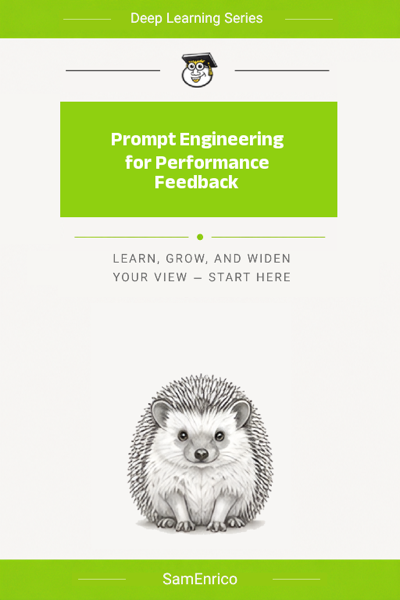
Non-FictionInformativeEducational
Prompt Engineering for Performance Feedback Audiobook
A Coursebook on Prompt Engineering for Performance
A Coursebook on Prompt Engineering for Performance Feedback
Formats
Free sample
Chapter 1: The Feedback Tax...--–- Every Monday morning, in thousands of conference rooms and Zoom tiles, the same quiet tragedy unfolds. A manager stares at a blinking cursor on a performance review template. She has ninety minutes before her next meeting. She remembers the employee in question—let’s call him Marcus—as generally competent, occasionally late, and once brilliant during a client crisis six months ago. She also remembers that she is required by HR to produce five hundred words about Marcus’s “collaboration skills” and “alignment with core values.” She writes: “Marcus is a solid team player.” Then she deletes it.
Then she writes: “Marcus needs to communicate more proactively.” Then she stares at the cursor again. The cursor blinks. She closes the document and opens her email instead.–- This ritual is not an outlier. It is the norm. According to a 2023 study by the Society for Human Resource Management, the average manager spends six hours per employee on annual performance reviews.
For a manager with ten direct reports, that is sixty hours—two and a half full work weeks—spent writing, revising, and worrying about feedback. And what is the return on those sixty hours? A metastudy of thirty years of performance management research found that 67 percent of employees report that performance reviews have no measurable impact on their subsequent performance. Worse, 22 percent report that feedback actively made their performance decline, usually because the feedback was vague, felt unfair, or arrived so late that the original context had dissolved into memory.–- This is the Feedback Tax. It is the hidden cost that organizations pay for the gap between the feedback they want to give and the feedback they actually deliver.
The tax has two components. The first is managerial time—the hours stolen from strategy, coaching, and deep work. The second, far more expensive component is foregone performance—the productivity that never materializes because feedback was too slow, too soft, too harsh, or too vague to change behavior. If you have ever received a review that said “good job” without explaining what made the job good, you have paid the Feedback Tax. If you have ever given a review that felt like filling out a form rather than shaping a career, you have collected the Feedback Tax.–- This book argues that generative AI—specifically large language models like GPT-4, Claude, and Gemini—can slash the Feedback Tax by…
This is the end of the free sample. Get the Audiobook to keep going. Buy now
About this book
Details
- Author
- Malloy Lamonica
- Publisher
- SamEnrico
- Language
- English
- Genre
- Non-Fiction, Informative, Educational
- Released
- 2026-05-09
- Pages (approx.)
- 148
- Available as
- eBook, Audiobook

Listen in the VoxFlicks app
Audiobooks and audio dramas wherever you go. Sign in with your SamEnrico account and press play.
More by Malloy Lamonica
 The White House Aide StressMalloy Lamonica$11.99
 Micronutrients For Athletes GuideMalloy Lamonica$11.99
 The Full Moon Over LakeMalloy Lamonica$11.99
 Pelvic Organ Prolapse GuideMalloy Lamonica$11.99
 Co Sale Agreement TermsMalloy Lamonica$11.99
 The IBS Mental Health GuideMalloy Lamonica$11.99
 MBSR for Body DysmorphiaMalloy Lamonica$11.99
 Time Blocking For Travel PlanningMalloy Lamonica$11.99
 The Midnight Codebreakers: Harriet Tubman’s Secret SignalsMalloy Lamonica$11.99
 The Last Black UnicornMalloy Lamonica$11.99
 The Unseen Brush: Frida Kahlo’s Secret Diaries RevealedMalloy Lamonica$11.99
 How to Start a Mortgage Broker Business (Beginners Guide)Malloy Lamonica$11.99
You may also like
 Hong Kong Handover 1997Dunn Johnnie$11.99
 Zumba For Postnatal Recovery CourseNeal Christian$11.99
 Zumba for BeginnersLadner Nikia$11.99
 YouTube Comment Mining GuideHumes Pandora$12.99
 Worry Box MeditationCarlin Rudy$11.99
 Workplace Stress MeditationNguyen Lynn$11.99
 Workplace Stress and Sleep RepairHawley Ivory$11.99
 Workplace Perfectionism CureDelaney Jeffry$11.99
 Workplace Injustice Anger GuideWallen Isabelle$11.99
 Work Addiction and Burnout LinkGreenwood Ester$11.99
 Women in Yoga and WellnessBeattie Galina$11.99
 Women in Stand Up ComedyChun Evangeline$11.99