
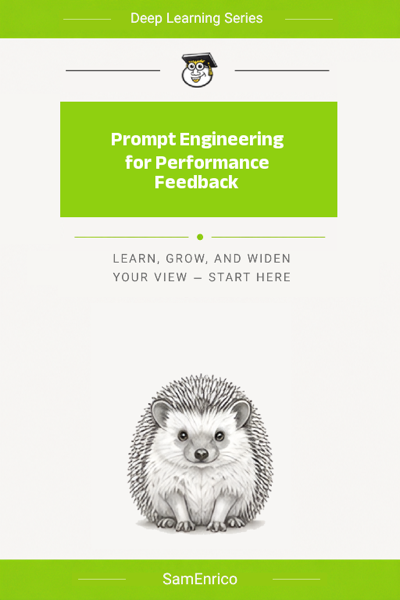
Prompt Engineering for Performance Feedback eBook
A Coursebook on Prompt Engineering for Performance
A Coursebook on Prompt Engineering for Performance Feedback
Formats
Free sample
Chapter 1: The Feedback Tax...--–- Every Monday morning, in thousands of conference rooms and Zoom tiles, the same quiet tragedy unfolds. A manager stares at a blinking cursor on a performance review template. She has ninety minutes before her next meeting. She remembers the employee in question—let’s call him Marcus—as generally competent, occasionally late, and once brilliant during a client crisis six months ago. She also remembers that she is required by HR to produce five hundred words about Marcus’s “collaboration skills” and “alignment with core values.” She writes: “Marcus is a solid team player.” Then she deletes it.
Then she writes: “Marcus needs to communicate more proactively.” Then she stares at the cursor again. The cursor blinks. She closes the document and opens her email instead.–- This ritual is not an outlier. It is the norm. According to a 2023 study by the Society for Human Resource Management, the average manager spends six hours per employee on annual performance reviews.
For a manager with ten direct reports, that is sixty hours—two and a half full work weeks—spent writing, revising, and worrying about feedback. And what is the return on those sixty hours? A metastudy of thirty years of performance management research found that 67 percent of employees report that performance reviews have no measurable impact on their subsequent performance. Worse, 22 percent report that feedback actively made their performance decline, usually because the feedback was vague, felt unfair, or arrived so late that the original context had dissolved into memory.–- This is the Feedback Tax. It is the hidden cost that organizations pay for the gap between the feedback they want to give and the feedback they actually deliver.
The tax has two components. The first is managerial time—the hours stolen from strategy, coaching, and deep work. The second, far more expensive component is foregone performance—the productivity that never materializes because feedback was too slow, too soft, too harsh, or too vague to change behavior. If you have ever received a review that said “good job” without explaining what made the job good, you have paid the Feedback Tax. If you have ever given a review that felt like filling out a form rather than shaping a career, you have collected the Feedback Tax.–- This book argues that generative AI—specifically large language models like GPT-4, Claude, and Gemini—can slash the Feedback Tax by eighty percent.
Not by replacing managers, but by giving them a superpower: the ability to turn messy observations into structured, specific, emotionally intelligent feedback in minutes instead of hours. But there is a catch. You cannot just open Chat GPT, type “write a performance review for Marcus,” and expect anything useful. What you will get back is a masterpiece of corporate blandness: “Marcus consistently demonstrates a commitment to excellence and aligns with our core values.” That is not feedback. That is a horoscope.
It sounds good. It means nothing.–- The difference between a useless AI-generated review and a transformative one is prompt engineering. This chapter introduces the core problem that prompt engineering solves, the anatomy of a feedback disaster, and the foundational metaphor that will guide you through the next eleven chapters: the AI as a cold reader.The Anatomy of a Feedback Disaster–- Before we can engineer a solution, we must diagnose the disease. Performance feedback fails in four predictable patterns. Each pattern is a different way of paying the Feedback Tax.
Recognize these patterns, because prompt engineering exists to eliminate them.Pattern One: The Vanilla Review–- The Vanilla Review says nothing while appearing to say everything. Examples include: “Meets expectations.” “Solid contributor.” “Good team player.” “Areas for growth include communication.” These phrases are technically true and completely useless. They are vanilla ice cream—inoffensive, forgettable, and incapable of changing anyone’s behavior. The Vanilla Review happens when a manager lacks specific observations or fears conflict. The AI, trained on millions of vanilla corporate documents, will default to vanilla unless forced otherwise.
Prompt engineering exists to force specificity.Pattern Two: The Recency Bomb–- The Recency Bomb weights the last three weeks as heavily as the last eleven months. A quiet quarter followed by a single missed deadline, and suddenly the review reads as if the employee spent the year asleep. This happens because human memory is not a video camera; it is a highlight reel of recent emotional events. The Recency Bomb is unfair, demotivating, and legally risky. But the AI, fed a data dump of the last month without context, will amplify recency bias unless prompted to consider the full time horizon.Pattern Three: The Emotional Landmine–- The Emotional Landmine is factually correct but devastating.
“You failed to meet the deadline.” “Your presentation was unclear.” “You interrupted Sarah three times in the last meeting.” Each statement is true. Each statement, delivered without context or repair, can trigger shame, defensiveness, and disengagement. The manager who writes these words is not trying to hurt anyone; they are trying to be clear. But clarity without emotional intelligence is just blunt force. Prompt engineering can detect and recalibrate emotional valence before the landmine explodes.Pattern Four: The Ghost Narrative–- The Ghost Narrative invents a story that the evidence does not support.
“Marcus seems disengaged.” “Maria lacks drive.” “James does not care about quality.” These are not observations. They are theories. They are ghosts—invisible, unfalsifiable, and dangerous. A manager who believes the ghost will write feedback that feels fundamentally unfair to the employee, because the feedback describes an inner state that the employee does not recognize. Prompt engineering forces the separation of observation (what you saw) from evaluation (what you think it means).
This single distinction is the highest-leverage intervention in all of performance management.–- Every chapter in this book is a weapon against one or more of these patterns. By the time you finish Chapter 12, you will be able to produce feedback that is specific (killing Vanilla), temporally balanced (killing Recency), emotionally calibrated (killing Landmines), and evidence-grounded (killing Ghosts). But first, you need to understand the tool you are about to wield.Why LLMs Are Different (And Why Your Boss Is Scared)–- Most managers have tried to automate feedback before. Spreadsheets with comment boxes. Form-driven review platforms.
The dreaded dropdown menu that offers “Exceeds,” “Meets,” or “Below” expectations. These tools failed because they were capture tools, not generation tools. They captured what you typed. They did not help you type better.–- Large language models are fundamentally different. An LLM is not a database.
It does not retrieve pre-written sentences. It generates new sentences by predicting the most likely next word given your prompt. This is both the magic and the danger. The magic: the LLM can combine information from vastly different sources—your data, its training corpus, the structure you requested—into a coherent whole that no human has ever written before. The danger: without constraints, the LLM will generate the most statistically likely sentence, which is also the most corporate vanilla sentence.
“Meets expectations” is statistically likely because it appears in millions of performance reviews. The LLM loves it. You must hate it.–- Your boss is…
This is the end of the free sample. Get the eBook to keep going. Buy now
About this book
Details
- Author
- Malloy Lamonica
- Publisher
- SamEnrico
- Language
- English
- Genre
- Non-Fiction, Informative, Educational
- Released
- 2026-05-09
- Pages (approx.)
- 148
- Available as
- eBook, Audiobook

Read better in the ZLOADR app
Your eBooks on your phone or tablet. Sign in with your SamEnrico account and start reading.
More by Malloy Lamonica
 The White House Aide StressMalloy Lamonica$11.99
 Micronutrients For Athletes GuideMalloy Lamonica$11.99
 The Full Moon Over LakeMalloy Lamonica$11.99
 Pelvic Organ Prolapse GuideMalloy Lamonica$11.99
 Co Sale Agreement TermsMalloy Lamonica$11.99
 The IBS Mental Health GuideMalloy Lamonica$11.99
 MBSR for Body DysmorphiaMalloy Lamonica$11.99
 Time Blocking For Travel PlanningMalloy Lamonica$11.99
 The Midnight Codebreakers: Harriet Tubman’s Secret SignalsMalloy Lamonica$11.99
 The Last Black UnicornMalloy Lamonica$11.99
 The Unseen Brush: Frida Kahlo’s Secret Diaries RevealedMalloy Lamonica$11.99
 How to Start a Mortgage Broker Business (Beginners Guide)Malloy Lamonica$11.99