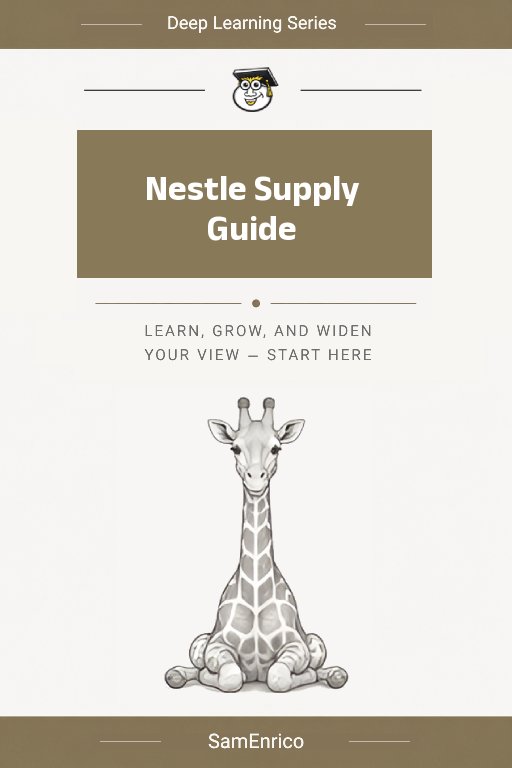
Procter Gamble Guide eBook
Trace supplier collaboration, retail partnership,
Trace supplier collaboration, retail partnership, and demand-driven replenishment that pioneered consumer goods logistics.
Formats
Free sample
Chapter 1: The Empty Shelf--–- On a Tuesday morning in 1983, a P&G executive named Tom Muccio walked the diaper aisle of a Walmart store in Bentonville, Arkansas. He was not there to check on product placement or to ensure the P&G display looked better than Kimberly-Clark's. He was there to count empty spaces. What he found would change the course of modern commerce. Row after row, shelf after shelf, the Pampers diapers that P&G had sold to Walmart were nowhere to be seen.
Yet according to Walmart's inventory system, the warehouse was full. According to P&G's shipping records, the product had been delivered. According to both companies, everything was working perfectly. And both companies were catastrophically wrong.Mucio knelt down in the aisle, running his finger along the empty shelf. A mother with a fussy toddler walked past him, glanced at the empty space, sighed, and continued pushing her cart toward a competitor's brand.
Mucio watched her go. In that moment, he understood something that would take the rest of the industry another decade to grasp: the supply chain was not designed for her.The Consumer That No One Saw Before P&G's revolution, the consumer goods industry operated on a foundation of mutually beneficial dysfunction. Manufacturers like P&G, Unilever, and Kimberly-Clark produced goods based on internal sales forecasts that were intentionally inflated. Salespeople routinely added fifteen to twenty percent to their projections, not because they believed demand would materialize, but because their bonuses depended on exceeding their targets. If you forecast low and delivered high, you looked like a hero.
If you forecast high and delivered low, you looked for a new job. The system rewarded optimism and punished honesty.Retailers like Walmart, Kroger, and Target played an equally distorted game. Their buyers negotiated aggressively for the lowest possible price per case, then ordered in massive quantities during promotional periods, stockpiling product in warehouses that were measured for efficiency not by how quickly product moved through them, but by how much product they could hold. A full warehouse was a sign of success. An empty warehouse was a sign of failure.
This was called "four-wall inventory thinking" – the belief that inventory sitting in your own building was an asset, regardless of whether it was actually selling through to consumers.The result was a system that looked efficient on paper and failed continuously in practice. P&G's own analysis in the early 1980s revealed that their warehouses were filled with product that retailers would not accept because those retailers had already loaded up during promotional periods. Meanwhile, store shelves were empty of the same products. P&G was paying to store product twice – once in their own distribution centers, once in retailer warehouses – while simultaneously losing sales because consumers could not find the product on the shelf.The Bullwhip Effect This phenomenon had a name, though few in the industry had heard it in the early 1980s. Supply chain academics called it the "bullwhip effect" – the tendency for small fluctuations in consumer demand to cause increasingly larger fluctuations in orders upstream.
The name came from the physics of a bullwhip: a small flick of the wrist creates a wave that grows larger as it travels down the length of the whip.In the diaper aisle, the bullwhip effect worked like this. A slight dip in diaper sales at a single store – perhaps because of a local event or a temporary shift in weather – would cause the store manager to reduce their next order by ten percent. Walmart's regional distribution center would see that reduction and cut their order to P&G by another ten percent. P&G's factory planning system would interpret the combined reduction as a sustained drop in demand and scale back production. P&G's raw material suppliers would see the reduced factory orders and delay their own production.
Then consumer demand would return to normal levels – because nothing fundamental had changed – and everyone would be out of stock for weeks.The system had no memory. It had no learning. It had no mechanism for distinguishing between a real change in consumer behavior and a random fluctuation. And it had no one whose job it was to ask the only question that mattered: what does the consumer actually want?The Language of Adversity The relationship between manufacturers and retailers in this era was defined by what business professors called "arms-length negotiations." Both parties shared almost no data. P&G would not tell Walmart what their production costs were or how much inventory they held.
Walmart would not tell P&G what their actual sales were or how much inventory they had in their warehouses. Every interaction was a negotiation over price per case, trade discounts, and promotional allowances. Neither party discussed flow. Neither party discussed the consumer. Neither party discussed the empty shelf that Tom Muccio had knelt beside in Bentonville.The language of the industry reflected this adversarial orientation.
Manufacturers spoke of "pushing" product to retailers. Retailers spoke of "extracting" concessions from manufacturers. Salespeople were trained to "overcome objections" and "close deals." Buyers were trained to "hold the line" and "protect margin." Both sides believed that their gain came at the other's expense. Both sides believed that information was power and sharing it was weakness. Both sides were wrong.The Hidden Cost of Guesswork P&G commissioned an internal study in 1984 to calculate the actual cost of this adversarial system.
The results were staggering. Forecast error – the difference between what P&G predicted they would sell and what they actually sold – averaged thirty to forty percent across most product categories. This meant that P&G was manufacturing approximately one-third of their products based on guesses that turned out to be wrong. Some of that overproduction ended up in discount stores at a loss. Some of it ended up in landfills.
Some of it sat in warehouses for months before finally being sold, tying up capital that could have been used elsewhere.The study also calculated the cost of stockouts – the empty shelves that consumers encountered when forecast error cut the other way. P&G estimated that when a consumer found an empty shelf where Tide or Pampers should have been, approximately half would buy a competitor's product. Of those, approximately half would never return to the P&G brand. The lifetime value of a lost customer, multiplied by the frequency of stockouts across thousands of stores, added up to hundreds of millions of dollars in annual losses.But the most damaging cost was invisible on any spreadsheet. The adversarial system had destroyed trust.
P&G's salespeople assumed that Walmart's buyers were lying about their inventory levels. Walmart's buyers assumed that P&G's salespeople were lying about their production constraints. Both were sometimes right, but their mutual suspicion made it impossible to solve the underlying problem. You cannot fix a system that you do not trust, and you cannot trust a system that you do not understand.The Accidental Pioneer Tom Muccio was not a supply chain expert. He had started his career in P&G's sales division, working his way up through a series of increasingly responsible roles.
He was known for being persistent, detail-oriented, and unusually willing to ask uncomfortable questions. When P&G's leadership decided to assign…
This is the end of the free sample. Get the eBook to keep going. Buy now
About this book
Details
- Author
- Heckman Karissa
- Publisher
- SamEnrico
- Language
- English
- Genre
- Non-Fiction, Strategic Atlas, CPG Logistics
- Released
- 2026-05-29
- Pages (approx.)
- 126
- Available as
- eBook, Audiobook

Read better in the ZLOADR app
Your eBooks on your phone or tablet. Sign in with your SamEnrico account and start reading.
More by Heckman Karissa
 Loving Kindness for BreakupsHeckman Karissa$11.99
 High Net Worth Wellness HabitsHeckman Karissa$11.99
 Overcoming Self Doubt in Creative FieldsHeckman Karissa$11.99
 Cameroon Union des PopulationsHeckman Karissa$11.99
 The Equifax Breach ExposedHeckman Karissa$11.99
 The Symphony of the Stars: How Apollo 8’s Christmas Broadcast United the WorldHeckman Karissa$11.99
 Technical Writing Workflow AIHeckman Karissa$12.99
 Understanding Moore–Smith–weaver SyndromeHeckman Karissa$17.99
 How to Become a Cloth-printing InspectorHeckman Karissa$11.99
 HR RecruiterHeckman Karissa$11.99